
Assessment of Heavy Metal Toxicity Potential in Edible Tissues of Poultry Birds in Lafia Metropolis, Nigeria
- Department of Biochemistry, Federal University of Technology, Ikot Abasi Akwa Ibom State, Nigeria
- Department of Physical and Natural Sciences, University of the Gambia, Barbara-Banta Campus, Gambia
- Department of Microbiology, Federal university of Technology, Ikot Abasi, Akwa Ibom State
- Department of Chemistry Federal University of Petroleum Resources, Effurun, Nigeria
- Department of Sciences, Technology and Mathematics Education, Nasarawa State University, Keffi, Nigeria
- Department of Chemistry,Federal University, Lafia
Correspondence: Ijah Silas Ioryue, silasoo4real@gmail.com
- Received
- Revised
- Accepted
- Published
Abstract
This study investigated the potential human health risk associated with five heavy metals (Cr, Cd, Ni, Cu, and Pb) in edible tissues of poultry birds in the Lafia metropolis. Four broilers, four layers, and four local chickens were purchased from Neighborhood, Modern, Shinge and New Tomatoes markets. Nitric acid was used in the wet digestion process to prepare the samples. A flame atomic absorption spectrophotometer (FAAS) was used to measure the amounts of heavy metals in the edible tissues. Among the poultry types, the bioaccumulation tendency of heavy metals declined. Chicken tissues > layers chicheen tissues > Local chicken tissues. The study revealed that the chickens have different potentials of accumulating heavy metals in their tissues with the broiler and layer chickens having the highest. The heart, intestine, and gizzard accumulated the highest concentrations of Cr, Pb, Cd, Ni, and Cu in both broilers and layers with minimal concentrations in local chickens. All of the tissues that were taken from the poultry birds were not fit for human consumption. Consuming the tissues of chicken birds carries the potential for both non-carcinogenic and carcinogenic health concerns. Poultry birds' tissues may become more heavily metal-laden due to uncontrolled leaks of hazardous heavy metals from human activity and specially prepared meals. Studies on heavy metal deposition and pollution should be carried out regularly to keep an eye on any potential health dangers to humans from consuming various bird species' tissues.
Introduction
Rapid economic growth, unorganized urbanization and injudicious use of the natural resources have resulted in detrimental impact on the environment. To fulfill the high food demands of exponentially growing human population, production of food stuffs has extensively been enhanced, which has greatly influenced its quality. Heavy metals are considered to be one of the most widely spread pollutants of the environment. The ecosystem is increasingly exposed to these pollutants due to fast industrial development and economic growth. Heavy metals are considered to be serious pollutants too; because of being persistent, accumulating and have the ability to be incorporated into the food chain (1,2,3). Heavy metal intake through food chain has been reported world-wide and if accumulated beyond the permissible limits, they severely affect the vital organs such as bones, heart, kidneys, brain, liver and blood (4). Trace elements are toxic because of their water solubility and based on their exposure time the toxicity may be acute or chronic (5,6).
According to European Union (7), the heavy metals produced neurotoxicity, teratogenicity, carcinogenicity and mutagenicity in humans.
Toxic elements are highly unsafe and can produce toxic effects even at trace levels, if ingested over a long period of time, while the essential metals can be harmful when exposed at excessively higher concentrations (8,9). For example,excessive intake of zinc (Zn) for several months may induce abdominal cramps, anemia, pancreatic damage, nausea and vomiting and reduction of HDL level. On the other hand, Zn deficiency may decrease the body immunity, hinder the development of sex organs and overall growth in young men and induce birth defects in pregnant women.
Furthermore, Zn deficiency can also cause reduction in taste and smell sensations, loss appetite and reduce HDL level (10). Lead (Pb) exposure beyond the permissible limits can harm body systems including neurological, hematological, and cardiovascular. The neurological symptoms include peripheral neuropathy, fatigue, headache, encephalopathy, severe convulsions and impaired intellectual and behavioral development in children (11,12).
Prolonged exposure of cadmium (Cd) may produce damaging effects on bone and renal systems and can induce chronic renal failure as the final endpoint. In addition to that, excess Cd intake may cause prostate and lung cancers (11,13).
The consumption of contaminated food stuffs constitutes the principal route of heavy metal intake in the humans. Although, most of the heavy metals at certain levels are naturally present in the food stuffs, further contamination occurs from the surrounding environment during their production and processing. The food products are regularly investigated for trace metals to evaluate their nutritional as well as toxicological associations and it was observed that the concentration of individual metal significantly varies among the variety of food products.
Regular monitoring of heavy metals in food stuffs is critical for setting up their dietary requirements and to assure the food safety (14,15).
Chicken (Gallus gallus domesticus) and chicken products are one of the major components of human platter because of high nutritional values, especially protein. There is a huge non-vegetarian trend in Nigeria and consumption of chicken is very high across the country; indeed, it is the highest among all available meat types, possibly due to lower price than other meat products. The main source of heavy metals exposure to chicken tissues is the poultry feeds. Several investigations conducted on poultry feeds have reported significantly high concentrations of heavy metals and few studies showing direct correlation between the heavy metal contents in the tissue samples and animal feeds (16,17). Several studies across the globe have reported remarkable levels of heavy metals in various chicken parts and related products (18,19); (15); (20,21). However, there is scarcity of data on heavy metal contents in chicken tissue samples in lafia markets and to the level of our apprehension, up till now no study performed for determining the concentration of toxic metals in chicken tissues available in the markets of Lafia metropolis.
However, with reference to the public health concerns, it is essential to monitor the heavy metal concentrations in food stuffs including chicken and chicken tissues. Therefore, this investigation was aimed, to estimate the concentrations of Cd, Cr, Cu, Ni and Pb in different tissues of chicken collected from Lafia markets using ICP-MS, to evaluate the accumulation behavior of heavy metals in different organs of chicken and possible adverse health effects posed by the exposure of tested heavy metals to the local inhabitants.
Materials and methods
Chemicals, instruments and reagents
Analytical grade reagents and substances were utilized in this investigation. The Department of Chemistry, Federal University of Agriculture, Makurdi Laboratory produced deionized water for use in dilutions.We bought 70% of the HNO3 and 30% of the H2O2 from Sigma-Aldrich in Germany. All of the utensils (plastic and glass) were immersed in diluted HNO3 (10%) for the whole night before being used, and they were then cleaned with deionized water. All of the heavy metals that were evaluated had standard solutions prepared from stock solutions (1000 mg/L) that were acquired from Emole Nigerian Ltd., located off Old Otukpo Road in Makurdi. Wet acid digestion was adopted for the samples preparation at Joseph Sarwuan Tarka University in Makurdi's Department of Soil Science, the amount of heavy metals were assessed using FAAS Agilent 240FS/280FSAA.
Sample collection
Four markets in the Lafia metropolis (the Neighborhood, Modern, Shinge, and New Tomatoes markets) were the source of 12 live adult chickens, with three chickens from each market: four broilers, four layers, and four local chickens. Upon dissection, various tissue sections, including the liver, lungs, gizzard, intestine, and heart, were separated. After being cleaned with distilled water, the chicken specimens were cut into smaller pieces. The chicken samples were homogenized after they had been completely thawed, chopped, and hammered using a wooden mallet. The samples were stored at -20 °C in sterile polythene bags prior to further processing.
Sample digestion and preparation
Chicken tissue samples were cut into small pieces, and approximately 30 g of each fresh sample was placed in petri dishes for oven drying. Samples were dried at 70°C in an electric hot air oven until reaching a constant weight. The dried samples were then ground into a homogeneous powder using a manual pestle and mortar, and stored in airtight plastic bags.
For analysis, 1.0 g of each dried sample was accurately weighed into a 50 ml beaker. 10 ml of concentrated 69 % nitric acid was added to each beaker in a digestion chamber, covered with a watch glass, and placed on a hotplate digestion system. The hotplate temperature was maintained between 60°C and 90°C for digestion. Samples were digested for 8 hours until the solution became colorless. After cooling, the digested samples were filtered using Whatman no. 41 filter paper and diluted to 20 ml with deionized water. The samples were then refrigerated. For quality control and accuracy checks, a blank, two spiked samples, and one standard reference material were digested similarly. A recovery study was conducted by spiking gizzard, liver, lungs, heart and intestine samples with 4 mg/kg lead, 2 mg/kg cadmium, 2 mg/kg chromium, 4 mg/kg Nickel and 4 mg/kg Copper. Triplicate experiments of spiked samples and blanks were performed through the digestion reaction. The digested and processed samples were analyzed for potentially toxic elements using an atomic absorption spectrophotometer (Agilent, Australia; Model: 240FS/280FSAA) at the Joseph Sarwuan Tarka University in Makurdi's Department of Soil Science, Nigeria.
Quantification of heavy metals
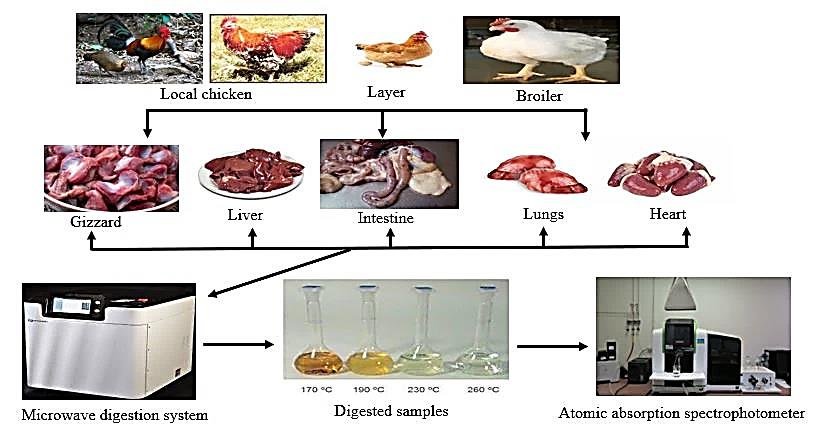
Using FAAS Agilent 240FS/280FSAA, the sample solutions were analyzed for the presence of Pb, Cd, Cr, Cu, and Ni. To calculate the milligrams per kilogram of each element's concentration, the fresh weight of the chicken tissue samples was utilized. The materials and analytical procedures of the experiment as highlighted from sections 2.1-2.4 are summarized and depicted in Figure 1.
Statistical tools
A one-way ANOVA test was performed on the collected data to ascertain the level of variation in the amounts of heavy metals in the tissues of the three varieties of the chicken birds.
Results and discussion
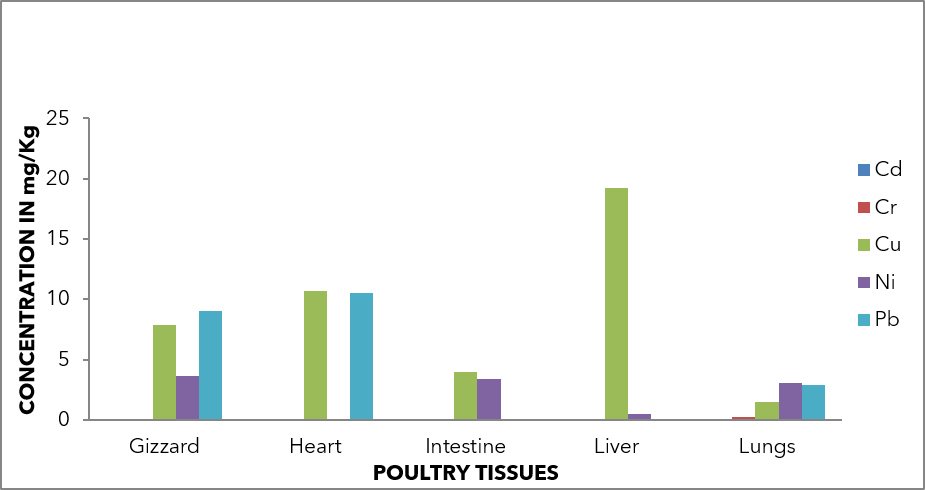
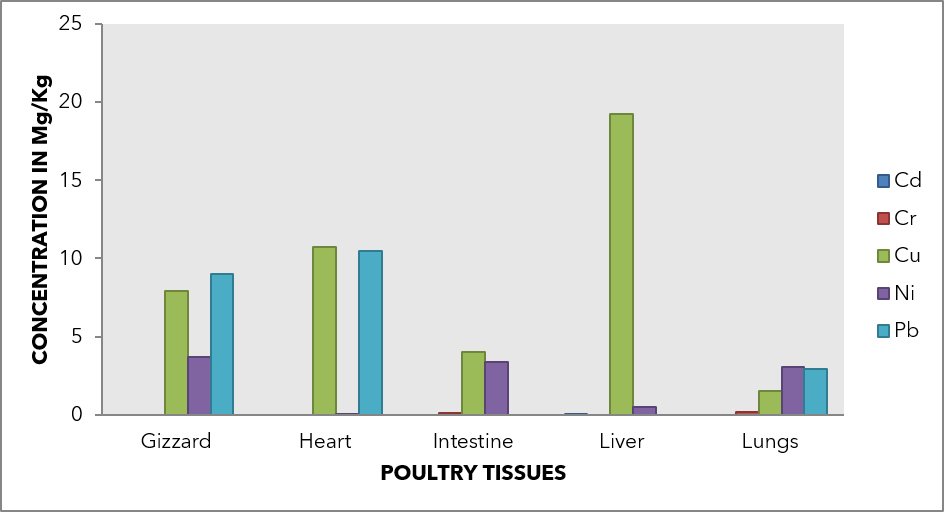
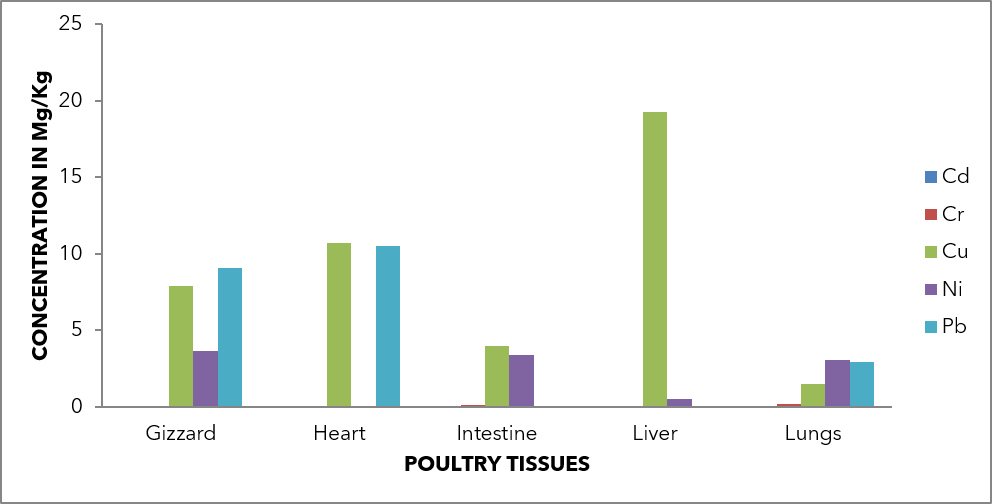
The mean concentrations of heavy metal in tissues of poultry birds- gizzards, heart, intestine, liver, and lungs of broilers, layers, and local chickens are presented in Table 2 and Figures 1- 3.
Distribution of heavy metals in poultry tissues
Cadmium (Cd)
Cadmium is one of the important industrial and environmental toxicants that affects the brain, lungs, heart, reproductive tracts, bone metabolism, blood vessels, and kidney (24). In this study, cadmium concentrations was undetectable in four tissues of local chicken, gizzard, heart, liver, and lungs except the intestine while in broilers it was not detected in gizzard, heart, and lungs but detected in intestine and liver. In Layers, only in liver was detected. The highest mean concentration was detected in the intestine of a broiler (4.32 mg/kg) and the least in the intestine of local chicken (0.03 mg/kg) (Table 2 and Figures 1 and 2). High concentration in broilers may be a result of the metal additive in feeds of broilers while less Cd concentration may be a result of not feeding on prepared feeds. The permissible limit for Cd in chicken is 0.5 ppm (25). This study is in agreement with the study conducted by (26) where the concentration of Cd was high in the chicken intestine of a broiler.
| Element | Maximum permissible limit (mg/Kg) | |
|---|---|---|
| EC, 2006 | FAO/WHO,2003 | |
| Cd | 0.05 for meat, 0.5 for liver | 0.05 for meat, 0.5 for liver 1.0 mg/kg |
| Cr | - | 0.01 |
| Cu | 1.0 | 100 |
| Ni | - | 0.05 |
| Pb | 0.1 | 1-5 |
| Parameter (per mg/kg-day) | Value | ||||
|---|---|---|---|---|---|
| Parameter (per mg/kg-day) | Cd | Cr | Cu | Ni | Pb |
| Oral Reference Dose (RfD) | 0.001 | 0.003 | 0.04 | 0.02 | 0.0036 |
| Oral Cancer Slope Factor | 1.5x101 | 5x 10⁻¹ | - | 8.4x10⁻¹ | 8.5x10⁻³ |
Chromium (Cr)
The concentration of Cr was not detected in the heart and liver of local chicken while in layers are the gizzards, hearts, and liver. All the tissues of broilers recorded high Cr concentrations with the highest concentrations recorded in the Liver (121.9 mg/kg), heart (190.25 kg/mg), intestine (149.80 kg/mg), gizzard (107.0 kg/mg) and the lungs (63.48 mg/kg) of broilers and the least concentration was recorded in local chicken intestine (0.09 mg/kg) (Tables 2). The high concentration of Cr in the tissues of broilers is a result of the poultry feeds used in feeding broilers while the least is due to the absence of Cr in local chicken feeds which they are allowed to feed freely around. The Cr concentrations in all the tissues detected in layers and broilers were above the FAO/WHO permissible limits in poultry tissues with the exception of the local chicken.
| Item | Cd | Cr | Cu | Ni | Pb | |
|---|---|---|---|---|---|---|
| Tissue | Mean ± SD | Mean ± SD | Mean ± SD | Mean ± SD | Mean ± SD | |
| Local chicken | Gizzard | BDL | 0.32±0.001 | 3.04±0.02 | 3.56±0.02 | 1.78±0.01 |
| Heart | BDL | BDL | 12.93±0.20 | 0.32±0.001 | 7.04±0.01 | |
| Intestine | 0.03±0.001 | 0.09±0.002 | 7.50±0.001 | 4.19±0.02 | 7.34±0.01 | |
| Liver | BDL | BDL | 25.82±0.23 | 3.40±0.02 | 6.56±0.01 | |
| Lungs | BDL | 0.19±0.001 | 2.79±0.001 | 4.44±0.002 | 8.99±0.001 | |
| Broilers | Gizzard | BDL | 107.0±0.001 | 0.76±0.23 | BDL | 1.75±0.001 |
| Heart | BDL | 190.3 ±0.001 | 4.93±0.23 | 5.36 ±0.03 | 22.26±0.23 | |
| Intestine | 4.32±0.01 | 149.8 ±0.001 | BDL | BDL | 2.60±0.04 | |
| Liver | 1.96±0.10 | 121.9 ±0.001 | 4.40±0.23 | 3.80±0.23 | BDL | |
| Lungs | BDL | 63.48±0.002 | 6.26±0.21 | 1.98 ±0.24 | 5.25 ±0.05 | |
| Layers | Gizzard | BDL | BDL | 7.90±0.22 | 3.66±0.26 | 9.03±0.26 |
| Heart | BDL | BDL | 10.70±0.20 | 0.06 ±0.00 | 10.49±0.22 | |
| Intestine | BDL | 0.09 ±0.001 | 3.99±0.24 | 3.35±0.001 | BDL | |
| Liver | 0.06±0.001 | BDL | 19.26±0.22 | 0.49±0.002 | BDL | |
| Lungs | BDL | 0.19 ±0.001 | 1.50 ±0.24 | 3.04±0.003 | 2.91±0.27 |
BDL= below the detectable limit
Copper (Cu)
The concentration of Cu was detected in all tissues of the poultry birds with the exception of the intestine of broilers, that is to say, all the tissues of poultry birds accumulate Cu. The Liver of the local chicken accumulated the highest concentration of Cu, (25.82 mg/kg) and the lowest in Gizzard of broilers (0.76 mg/kg) as showned from Figure 2. Given that copper is a necessary component of metabolism, the elevated copper levels seen in chicken tissues is not surprising. According to (27), factors such as agricultural inputs, soil pollution, and processing-related food access could all have an impact on the copper levels in chickens. The mean values in all the tissues of the poultry birds were above the permissible value of 1.0 mg/kg by the WHO with the exception of the gizzard and intestine of broilers. Our findings concur with the results of (28), who stated that samples of hens taken from three cities of Sindh were polluted with lead, nickel, copper, and cadmium. In contrast, the greatest degree of copper contamination was discovered to be concerning when compared to the other metals that were analyzed.
Nickel (Ni)
Apart from being one of the naturally abundant metals, nickel (Ni) is released into the atmosphere when trash, coal, and diesel oil are burned. Nickel (Ni) can cause respiratory problems and is a carcinogen (29). The mean concentration of Ni was detected in all the tissues of the poultry birds with the exception of the Gizzard of broilers. The highest concentration was recorded in the heart of broiler chicken (5.36 mg/kg) and the least in the heart of the layers chicken (0.06 mg/kg). The increased level of concentration of heavy metals in the three poultry birds tissues are in the order as viz:
Local chicken: Higher in the heart, followed by the liver, Gizzard, intestine and the highest in lungs.
Broilers: It was higher in Lungs followed by the Liver and highest in the Heart similarly in layers chicken tissues, higher concentration in heart, Liver, Lungs, intestine and the highest was observed in the Gizzard.
The high concentrations of Ni in the gizzard, heart, and lungs are a result of their functions. The concentration of nickel in this study slightly exceeded the permissible limit of 0.5 mg/kg (23). This could also be from contaminated grains used in feed formulation and other human activities like processing. This study is in agreement with work carried out and reported by some researchers. Higher concentrations of Ni were reported by (30) in chicken meat (1.20 - 9.02 μg/g) and chicken gizzard (2.07 - 6.67 μg/g) and (31) in gizzard (1.839 ± 0.43 μg/g), liver (1.909 ± 0.96 μg/g) and muscle (1.19 ± 0.84 μg/g).
Lead (Pb)
Exposure to lead and lead chemicals mainly accumulates by the ingestion of lead-contaminated foods and water, dermal absorption, inhalation, and trans-placental (endogenous) routes (32). high Pb concentrations were detected in all the tissues of local chicken, broilers, and layers with the exception of the livers of broilers and layers as well as the intestine of the layers (Table 2). The highest mean concentrations of Pb were detected in the heart of broilers (22.26 mg/kg) and heart of layers (10.49 mg/kg) while the least mean concentrations were recorded in Gizzards of both local chicken and broilers chicken with values of 1.78 mg/kg and 1.75 mg/kg respectively (Figures 1,2 and 3). Similar results to this study were reported for lead in poultry liver (3.15 ppm) and lean meat (3.10 ppm) by (33) while (30) observed 0.01 - 4.60 mg/kg and 0.01 - 3.22 mg/kg in chicken meat and gizzard respectively. The lead concentrations found in this study were higher than the maximum permissible limit of 1 mg/kg (34).
Human health risk assessment
The calculated amount of daily intake (EDI) (mg/kg/day) of all the heavy metals was estimated using the metal concentrations obtained in the gizzard, heart, intestine, liver, and lungs from local, broilers and layer chickens. Table 3, presents the estimated daily intake (EDI) (mg/kg/day) of heavy metals in adults through consumption of gizzard, heart, intestine, liver, and lungs from local, broilers and layer chickens. The EDI of Cd, Cu, Cr, Pb, and Ni in all the poultry birds’ tissues was evaluated to be less than their RfDs with the exception of Cr was above their reference doses in all the tissues of broilers. Lead (Pb) in heart, intestine, liver, and lungs of local chickens as well as well of all the tissues of layers were above reference doses indicating that daily consumption of the chickens’ tissues poses health risks for all the metals except Cd Cu and Ni.
| Item | Tissue | Cd | Cr | Cu | Ni | Pb |
|---|---|---|---|---|---|---|
| Local chicken | Gizzard | BDL | 0.000264 | 0.00250 | 0.00293 | 0.00147 |
| Heart | BDL | BDL | 0.0165 | 0.000264 | 0.00579 | |
| Intestine | 0.0000247 | 0.0000741 | 0.00618 | 0.00345 | 0.00605 | |
| Liver | BDL | BDL | 0.02127 | 0.00280 | 0.00540 | |
| Lungs | BDL | 0.000157 | 0.00229 | 0.00366 | 0.00741 | |
| Broilers | Gizzard | BDL | 0.08814 | 0.000626 | BDL | 0.00144 |
| Heart | BDL | 0.15671 | 0.00406 | 0.00442 | 0.01834 | |
| Intestine | 0.00356 | 0.12339 | BDL | BDL | 0.00214 | |
| Liver | 0.00161 | 0.10041 | 0.00362 | 0.00313 | BDL | |
| Lungs | BDL | 0.05229 | 0.00516 | 0.00163 | 0.0000432 | |
| Layers | Gizzard | BDL | BDL | 0.00651 | 0.00301 | 0.00744 |
| Heart | BDL | BDL | 0.00881 | 0.000049 | 0.00864 | |
| Intestine | BDL | 0.000074 | 0.00329 | 0.00276 | BDL | |
| Liver | 0.000049 | BDL | 0.01586 | 0.00040 | BDL | |
| Lungs | BDL | 0.00016 | 0.00124 | 0.00250 | 0.00239 |
BDL= below the detectable limit
Non-carcinogenic risks
Target hazard quotient (THQ) was used to assess the non-carcinogenic risks associated with consuming chicken tissues contaminated with the heavy metals under test. Table 4 lists the target hazard quotient (THQ) and hazard index (HI) of heavy metals from eating poultry and local chicks. Due to exposure to the examined heavy metals, the target hazard quotient (THQ) values fell in the following orders: Pb˃ Ni˃ Cu ˃Cr ˃Cd for local chicken, Cr˃ Cd˃ Pb ˃Ni ˃Cu for broiler chicken and Pb ˃Ni ˃Cu ˃Cr ˃Cd for layer chicken respectively. The highest and lowest THQ values were recorded in Cr (52.240) and Ni (0.00245) hearts of broiler and layers of chicken respectively (Table 4). The THQ of all the heavy metals for local chicken, broilers, and Layers of chicken in all the tissues were above their oral reference dose values. The THQ acceptable guideline value is ≤ 1 (35). For the local chicken, broilers, and layers of chickens the THQ values of all the metals were < 1 with exception of THQpb values for heart, intestine, liver and lungs for local chicken, heart and lungs for Broilers and heart and gizzard for layers that were above the guideline values. Similarly the THQcd for broilers in intestine and liver were above 1, which indicates significant non-carcinogenic risk (Table 4). This suggests that the consumption of chicken’ tissues from this study poses non-carcinogenic potential health risks to the exposed population. Prolonged consumption of these chickens can cause serious health effects since these metals are bioaccumulative. The hazard index (HI) was calculated to assess the cumulative risk due to exposure to multiple heavy metals. A hazard index value > 1 is an indicator of public health concern. The cumulative impact of all metals in all the tissues (HI) for local, broilers and layers of chicken was > 1. The hazard index values for all the tissues in all three poultry birds were greater than the acceptable limit of 1, showing a considerable risk to public health resulting from the population's cumulative exposure to the metals under investigation through ingestion of the tissues of the three species of chicken birds.
Carcinogenic human health risk
Table 5 shows the cancer risk, overall cancer risk, and carcinogenic health concerns for humans resulting from eating the tissues of local chicken, layer, and chickens. Table 1b lists the oral slope factor's carcinogenic potencies for Cd, Cr, Ni, and Pb. The cancer health risk is insignificant below 10-6, intolerable beyond 10-4, and acceptable between 10-6 and 10-4 (36). According to this study, the chances of Pb-related cancer were insignificant, while the risks of Cd, Cr, and Ni were not negligible. The TCR for each of the three birds' tissues was too high. The allowed range was exceeded by the amounts of heavy metal buildup in the tissues of local chickens, broilers, and layers. This suggested that eating local chicken, broilers, and layers from the Lafia city that were contaminated with heavy metals might put people at risk for cancer. To monitor the potential health risk to humans from consuming the tissues of poultry birds processed and sold as local delicacies (such as 'suya kaza') by road side vendors should be carried out regularly.
| Item | Tissue | THQCd | THQCr | THQCu | THQNi | THQPb | HI |
|---|---|---|---|---|---|---|---|
| Local chicken | Gizzard | BDL | 0.0880 | 0.0625 | 0.1465 | 0.4083 | 0.7053 |
| Heart | BDL | BDL | 0.4125 | 0.0132 | 1.6083 | 2.0340 | |
| Intestine | 0.0494 | 0.00247 | 0.1545 | 0.1725 | 1.6806 | 2.0595 | |
| Liver | BDL | BDL | 0.53175 | 0.1400 | 1.5000 | 2.1718 | |
| Lungs | BDL | 0.05233 | 0.05725 | 0.1830 | 2.0583 | 2.3509 | |
| Broilers | Gizzard | BDL | 29.380 | 0.1565 | BDL | 0.4000 | 29.9365 |
| Heart | BDL | 52.240 | 0.1015 | 0.2210 | 5.0944 | 57.6569 | |
| Intestine | 7.120 | 41.130 | BDL | BDL | 0.5944 | 48.8444 | |
| Liver | 3.220 | 33.470 | 0.0905 | 0.1565 | BDL | 36.9370 | |
| Lungs | BDL | 17.430 | 0.1290 | 0.0815 | 1.2000 | 18.8405 | |
| Layers | Gizzard | BDL | BDL | 0.1628 | 0.1505 | 2.0667 | 2.3800 |
| Heart | BDL | BDL | 0.2203 | 0.00245 | 2.4000 | 2.6228 | |
| Intestine | BDL | 0.0247 | 0.0823 | 0.1380 | BDL | 0.2450 | |
| Liver | 0.0098 | BDL | 0.3965 | 0.0200 | BDL | 0.4263 | |
| Lungs | BDL | 0.0533 | 0.0310 | 0.1250 | 0.6639 | 0.8732 | |
| RfD | 0.0005 | 0.003 | 0.04 | 0.02 | 0.0036 |
BDL= below the detectable limit
| Item | Tissue | CRCd | CRCr | CRNi | CRPb |
|---|---|---|---|---|---|
| Local chicken | Gizzard | BDL | 0.0001320 | 0.0024612 | 0.00001249 |
| Heart | BDL | BDL | 0.00022176 | 0.00004922 | |
| Intestine | 0.0003705 | 0.00003705 | 0.00289800 | 0.00005143 | |
| Liver | BDL | BDL | 0.00235200 | 0.00006298 | |
| Lungs | BDL | 0.00007850 | 0.00307440 | 0.00006299 | |
| ∑CR | 0.0003705 | 0.00143560 | 0.01300320 | 0.00023910 | |
| TCRLC | 0.0150484 | ||||
| Broilers | Gizzard | BDL | 0.044070 | BDL | 0.000012124 |
| Heart | BDL | 0.078355 | 0.00371280 | 0.000155890 | |
| Intestine | 0.05340 | 0.061695 | BDL | 0.000018190 | |
| Liver | 0.024150 | 0.050205 | 0.00262920 | BDL | |
| Lungs | BDL | 0.026145 | 0.00136920 | 0.00003672 | |
| ∑CR | 0.077550 | 0.260470 | 0.00771120 | 0.00022304 | |
| TCRBC | 0.3459542 | ||||
| Layers | Gizzard | BDL | BDL | 0.00252840 | 0.00006324 |
| Heart | BDL | BDL | 0.00004116 | 0.00007344 | |
| Intestine | BDL | 0.000037 | 0.00231840 | BDL | |
| Liver | 0.0007350 | BDL | 0.00033600 | BDL | |
| Lungs | BDL | 0.000080 | 0.00210000 | 0.00002032 | |
| ∑CR | 0.000735 | 0.000117 | 0.00732390 | 0.00015699 | |
| TCRL | 0.0083329 |
Conclusion
Because food poisoning can have serious health consequences, food safety is one of the biggest problems in the world. According to the study's findings, heavy metal contamination was found in the majority of the chicken tissues and parts. The various tissues of the chicken often contain varied amounts of heavy metals. The highest quantities of Cr, Pb, Cd, Ni, and Cu were found in the hearts, intestines, and gizzards of broiler and layer chickens as well as local birds. This may be explained by the way the tissue components and their feeding work. All of the tissues that were taken from the poultry birds were not fit for human consumption, and there were dangers to human health based on heavy metal exposure after consuming contaminated poultry bird tissues in Lafia city. The intake of broilers, layers, and local chicken tissues may provide health hazards that range from non-carcinogenic to carcinogenic. Heavy metal levels in the tissues of poultry birds might rise due to uncontrolled releases of hazardous heavy metals from human activities and prepared meals. According to the study, there is a risk of heavy metal toxicity for those who eat the tissues of these chicken birds. It is important to conduct heavy metal contamination and accumulation studies regularly to keep an eye on any potential health dangers to humans from consuming the various tissues of birds.
Author Contributions
Conceptualization, Silas I. Ioryue, and Ayua John, Uzah T.T.; Formal analysis, Silas I. Ioryue and Uzah T.T. and Idongesit S.A.; Validation, Silas I. Ioryue; Writing—original draft, Silas I. Ioryue and Ayua John., Writing—review & editing; IoryueI.Silas, Ayua John, Omaku D. Shagari,Uzah T.T and Augustine UA. All authors have read and agreed to the published version of the manuscript.
Acknowledgements
The authors would like to thank the Central Lab, Department of Soil Science and Chemistry, Joseph Sarwuan Tarka University, (formally Federal University of Agriculture) Makurdi-Nigeria for the opportunity to use their instruments and equipment for heavy metals analysis.
Conflict of Interest
The authors declare no conflict of interest.
Funding
No funding was received.
Data Availability
All data generated or analyzed during this study are included in this published article.
Ethics Approval
Not applicable.
Use of Generative AI
Authors declared that there was no use of generative AI in the manuscript preparation process upon submission of the paper.
References
- Assessment of trace metal contamination in mangrove ecosystems from Senegal, West Africa. Chemosphere. 2013;90:150-157.Crossref
- Ecological risk assessment and source identification for heavy metals in surface sediment from the Liaohe River protected area, China. Chemosphere. 2017;175:473-481.Crossref
- Fractionation, transfer, and ecological risks of heavy metals in riparian and ditch wetlands across a 100-year chronosequence of reclamation in an estuary of China. Sci Total Environ. 2015;517:66-75.Crossref
- Heavy metals in vegetables: screening health risks involved in cultivation along wastewater drain and irrigating with wastewater. SpringerPlus. 2016;5:488.Crossref
- Human risk assessment of heavy metals: principles and applications. Met Ions Life Sci. 2011;8:27-60.Crossref
- Hazards of heavy metal contamination. Br Med Bull. 2003;68:167-182.Crossref
- Heavy Metals in Waste: Final Report. European Commission; 2002.
- High contents of cadmium, lead, zinc and copper in popular fishery products sold in Turkish supermarkets. Food Control. 2007;18:258-261.Crossref
- Determination of heavy metals in fish samples of the middle Black Sea (Turkey) by graphite furnace atomic absorption spectrometry. Food Chem. 2003;80:119-123.
- Levels of zinc, copper, cadmium, and lead in fruits and vegetables grown and consumed in Aseer Region, Saudi Arabia. Environ Monit Assess. 2015;187(11):676.Crossref
- Estimation of dietary intake of cadmium and lead through food consumption. Rev Med Chir Soc Med Nat Iasi. 2012;116:617-623.
- Heavy metal concentration analysis in air particulates of some major towns of Nasarawa State, Nigeria. ISCA Int Res J Environ Sci. 2016;5(8):22-28.
- Fish and seafood availability in markets in the Baie des Chaleurs region, New Brunswick, Canada: a heavy metal contamination baseline study. Environ Sci Pollut Res Int. 2013;20:761-770.Crossref
- Seasonal variation in water quality parameters of River Mkomon, Kwande Local Government Area, Nigeria. Int J Recent Res Phys Chem Sci. 2018;5(1):42-62.
- Estimation of lead and cadmium residual levels in chicken giblets at retail markets in Ismailia city, Egypt. Int J Vet Sci Med. 2013;1:109-112.Crossref
- Heavy metal concentrations in diet and livers of black-crowned night heron Nycticorax nycticorax and grey heron Ardea cinerea chicks from Pyeongtaek, Korea. Ecotoxicology. 2007;16(5):411-416.Crossref
- Toxic and essential trace metals in muscle, liver and kidney of bovines from a polluted area of Morocco. Sci Total Environ. 2003;317:201-205.Crossref
- Assessment of trace metals contents in chicken (Gallus gallus domesticus) and quail (Coturnix coturnix japonica) tissues from Selangor (Malaysia). J Environ Sci Technol. 2012;5:441-451.Crossref
- Potential human health risk assessment of heavy metals in various brands of sausages and salami sold in different eateries in Lafia Township, Nigeria. Biological Sciences. 2025;5(1):822-830.Crossref
- Assessment of trace element contents of chicken products from Turkey. J Hazard Mater. 2009;163:982-987.Crossref
- Health risk posed by lead, copper and iron via consumption of organ meats in Kampala City (Uganda). J Environ Pollut Hum Health. 2014;2:69-73.
- Heavy metal concentrations in five tissues of chickens from a mining area. Pol J Environ Stud. 2014;23(6):2375-2379.
- Joint FAO/WHO Food Standards Programme, Codex Committee on Food Additives and Contaminants, 36th Session, Rotterdam. 2003.
- Levels of selected heavy metals in fresh meat from cattle, sheep, chicken, and camel produced in Algeria. Annu Res Rev Biol. 2014;4(8):1260-1267.Crossref
- Report of the 32nd Session of the Codex Committee on Food Additives and Contaminants, Beijing, China, 20–24 March 2000. FAO/WHO Codex Alimentarius Commission; 2000.
- Concentrations of heavy metals in liver, meat and blood of poultry chicken Gallus domesticus in three selected cities of Pakistan. Indus Journal of Bioscience Research. 2015;3(10):427-436.Crossref
- Copper and zinc contents of Nigerian foods and estimates of the adult dietary intakes. Food Chem. 2001;72:89-95.
- Determination of heavy metals in brain, liver, and heart muscles of poultry chicken Gallus domesticus in three cities of Sindh. Can J Pure Appl Sci. 2012;6(3):2089-2104.
- Toxicological profile for Ammonia. 2004.
- Heavy metal residues of chicken meat and gizzard and turkey meat consumed in southern Nigeria. Bulg J Vet Med. 2008;11(4):275-280.
- Distribution of Heavy Metals in the Liver, Kidney and Meat of Beef, Mutton, Caprine and Chiken from Kasuwan Shanu Market in Maiduguri Metropolis, Borno State, Nigeria. Res J Applied Sci Eng Tech. 2010;2:743-748.
- Lead Toxicity: Case Studies in Environmental Medicine. Agency for Toxic Substances and Disease Registry; 2017.
- Distribution of some trace and macro minerals in beef, mutton, and poultry. Int J Agric Biol. 2004;6:816-820.
- Joint FAO/WHO Food Standards Programme, Codex Alimentarius Commission, 24th Session, Geneva, Switzerland. 2001.
- Exposure Factors Handbook: 2011 Edition. Washington, DC, USA: National Center for Environmental Assessment; 2011.
- Domestic ducks. Cornell University; 2008.
References
References
- Assessment of trace metal contamination in mangrove ecosystems from Senegal, West Africa. Chemosphere. 2013;90:150-157.Crossref
- Ecological risk assessment and source identification for heavy metals in surface sediment from the Liaohe River protected area, China. Chemosphere. 2017;175:473-481.Crossref
- Fractionation, transfer, and ecological risks of heavy metals in riparian and ditch wetlands across a 100-year chronosequence of reclamation in an estuary of China. Sci Total Environ. 2015;517:66-75.Crossref
- Heavy metals in vegetables: screening health risks involved in cultivation along wastewater drain and irrigating with wastewater. SpringerPlus. 2016;5:488.Crossref
- Human risk assessment of heavy metals: principles and applications. Met Ions Life Sci. 2011;8:27-60.Crossref
- Hazards of heavy metal contamination. Br Med Bull. 2003;68:167-182.Crossref
- Heavy Metals in Waste: Final Report. European Commission; 2002.
- High contents of cadmium, lead, zinc and copper in popular fishery products sold in Turkish supermarkets. Food Control. 2007;18:258-261.Crossref
- Determination of heavy metals in fish samples of the middle Black Sea (Turkey) by graphite furnace atomic absorption spectrometry. Food Chem. 2003;80:119-123.
- Levels of zinc, copper, cadmium, and lead in fruits and vegetables grown and consumed in Aseer Region, Saudi Arabia. Environ Monit Assess. 2015;187(11):676.Crossref
- Estimation of dietary intake of cadmium and lead through food consumption. Rev Med Chir Soc Med Nat Iasi. 2012;116:617-623.
- Heavy metal concentration analysis in air particulates of some major towns of Nasarawa State, Nigeria. ISCA Int Res J Environ Sci. 2016;5(8):22-28.
- Fish and seafood availability in markets in the Baie des Chaleurs region, New Brunswick, Canada: a heavy metal contamination baseline study. Environ Sci Pollut Res Int. 2013;20:761-770.Crossref
- Seasonal variation in water quality parameters of River Mkomon, Kwande Local Government Area, Nigeria. Int J Recent Res Phys Chem Sci. 2018;5(1):42-62.
- Estimation of lead and cadmium residual levels in chicken giblets at retail markets in Ismailia city, Egypt. Int J Vet Sci Med. 2013;1:109-112.Crossref
- Heavy metal concentrations in diet and livers of black-crowned night heron Nycticorax nycticorax and grey heron Ardea cinerea chicks from Pyeongtaek, Korea. Ecotoxicology. 2007;16(5):411-416.Crossref
- Toxic and essential trace metals in muscle, liver and kidney of bovines from a polluted area of Morocco. Sci Total Environ. 2003;317:201-205.Crossref
- Assessment of trace metals contents in chicken (Gallus gallus domesticus) and quail (Coturnix coturnix japonica) tissues from Selangor (Malaysia). J Environ Sci Technol. 2012;5:441-451.Crossref
- Potential human health risk assessment of heavy metals in various brands of sausages and salami sold in different eateries in Lafia Township, Nigeria. Biological Sciences. 2025;5(1):822-830.Crossref
- Assessment of trace element contents of chicken products from Turkey. J Hazard Mater. 2009;163:982-987.Crossref
- Health risk posed by lead, copper and iron via consumption of organ meats in Kampala City (Uganda). J Environ Pollut Hum Health. 2014;2:69-73.
- Heavy metal concentrations in five tissues of chickens from a mining area. Pol J Environ Stud. 2014;23(6):2375-2379.
- Joint FAO/WHO Food Standards Programme, Codex Committee on Food Additives and Contaminants, 36th Session, Rotterdam. 2003.
- Levels of selected heavy metals in fresh meat from cattle, sheep, chicken, and camel produced in Algeria. Annu Res Rev Biol. 2014;4(8):1260-1267.Crossref
- Report of the 32nd Session of the Codex Committee on Food Additives and Contaminants, Beijing, China, 20–24 March 2000. FAO/WHO Codex Alimentarius Commission; 2000.
- Concentrations of heavy metals in liver, meat and blood of poultry chicken Gallus domesticus in three selected cities of Pakistan. Indus Journal of Bioscience Research. 2015;3(10):427-436.Crossref
- Copper and zinc contents of Nigerian foods and estimates of the adult dietary intakes. Food Chem. 2001;72:89-95.
- Determination of heavy metals in brain, liver, and heart muscles of poultry chicken Gallus domesticus in three cities of Sindh. Can J Pure Appl Sci. 2012;6(3):2089-2104.
- Toxicological profile for Ammonia. 2004.
- Heavy metal residues of chicken meat and gizzard and turkey meat consumed in southern Nigeria. Bulg J Vet Med. 2008;11(4):275-280.
- Distribution of Heavy Metals in the Liver, Kidney and Meat of Beef, Mutton, Caprine and Chiken from Kasuwan Shanu Market in Maiduguri Metropolis, Borno State, Nigeria. Res J Applied Sci Eng Tech. 2010;2:743-748.
- Lead Toxicity: Case Studies in Environmental Medicine. Agency for Toxic Substances and Disease Registry; 2017.
- Distribution of some trace and macro minerals in beef, mutton, and poultry. Int J Agric Biol. 2004;6:816-820.
- Joint FAO/WHO Food Standards Programme, Codex Alimentarius Commission, 24th Session, Geneva, Switzerland. 2001.
- Exposure Factors Handbook: 2011 Edition. Washington, DC, USA: National Center for Environmental Assessment; 2011.
- Domestic ducks. Cornell University; 2008.
Downloads

This work is licensed under a Creative Commons Attribution 4.0 International License.
Copyright (c) 2026 Ijah S. Ioryue , Tyoyima John Ayua, Terngu Timothy Uzah, David Shagari Omaku, Augustine U. Abel
License terms
-
Attribution — You must give appropriate credit, provide a link to the license, and indicate if changes were made. You may do so in any reasonable manner, but not in any way that suggests the licensor endorses you or your use.
- No additional restrictions — You may not apply legal terms or technological measures that legally restrict others from doing anything the license permits.