Category: Fellowships Application Guide

  • UK vs Ireland for PhD: Costs, Funding, Visas & Careers

    UK vs Ireland for PhD: Costs, Funding, Visas & Careers

    Introduction

    Choosing between the UK vs Ireland for PhD is a common dilemma for international applicants who want world-class research, English-language programs, and strong post-study work options. Both countries offer excellent supervision, global research networks, and clear pathways into academia or industry. Yet they differ in important ways: costs, funding structures, visa rules, and how research is organized and funded across disciplines.

    Who should read this guide? Prospective PhD applicants weighing the UK against Ireland; master’s students seeking fully funded doctoral places; professionals returning to academia; and anyone prioritizing post-PhD employability, immigration pathways, or specific research strengths (for example, AI, biotech, materials, fintech, or medtech).

    What matters most? Realistic total costs (tuition + fees + living + healthcare), the likelihood of securing full funding, program length, supervisor fit, visa timelines, and post-PhD career routes (Graduate Route vs Stamp 1G, Skilled Worker vs Critical Skills). In this guide you will learn how these variables compare, where each country excels, and how to choose the best fit for your goals.

    How to Find Fully Funded PhD Positions in Europe (2026)

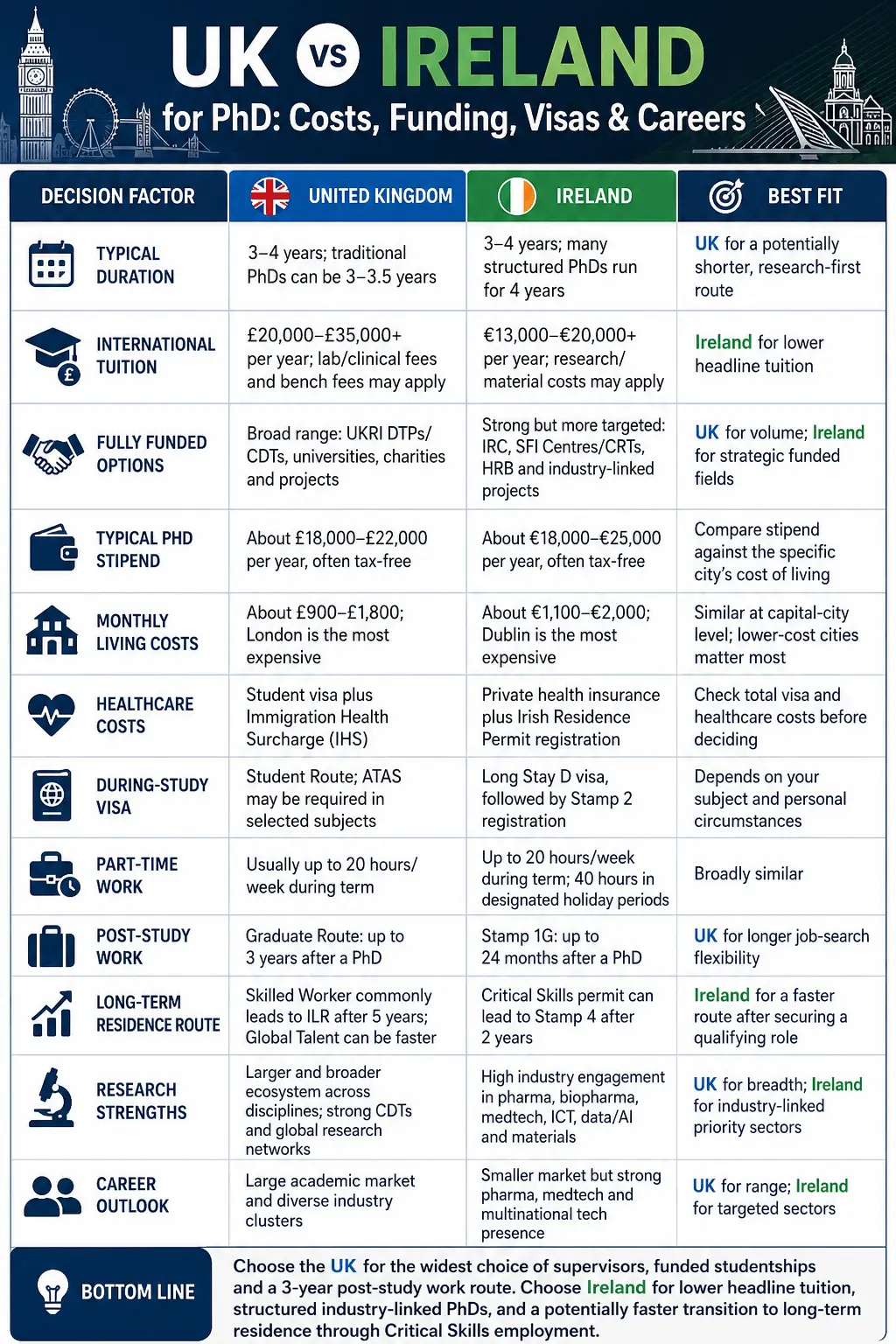
    UK vs Ireland for PhD: Quick Comparison

    Decision factorUnited KingdomIrelandBest fit
    Typical duration3–4 years; traditional PhDs can be 3–3.5 years3–4 years; many structured PhDs run for 4 yearsUK for a potentially shorter, research-first route
    International tuition£20,000–£35,000+ per year; lab/clinical fees and bench fees may apply€13,000–€20,000+ per year; research/material costs may applyIreland for lower headline tuition
    Fully funded optionsBroad range: UKRI DTPs/CDTs, universities, charities and projectsStrong but more targeted: IRC, SFI Centres/CRTs, HRB and industry-linked projectsUK for volume; Ireland for strategic funded fields
    Typical PhD stipendAbout £18,000–£22,000 per year, often tax-freeAbout €18,000–€25,000 per year, often tax-freeCompare stipend against the specific city’s cost of living
    Monthly living costsAbout £900–£1,800; London is the most expensiveAbout €1,100–€2,000; Dublin is the most expensiveSimilar at capital-city level; lower-cost cities matter most
    Healthcare costsStudent visa plus Immigration Health Surcharge (IHS)Private health insurance plus Irish Residence Permit registrationCheck total visa and healthcare costs before deciding
    During-study visaStudent Route; ATAS may be required in selected subjectsLong Stay D visa, followed by Stamp 2 registrationDepends on your subject and personal circumstances
    Part-time workUsually up to 20 hours/week during termUp to 20 hours/week during term; 40 hours in designated holiday periodsBroadly similar
    Post-study workGraduate Route: up to 3 years after a PhDStamp 1G: up to 24 months after a PhDUK for longer job-search flexibility
    Long-term residence routeSkilled Worker commonly leads to ILR after 5 years; Global Talent can be fasterCritical Skills permit can lead to Stamp 4 after 2 yearsIreland for a faster route after securing a qualifying role
    Research strengthsLarger and broader ecosystem across disciplines; strong CDTs and global research networksHigh industry engagement in pharma, biopharma, medtech, ICT, data/AI and materialsUK for breadth; Ireland for industry-linked priority sectors
    Career outlookLarge academic market and diverse industry clustersSmaller market but strong pharma, medtech and multinational tech presenceUK for range; Ireland for targeted sectors

    Bottom line: Choose the UK for the widest choice of supervisors, funded studentships and a 3-year post-study work route. Choose Ireland for lower headline tuition, structured industry-linked PhDs, and a potentially faster transition to long-term residence through Critical Skills employment.

    Important: Figures vary by university, field, and year. Always verify tuition, stipend amounts, fees, and visa rules on official websites before applying.

    Tuition Fees and Total Cost of Study

    United Kingdom

    • International PhD tuition typically ranges from about £20,000 to £35,000+ per year. Laboratory-intensive or clinical programs can be higher.
    • Some departments charge additional bench fees for lab consumables, equipment, or fieldwork. These can add several thousand pounds annually; always confirm with your department.
    • Home (UK) fees are much lower but only apply to eligible students (settled/pre-settled status, or other specific categories).
    • You must also budget for the UK’s Immigration Health Surcharge (IHS) at the discounted student rate (payable per year of visa), plus the visa application fee and potential ATAS clearance for certain sensitive subjects.

    Australia vs New Zealand for PhD: Costs, Visas, Jobs

    Ireland

    • International PhD tuition generally ranges from about €13,000 to €20,000+ per year, with some variation by institution and discipline. Laboratory/clinical fields can be higher.
    • Structured PhDs may include research training modules; check for any additional research costs, materials, or travel.
    • Non-EEA students typically must purchase private medical insurance and pay a registration fee to obtain the Irish Residence Permit (IRP).

    Which is more affordable? Ireland’s headline international tuition can be lower on average, but Dublin’s living costs and private health insurance can offset savings. The UK’s tuition often runs higher, especially at prestigious institutions; however, if you secure a funded studentship covering fees+stipend, your out-of-pocket cost may be minimal in either country. The decisive factor is whether you win full funding.

    Funding Opportunities

    United Kingdom

    • UKRI Studentships: Doctoral Training Partnerships (DTPs) and Centres for Doctoral Training (CDTs) funded by UKRI councils (e.g., EPSRC, MRC, BBSRC, NERC, ESRC, AHRC, STFC). Many now accept international applicants, though competition is strong and quotas may apply.
    • University/Departmental Scholarships: Examples include Clarendon (Oxford), Gates Cambridge (University of Cambridge), and numerous institutional or faculty awards.
    • Charitable/Trust Funding: Cancer Research UK, Wellcome-funded PhD programmes (in participating universities), Leverhulme Trust co-funding, and others.
    • EU and International: Horizon Europe projects and Marie Skłodowska-Curie Doctoral Networks (the UK is associated from 2024), plus country-specific scholarships.
    • Stipends: UKRI minimum stipends change annually; typical stipends are around £18,000–£22,000 per year, with possible London weighting. Stipends are generally tax-free.

    Ireland

    • Irish Research Council (IRC) – Government of Ireland Postgraduate Scholarship: Competitive national award that typically covers fees (often at EU rate; check institutional policy for non-EU fee coverage) plus a stipend. Stipend levels have been increasing in recent budgets; check current IRC call documentation.
    • Science Foundation Ireland (SFI): PhD funding through SFI Centres, Centres for Research Training (CRTs), and investigator-led grants; strong industry-linked themes in ICT, data/AI, materials, and medtech.
    • Health Research Board (HRB), Teagasc, Marine Institute, and other agencies fund domain-specific doctorates.
    • EU and International: Horizon Europe and Marie Skłodowska-Curie Actions (MSCA) remain significant sources; Ireland is an EU member state with full access.
    • Stipends: Commonly ~€18,000–€25,000, depending on funder and discipline. Many awards are tax-free scholarships.

    Which is better? The UK offers a larger volume of studentships across many disciplines, but they are highly competitive. Ireland has fewer positions overall, yet many are fully funded within strategic research areas and can be attractive if your interests align with SFI/IRC priorities. For applicants in AI/data, medtech, and pharma, Ireland’s industry-connected funding can be especially compelling.

    Cost of Living

    United Kingdom

    • London: Typically the most expensive; a single student might budget ~£1,400–£1,800 per month for housing, food, local transport, and incidentals. University accommodations can ease planning but may cost more.
    • Other cities (e.g., Manchester, Glasgow, Leeds, Nottingham): Often ~£900–£1,400 per month, strongly dependent on rent and lifestyle.
    • Official financial requirement for visas (subject to change): Generally around £1,334/month in London and £1,023/month outside London (for up to 9 months of the course) to demonstrate maintenance funds. Verify current figures on gov.uk before applying.

    Ireland

    • Dublin: High rents and living costs. A single student commonly budgets ~€1,500–€2,000 per month inclusive of rent, food, and transport.
    • Other cities (e.g., Cork, Galway, Limerick): Often ~€1,100–€1,600 per month, depending on accommodation and lifestyle.
    • Official financial requirement for visas (subject to change): Non-EEA students are generally asked to show at least €10,000 in living expenses for one academic year, along with proof of paid tuition and private health insurance. Verify current guidance on Irish Immigration Service Delivery (ISD) pages.

    Bottom line: Dublin vs London costs are broadly comparable at the high end; many UK and Irish cities outside the capitals are more affordable. Securing university housing, sharing accommodation, and choosing lower-cost areas can substantially reduce expenses.

    Visa and Immigration Pathways

    United Kingdom

    • Student Route Visa: Requires a Confirmation of Acceptance for Studies (CAS), meeting English and financial requirements, paying the visa fee and the discounted student-rate Immigration Health Surcharge (IHS). Some STEM/dual-use subjects require ATAS clearance before the visa.
    • Dependants: Postgraduate research students (PhD) can generally bring dependants if eligibility criteria are met; check the latest gov.uk rules.
    • Post-Study Work: The Graduate Route provides up to 3 years’ permission after PhD completion; it does not require a sponsoring employer and is not extendable. Time on the Graduate Route typically does not count towards settlement.
    • Long-Term Options: Skilled Worker visa (sponsorship + salary threshold; time counts towards settlement, typically 5 years). Global Talent for outstanding researchers can lead to settlement more quickly (often 3 years). Rules and thresholds change periodically; always consult the latest gov.uk guidance.

    Ireland

    • Long Stay D Visa + Stamp 2: Apply for a long stay study visa, then register in Ireland for Stamp 2 permission (non-EEA). Requires acceptance to a program on the Interim List of Eligible Programmes (ILEP), proof of funds, health insurance, and fee payment.
    • Dependants: Study visas generally do not allow immediate family reunification; dependants typically follow through employment routes. Confirm current policy on Department of Justice/ISD pages.
    • Post-Study Work: The Third Level Graduate Programme (Stamp 1G) allows up to 24 months after a PhD (NFQ Level 10) to seek work.
    • Long-Term Options: Critical Skills Employment Permit (CSEP) offers a fast track to Stamp 4 after 2 years. The General Employment Permit is another route (usually longer to Stamp 4). Student and Stamp 1G periods are generally not reckonable for long-term residence; check exact reckonable residence rules on official sites.

    Which is better? For post-PhD job search time, the UK offers 3 years on the Graduate Route vs Ireland’s 24 months on Stamp 1G. For quicker settlement once employed, Ireland’s Critical Skills route can be faster to Stamp 4 (after 2 years), whereas the UK’s Skilled Worker usually requires 5 years to ILR (unless you qualify for Global Talent).

    Program Structure and Duration

    United Kingdom

    • Many PhDs are 3–4 years, with a strong focus on independent research under a supervisor’s guidance.
    • Some areas use Centres for Doctoral Training (CDTs) or Doctoral Training Partnerships (DTPs) with a 1-year taught or cohort-based training phase followed by 3 years of research (4-year total).
    • Progress reviews, transferable-skills training, and optional teaching duties vary by institution.

    Ireland

    • Structured PhDs (often 4 years) combine research with formal modules in methods, professional skills, and sometimes industry placements.
    • Supervision teams and Graduate Schools are common, with progression reviews and research training plans.
    • Teaching assistantships may be part of the training (varies by discipline and school).

    Which is better? If you prefer a cohort model with explicit training components, Ireland’s structured programs and UK CDTs/DTPs are attractive. If you want to dive directly into independent research, a traditional 3–3.5-year UK PhD may be ideal.

    Research Quality and Opportunities

    United Kingdom

    • Major global research hub with comprehensive disciplinary strength, tracked by national assessments such as the Research Excellence Framework (REF).
    • Strong international collaboration and high publication impact; excellent research infrastructure across leading universities and institutes.
    • Re-associated to Horizon Europe from 2024, restoring access to large EU research consortia and doctoral networks.

    Fully Funded Postdoctoral Fellowships in Germany 2027

    Ireland

    • High-impact in selected strategic domains: ICT/data/AI, pharmaceuticals and bioprocessing, medtech, materials, marine/agri-food, and sustainability.
    • Science Foundation Ireland (SFI) Centres create deep academia–industry ties; many PhDs are embedded in multidisciplinary, applied research contexts.
    • Full participant in Horizon Europe and MSCA Doctoral Networks, offering international mobility and cross-sector training.

    Which is better? For breadth and scale, the UK is hard to beat. For targeted, industry-engaged research with strong EU connectivity, Ireland offers compelling opportunities—especially if your topic aligns with national priority areas.

    Language and Entry Requirements

    United Kingdom

    • English is the language of instruction. Common minimums: IELTS 6.5–7.0 overall (with subscore requirements), TOEFL iBT and PTE equivalents accepted at many universities.
    • Entry usually requires a strong bachelor’s (and/or master’s) degree with research experience and a viable research proposal.

    Ireland

    • English-language instruction across universities. Typical minimums similar to the UK (e.g., IELTS 6.5–7.0 or equivalent), with some program-specific variations.
    • Admission often requires a relevant bachelor’s/master’s and a research proposal aligned with supervisor expertise or a funded project’s scope.

    Tip: Always check department-level requirements, which can be higher than university minima, particularly for competitive programs.

    Application Process and Timelines

    United Kingdom

    • Find a supervisor whose work matches your interests. Many universities expect you to contact potential supervisors with a concise proposal and CV before submitting a formal application.
    • Funding cycles: DTP/CDT deadlines often fall between October and February for entry the following academic year. Self-funded applications can be accepted on a rolling basis.
    • Documents: Research proposal, academic CV, transcripts, references, English test scores (if required), and possibly a personal statement. Some programs may interview.
    • ATAS: Required for certain sensitive subjects for non-UK nationals; must be obtained before the visa stage.

    Ireland

    • Structured calls: Many funded PhD positions are advertised by departments or SFI/IRC projects with specific calls and deadlines.
    • Supervisor-led: It’s common to secure supervisor support first, then apply via the Graduate School or department portal.
    • Documents: Similar to the UK—proposal, CV, references, transcripts, and English proficiency. Interviews are common for funded roles.
    • Visa timing: Non-EEA students should apply for a long stay D visa and plan early for registration on arrival.

    Which is better? Both systems value supervisor fit. If you prefer cohort-based recruitment with clear funding attached to specific topics, Ireland’s structured advertisements (and UK CDTs) are ideal. If you want to pitch your own project to a PI or apply year-round, the UK has more rolling opportunities.

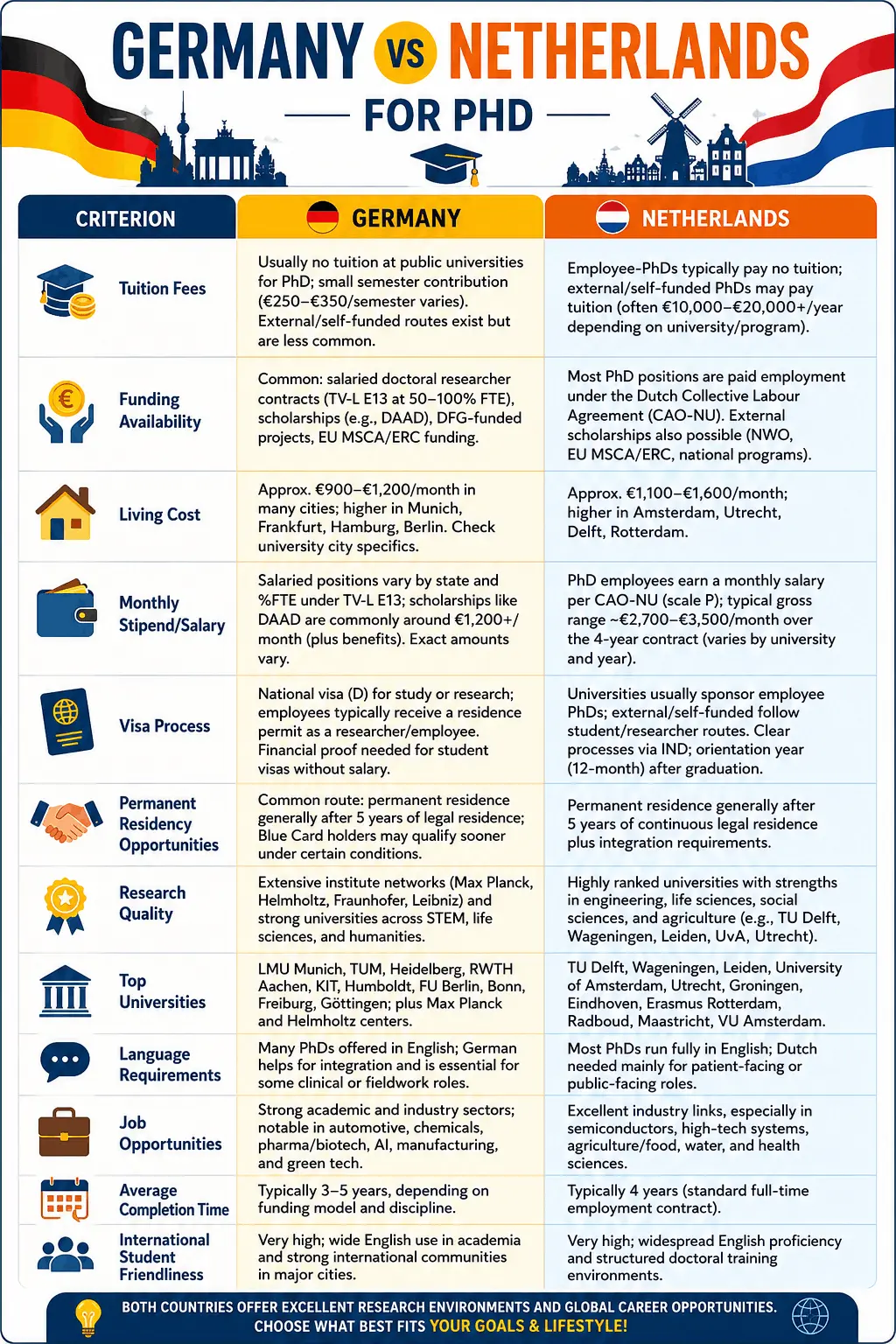
    Fully Funded PhD Scholarships in Germany 2027 | Apply Now

    Career Opportunities After Graduation

    Academic Careers

    • UK: Large ecosystem of postdoctoral and research fellow roles; typical starting salaries for postdocs are often ~£35,000–£45,000 (higher in London or for senior roles), varying by institution and field.
    • Ireland: Postdoc roles follow nationally informed salary scales; many positions start around ~€39,000–€50,000+, depending on level and experience. Availability is concentrated in research-active universities and SFI centres.

    Industry Careers

    • UK: Strong markets in AI/data, fintech, aerospace, automotive, biotech, pharmaceuticals, energy, and consulting. Research-intensive clusters exist around London, the “Golden Triangle” (Oxford–Cambridge–London), and major regional hubs (e.g., Manchester, Edinburgh, Bristol).
    • Ireland: Global leaders in pharma/biopharma (Pfizer, MSD, Janssen, Novartis), medtech (Medtronic, Boston Scientific, Stryker), and ICT (Google, Apple, Intel, Microsoft, Meta). Strong R&D links via SFI centres, often facilitating industry placements and collaborations.

    Visa Pathways

    • UK: PhD graduates use the 3-year Graduate Route to job-hunt, then switch to Skilled Worker (sponsored) or Global Talent (for recognized researchers). Skilled Worker time typically counts towards settlement.
    • Ireland: PhD graduates use Stamp 1G (up to 24 months) to secure employment. The Critical Skills Employment Permit is a fast track to Stamp 4 after 2 years; General Employment Permit usually takes longer for long-term residence eligibility.

    Which is better? If you want maximum time to job-hunt post-PhD, the UK’s 3-year Graduate Route is advantageous. If you’re targeting pharma/medtech or big tech with a goal of earlier long-term residence, Ireland’s Critical Skills pathway can be very attractive once you have a qualifying job offer.

    Fully Funded PhD Opportunities in New Zealand 2026

    Best Universities and Research Institutes

    United Kingdom (examples)

    • University of Oxford; University of Cambridge; Imperial College London; University College London; University of Edinburgh; University of Manchester; King’s College London; University of Bristol; University of Warwick; University of Glasgow.
    • Specialist research organizations and national labs also contribute to doctoral training in partnership with universities.

    Ireland (examples)

    • Trinity College Dublin; University College Dublin; University of Galway; University College Cork; Dublin City University; University of Limerick; Maynooth University.
    • Research institutes and SFI Centres: Tyndall National Institute; ADAPT; Insight (data/AI); CONNECT (communications); SSPC (pharma); I-Form (materials manufacturing); VistaMilk; INFANT; and others.

    Always check the department-level research groups and your prospective supervisor’s recent publications to evaluate lab fit, facilities, and ongoing grants.

    Pros and Cons

    Pros of the UK

    • Large volume of funded studentships across a wide spectrum of fields.
    • 3-year Graduate Route gives more time to find skilled employment.
    • Global research scale and breadth; re-associated to Horizon Europe.
    • Many cities and universities to match budget and research interests.

    Cons of the UK

    • International tuition can be high; bench fees may add costs.
    • Healthcare surcharge (IHS) increases total budget.
    • Graduate Route time typically does not count toward settlement; Skilled Worker thresholds and sponsorship requirements apply.

    Pros of Ireland

    • Strong industry-linked research via SFI Centres; excellent in pharma/medtech/ICT.
    • Many funded PhDs provide fees+stipend; structured training and placements.
    • Critical Skills Employment Permit can lead to Stamp 4 after 2 years.
    • Full participant in Horizon Europe and MSCA Doctoral Networks.

    Cons of Ireland

    • Fewer total PhD positions overall; competition concentrated in priority areas.
    • Dublin living costs are high; private health insurance required.
    • Post-study work permission (Stamp 1G) is up to 24 months, shorter than UK’s 3 years.

    Which Option is Best for You?

    • Students with a limited budget: Prioritize fully funded positions in either country. Ireland may have lower headline tuition, but a funded UK studentship can eliminate fees. Compare total stipends vs city costs.
    • Biomedical/Pharma/Medtech researchers: Ireland’s ecosystem (SFI centres, pharma/medtech clusters) is exceptionally strong. The UK also has excellent biomedical hubs; focus on supervisor fit and lab resources.
    • Engineering and Materials: Both are strong. The UK offers broad options and CDTs; Ireland’s I-Form (materials) and other centres can be ideal for industry-aligned projects.
    • Computer Science/Data/AI: Both countries are excellent. Ireland’s ADAPT/Insight and major tech companies provide strong applied pathways; the UK’s AI hubs and CDTs offer scale and breadth.
    • Long-term immigration goals: UK offers Global Talent and Skilled Worker (5 years to ILR); Ireland’s Critical Skills route can lead to Stamp 4 after 2 years. Choose based on your likelihood of landing a qualifying job and personal circumstances.
    • Academic careers: UK has a larger volume of postdoc and lecturer opportunities. Ireland has strong roles but a smaller market—network early and leverage EU collaborations.
    • Industry careers: UK provides breadth across many sectors; Ireland shines in pharma/biopharma, medtech, and ICT with close industry ties.

    Expert Tips

    • Anchor your decision in supervisor fit: Email potential supervisors with a concise, tailored message and a 1–2 page proposal linked to their recent papers.
    • Apply where funding is strongest: Target DTP/CDTs (UK) and SFI/IRC-funded positions (Ireland). Many projects are pre-funded—apply early.
    • Budget carefully: Add bench fees, visa costs, IHS (UK), private health insurance (Ireland), and moving costs to your spreadsheet.
    • Use official visa guidance: Rules and thresholds change. Confirm maintenance funds, dependants policy, and timelines on gov.uk (UK) and ISD/Department of Justice (Ireland).
    • Leverage EU funding: Look for MSCA Doctoral Networks and Horizon Europe projects in both countries.
    • Plan your post-PhD pathway now: Map Graduate Route vs Stamp 1G, and shortlist employers who sponsor Skilled Worker (UK) or Critical Skills (Ireland).
    • Consider city-level costs: A slightly lower stipend in a cheaper city may stretch further than a higher stipend in a capital.
    • Network: Attend virtual open days, Graduate School webinars, and research group seminars. Ask current PhD students candid questions about workload, culture, and outcomes.
    • Publish and present: Strong research outputs and conference networking improve both academic and industry prospects. For dissemination and visibility, consider reputable platforms like IR Research Publication.

    External Resources (Official)

    Internal Links

    For publishing and sharing your doctoral research, visit IR Research Publication.

    Explore calls for papers, editorial policies, and author services with IR Research Publication.

    Stay updated with research best practices and dissemination tips at IR Research Publication.

    Frequently Asked Questions

    Is the UK or Ireland cheaper for a PhD?

    Ireland often lists lower international tuition on average, but Dublin’s living costs and private health insurance can offset savings. UK tuition is frequently higher, yet funded studentships can cover full fees and stipend. The cheapest option is the one where you secure full funding aligned with an affordable city.

    What is the typical PhD stipend in the UK vs Ireland?

    UK stipends commonly range around £18,000–£22,000 per year (often tax-free; London can be higher). In Ireland, many stipends fall around €18,000–€25,000 per year (often tax-free scholarships). Exact amounts depend on funder, discipline, and year.

    How long does a PhD take in the UK vs Ireland?

    Both typically take 3–4 years. Ireland’s structured programs and UK CDTs are often 4 years; traditional UK PhDs can be 3–3.5 years, sometimes with a writing-up period.

    What post-study work rights do I get?

    UK PhD graduates can usually stay up to 3 years on the Graduate Route. Ireland offers up to 24 months on the Third Level Graduate Programme (Stamp 1G) after PhD completion.

    Which country is better for permanent residency?

    It depends on your job path. In the UK, Skilled Worker typically leads to settlement after 5 years; Global Talent can be faster. In Ireland, the Critical Skills Employment Permit can lead to Stamp 4 after 2 years. Student/graduate periods generally don’t count—verify reckonable residence rules on official sites.

    Are dependants allowed for PhD students?

    In the UK, eligible postgraduate research students (PhD) can generally bring dependants subject to current rules. In Ireland, study visas usually do not allow immediate family reunification; dependants typically follow via employment-based routes. Always check the latest immigration guidance.

    Do I need ATAS clearance?

    ATAS applies to certain subjects in the UK involving advanced technologies with potential military applications. If your course is on the controlled list and you are a non-exempt nationality, you must secure ATAS before your visa. Ireland does not use ATAS.

    Are English tests required?

    Usually yes for non-native speakers. Typical requirements are IELTS 6.5–7.0 or equivalent (TOEFL, PTE). Some universities waive tests for prior degrees taught in English—check departmental policies.

    Can I work during my PhD?

    In both countries, students can usually work part-time up to 20 hours per week during term and more during holidays (Ireland specifies 40 hours in designated periods). Your stipend or visa may include additional conditions—confirm locally.

    Which is better for industry careers: UK or Ireland?

    Both are excellent. The UK has breadth across many sectors. Ireland has particularly strong ecosystems in pharma/biopharma, medtech, and ICT with close industry ties and pathways to Critical Skills permits.

    Conclusion: UK vs Ireland for PhD

    There is no universal “best” choice in the UK vs Ireland for PhD debate—only the best match for your goals and funding prospects.

    • Choose the UK if you value a very large and diverse research ecosystem, want up to 3 years of post-study work time, and can secure a strong studentship (DTP/CDT or institutional award). The UK is ideal if you prioritize breadth of supervisors, centers, and cities.
    • Choose Ireland if your interests align with SFI/IRC priority areas, you prefer structured training with industry links, and you plan to transition quickly into a Critical Skills role that can lead to Stamp 4 after 2 years. Ireland is especially compelling for pharma/biopharma, medtech, and ICT.

    Whichever you select, prioritize supervisor fit, funded positions, and a city you can afford. Confirm visa and financial requirements on official sites and plan early for a smooth start.

    About IR Research Publication

    IR Research Publication is dedicated to advancing global scholarship by helping researchers disseminate high-quality work to the academic community and industry stakeholders. Through accessible publishing, editorial support, and outreach, IR Research Publication empowers doctoral candidates and early-career researchers to increase the visibility, impact, and credibility of their findings. Learn more at irrespub.com.

    Related Articles

  • How to Find Fully Funded PhD Positions in Europe (2026)

    How to Find Fully Funded PhD Positions in Europe (2026)

    Introduction: Why This Guide Matters

    Fully funded PhD positions in Europe offer an exceptional route to develop as a researcher without incurring heavy tuition costs. In many European countries, doctoral candidates are contracted employees with social benefits, while in others, scholarships and stipends cover living expenses and fees. This guide is written for master’s students, graduating seniors, industry professionals switching to research, and postgraduates seeking international doctoral training.

    Common mistakes include applying to the wrong type of funding, missing mobility rules (e.g., MSCA), sending generic emails to supervisors, and underestimating the time needed to prepare documents. Here you’ll learn how to target the right opportunities, make your profile competitive, and confidently navigate applications, interviews, and relocation.

    We provide evidence-based advice, real examples, official resources, and templates you can use immediately to improve your success rate in 2026 application cycles and beyond.

    Fully Funded PhD Scholarships in France 2027 | Apply Now

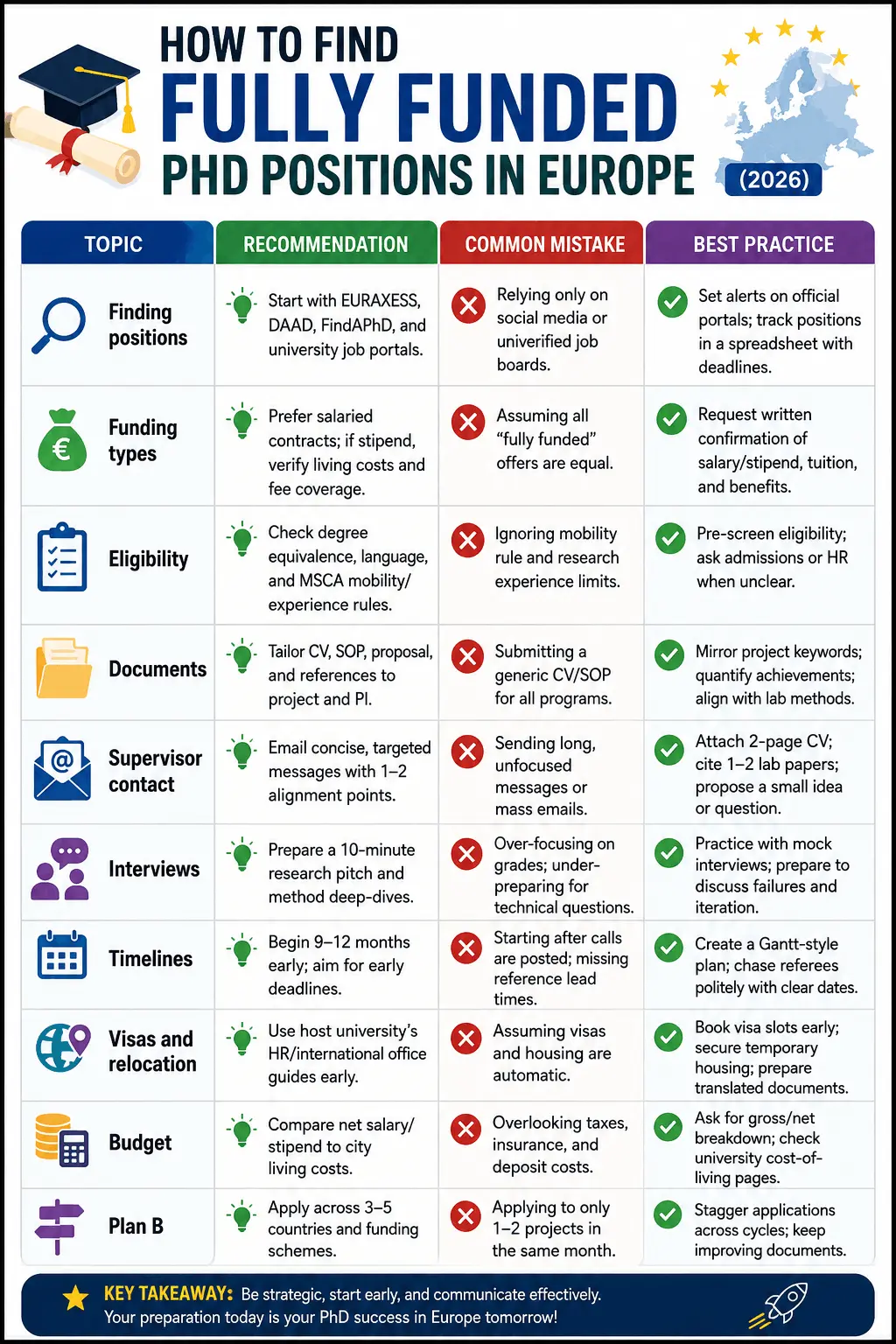
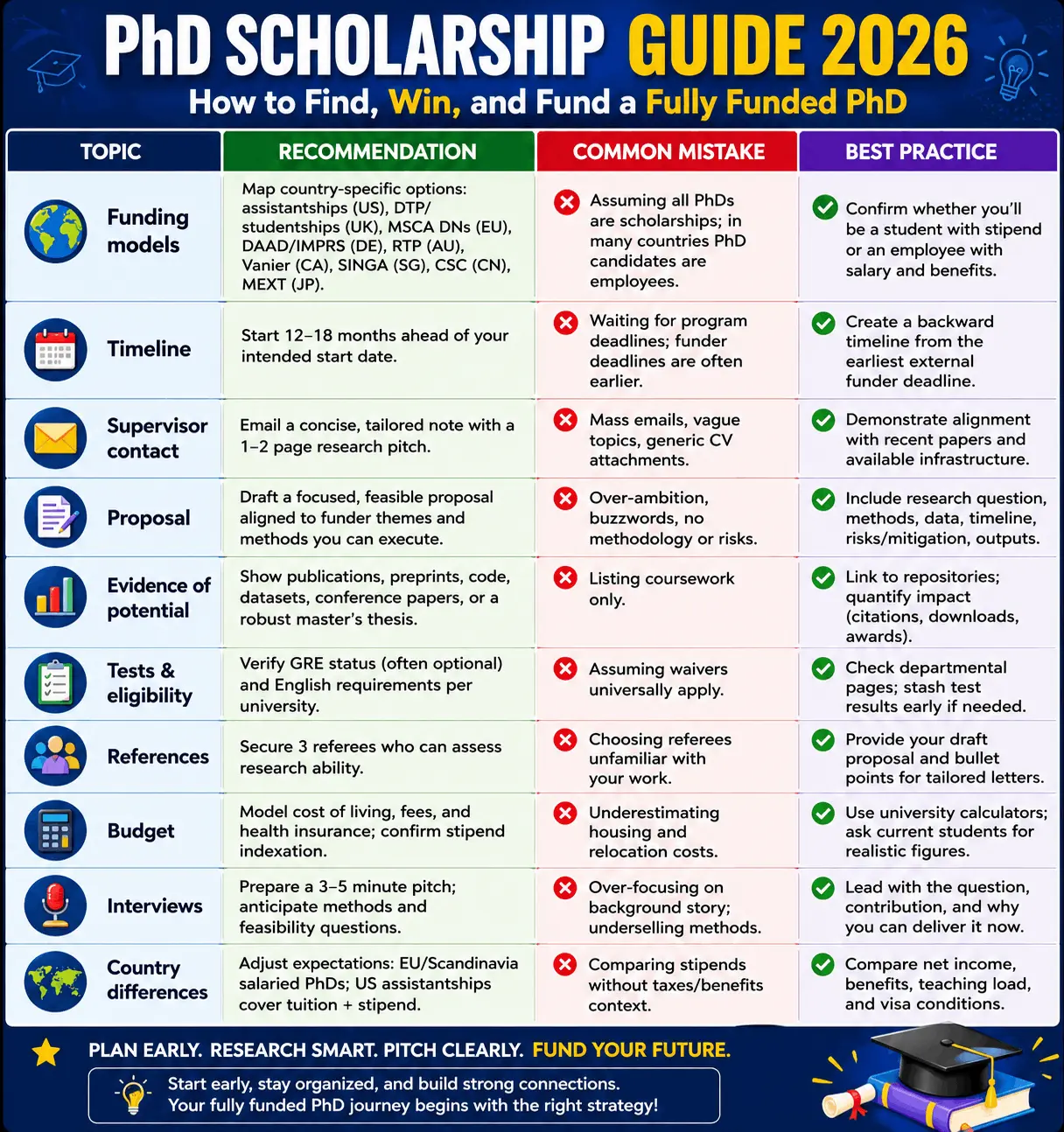
    Quick Summary Table: How to Find Fully Funded PhD Positions in Europe (2026)

    TopicRecommendationCommon MistakeBest Practice
    Finding positionsStart with EURAXESS, DAAD, FindAPhD, and university job portals.Relying only on social media or unverified job boards.Set alerts on official portals; track positions in a spreadsheet with deadlines.
    Funding typesPrefer salaried contracts; if stipend, verify living costs and fee coverage.Assuming all “fully funded” offers are equal.Request written confirmation of salary/stipend, tuition, and benefits.
    EligibilityCheck degree equivalence, language, and MSCA mobility/experience rules.Ignoring mobility rule and research experience limits.Pre-screen eligibility; ask admissions or HR when unclear.
    DocumentsTailor CV, SOP, proposal, and references to project and PI.Submitting a generic CV/SOP for all programs.Mirror project keywords; quantify achievements; align with lab methods.
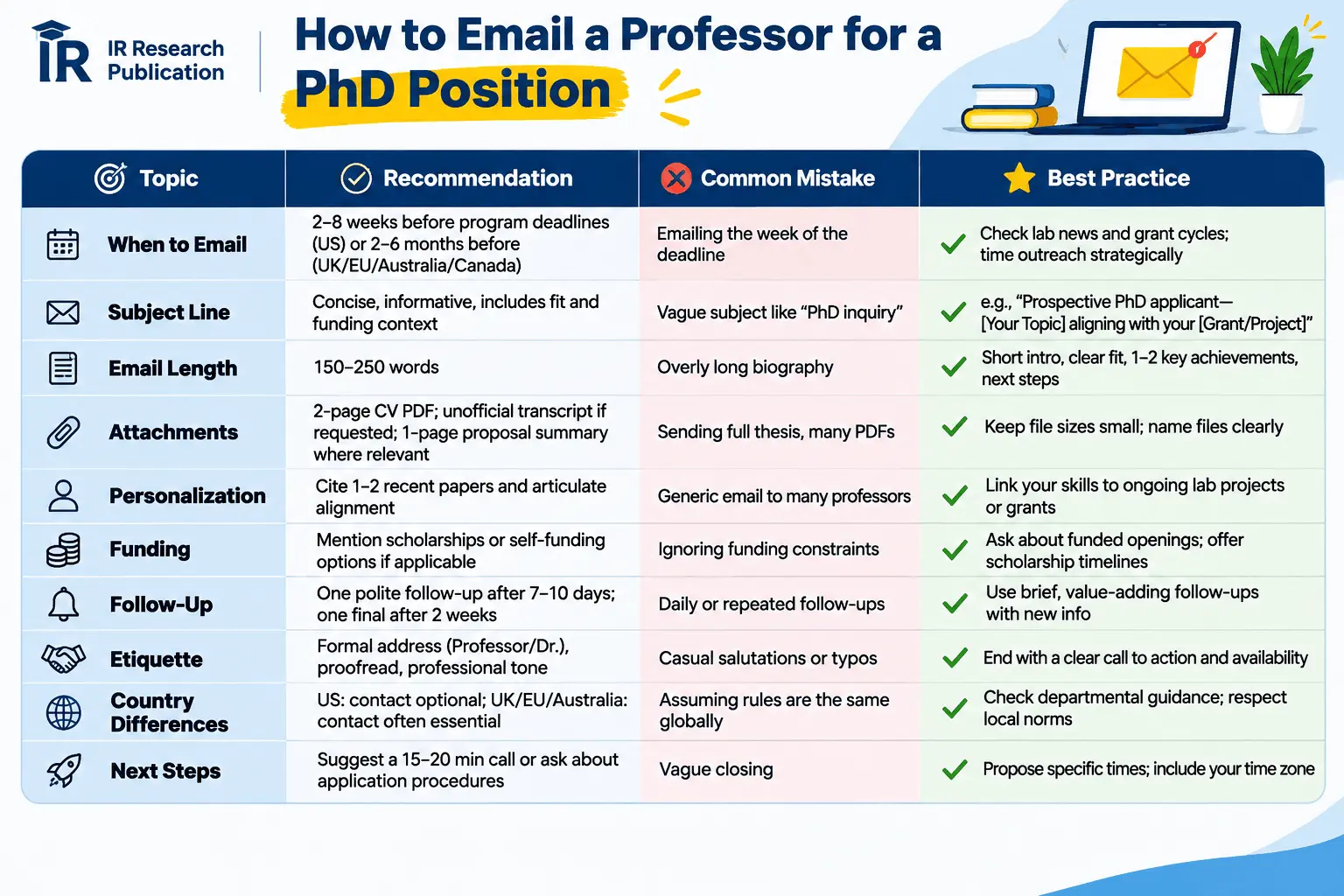
    Supervisor contactEmail concise, targeted messages with 1–2 alignment points.Sending long, unfocused messages or mass emails.Attach 2-page CV; cite 1–2 lab papers; propose a small idea or question.
    InterviewsPrepare a 10-minute research pitch and method deep-dives.Over-focusing on grades; under-preparing for technical questions.Practice with mock interviews; prepare to discuss failures and iteration.
    TimelinesBegin 9–12 months early; aim for early deadlines.Starting after calls are posted; missing reference lead times.Create a Gantt-style plan; chase referees politely with clear dates.
    Visas and relocationUse host university’s HR/international office guides early.Assuming visas and housing are automatic.Book visa slots early; secure temporary housing; prepare translated documents.
    BudgetCompare net salary/stipend to city living costs.Overlooking taxes, insurance, and deposit costs.Ask for gross/net breakdown; check university cost-of-living pages.
    Plan BApply across 3–5 countries and funding schemes.Applying to only 1–2 projects in the same month.Stagger applications across cycles; keep improving documents.

    What “Fully Funded PhD Positions in Europe” Means

    In Europe, “fully funded” typically means your tuition/fees are covered and you receive a monthly salary or stipend sufficient to live modestly in the host city. There are two common models:

    Australia vs New Zealand for PhD: Costs, Visas, Jobs

    • Salaried employment (most common in Northern/Western Europe): You are hired as an employee (e.g., PhD candidate/doctoral researcher) with a contract, salary, and benefits (social insurance, pension, paid leave). Examples: Netherlands, Sweden, Denmark, Norway, Finland, Germany (often 50–100% TV-L E13), Switzerland, Belgium, and many MSCA Doctoral Networks.
    • Scholarship or stipend model: You receive a monthly allowance and fee waiver. Common in some programs in France (contrat doctoral is employment; some schools use stipends), Italy, Spain (FPI/FPU contracts are employment; other schemes may be stipends), Portugal (FCT fellowships), Central/Eastern Europe, and certain UK studentships (stipend plus fee coverage).

    Always request written details: salary or stipend amount, indexation over years, fee coverage, insurance, parental leave, teaching loads, and contract duration (usually 3–4 years, up to 5–6 in some countries including the Netherlands or part-time arrangements).

    Where to Find Fully Funded PhD Positions in Europe (Top Portals)

    • EURAXESS Jobs – The EU’s official portal for research jobs and fellowships across Europe. Filter by “PhD Candidate” or “Recognised Researcher,” field, country, and funding.
    • FindAPhD – Comprehensive listings of funded and competition-based PhD positions, especially UK, Ireland, Benelux, DACH, Nordics, and EU networks.
    • DAAD Scholarship Database – Official funding for studies and research in Germany, including structured doctoral programs, research grants, and graduate schools.
    • MSCA Doctoral Networks (DNs) – EU-funded networks recruiting international doctoral candidates. Check network websites or EURAXESS for open positions. Note the mobility rule and early-stage researcher criteria.
    • Nature Careers – Research jobs across Europe, including many top labs and institutes.
    • Academic Positions – Aggregated research and academic vacancies across Europe; filter by “PhD” level.
    • THE UniJobs – Academic jobs including doctoral candidateships, especially in the UK and EU.
    • University portals – Always check the “Jobs,” “Doctoral School,” or “Graduate School” pages of target universities and institutes (e.g., Max Planck, EMBL, ETH Domain).

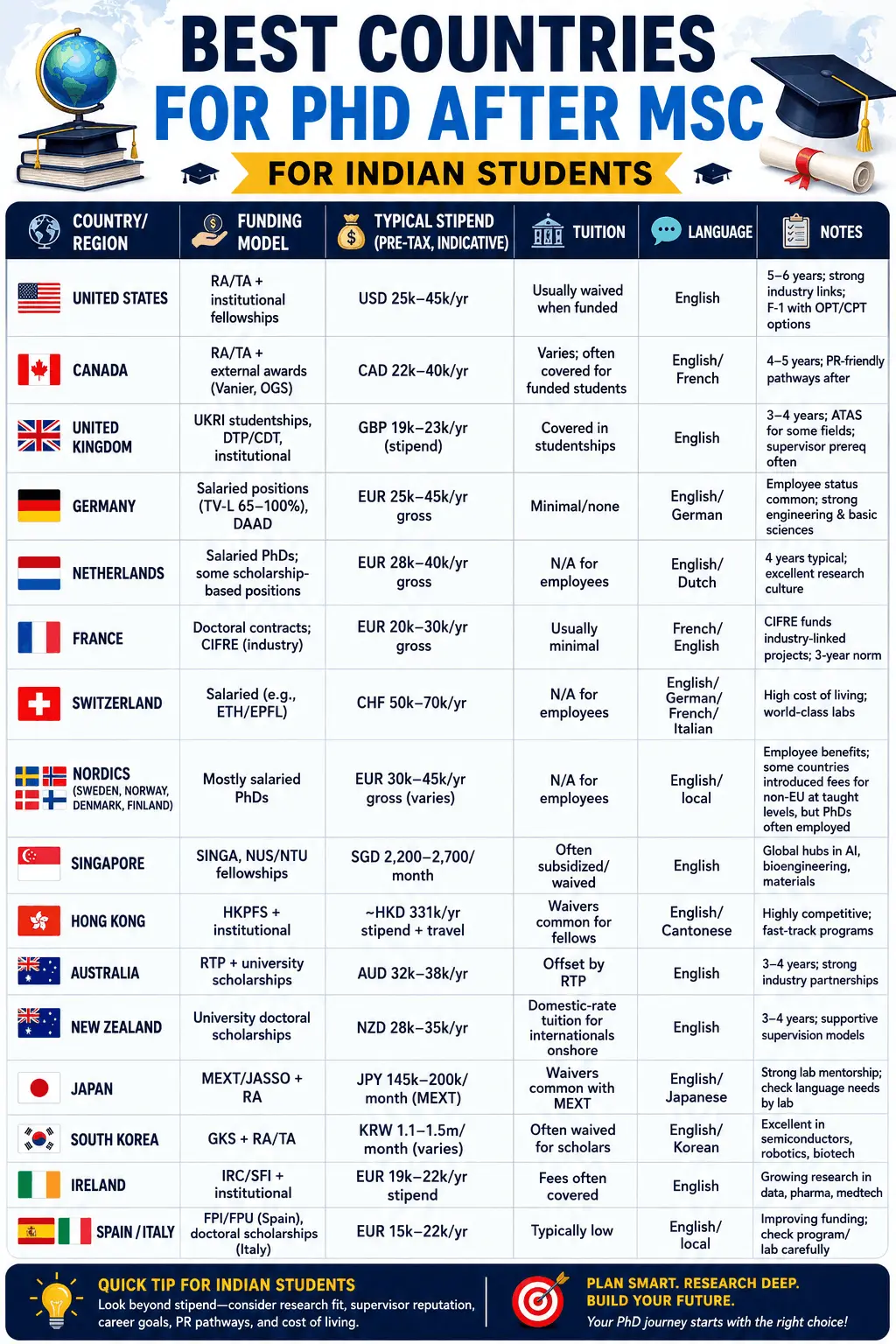
    Funding Models by Country (2026 Snapshot)

    Funding structures vary significantly. Below is a practical overview (always verify current terms on official pages):

    • Germany: Many PhD candidates are employed on TV-L E13 contracts at 50–100% (part-time or full-time), especially in DFG-funded projects and graduate schools. Others hold DAAD or external scholarships. Fees are generally minimal (semester contributions). See DFG funding and DAAD.
    • Netherlands: PhD candidates are university employees with salaries following national scales (e.g., UFO Scale P). Typical 4-year contracts with annual progression and no tuition fees. See a typical vacancy on AcademicTransfer.
    • Sweden: PhD students are employees with monthly salaries and benefits; tuition fees are generally not charged for doctoral education. See Studera.nu and university HR pages.
    • Denmark: PhD fellows are employees under collective agreements, with salary and pension. Check host universities (e.g., University of Copenhagen PhD).
    • Norway: PhD candidates are employees with full salaries; doctoral education has no tuition fees for employees. See JobbNorge and university HR portals.
    • Finland: Doctoral researchers are often employed, sometimes with mixed funding (projects + grants). Many universities offer salaried Doctoral Researcher posts.
    • France: Doctoral candidates often hold a contrat doctoral (employment) or other funded arrangements. Tuition is modest compared to many countries. See Campus France.
    • Switzerland: PhD candidates are usually employed by universities or institutes (ETH/EPFL/Universities/CERN affiliations), with competitive salaries. See ETH Doctorate and EPFL Doctorate.
    • Belgium: Funding through employment (e.g., doctoral assistant) or scholarships (FWO/FNRS). See FWO and FNRS.
    • Austria: Mixture of employment contracts and stipends; most doctoral candidates in funded projects are employees. See FWF.
    • Ireland: Funded studentships via SFI Centres, IRC (Irish Research Council), and industry co-funding; often stipend + fee coverage. See Irish Research Council and SFI.
    • Spain: Many fully funded via employment contracts (FPI/FPU), others via scholarships. See Agencia Estatal de Investigación.
    • Portugal: FCT fellowships and contracts fund many PhDs; verify fee waivers and insurance. See FCT.
    • Italy: PhD scholarships are common; amounts and fee waivers vary by university and region. See individual university doctoral schools.
    • United Kingdom: UK remains a top destination in Europe with “studentships” (stipend + fee coverage). Check FindAPhD, Jobs.ac.uk, DTP/CDT websites, and university portals.

    Step 1: Define Your Fit and Research Direction

    Before searching, crystalize your research identity and constraints:

    • Field and subfield (e.g., machine learning for healthcare NLP; molecular immunology; sustainable catalysis).
    • Methods you bring (e.g., RCT design, single-cell RNA-seq, finite element modeling).
    • Outputs that prove readiness (thesis, preprints, code repositories, internships, conference posters).
    • Constraints (start date, family, location preferences, language, visa requirements).

    Create a one-page “profile brief” to guide your search and outreach.

    Step 2: Learn Eligibility and Rules That Can Disqualify You

    • Degree requirements: Most programs require a master’s (or 4–5-year integrated degree). Some allow direct PhD entry from bachelor’s in STEM with exceptional records (e.g., Netherlands, UK, select Germany tracks).
    • Language: English suffices for most STEM PhDs. For programs taught in local languages, check DSH/TestDaF (Germany), TCF/DELF-DALF (France), etc.
    • MSCA Doctoral Networks: You must have less than 4 years of full-time equivalent research experience and not have lived/studied in the host country for more than 12 months in the last 36 months before recruitment.
    • Work status: For employee-based PhDs, you must meet employment and visa rules; for scholarship-based, check residency/taxation impacts.
    • GRE/GMAT: Rarely required in Europe; verify for specific schools.

    Highest-Paying Postdoctoral Fellowships Worldwide (2026)

    Step 3: Source Positions Systematically

    1. Set alerts on EURAXESS, FindAPhD, Academic Positions, and Nature Careers.
    2. List target universities and institutes; subscribe to their vacancy newsletters.
    3. Track deadlines in a spreadsheet: portal, project title, PI, requirements, documents, referee status, and submission URL.
    4. Check MSCA DN consortium pages for each network you’re interested in; positions may be posted on multiple partner sites.

    Step 4: Shortlist by Funding Security and Fit

    Consider:

    • Contract vs stipend: Employment contracts generally offer higher stability and benefits.
    • Fee policy: Ensure full fee waiver for international students if not an employee.
    • Cost-of-living match: Compare monthly net income to local living expenses using university guides.
    • Supervisor track record: Review recent publications, completed PhD supervisions, funding stability, and alumni outcomes.

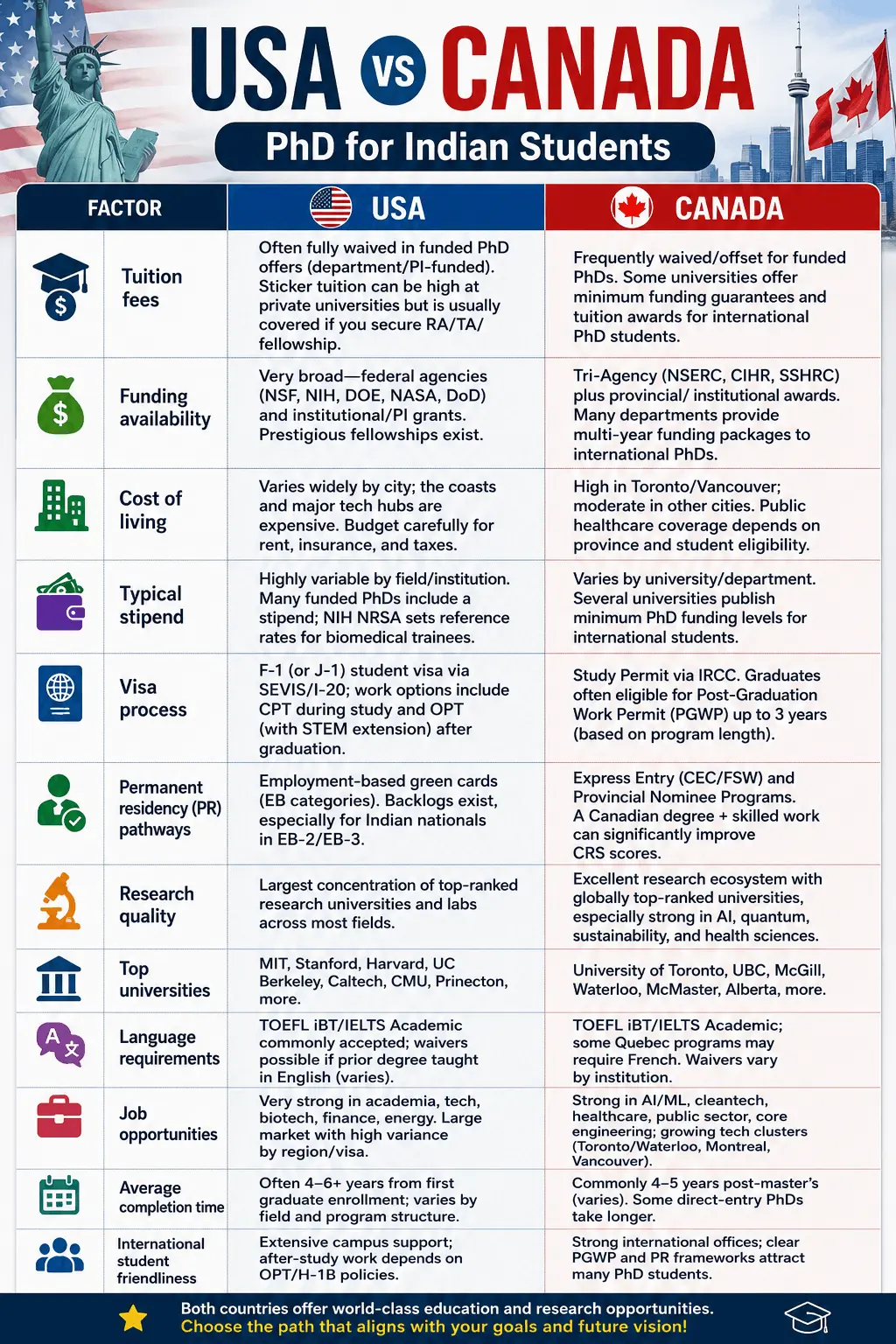
    USA vs Canada for PhD: Best Choice for Indian Students in 2026

    Step 5: Prepare Core Documents that Win Interviews

    • Academic CV (2–3 pages): Results-focused, with quantifiable outputs.
    • Statement of Purpose/Motivation (1–2 pages): Your research trajectory, fit, and why this lab/program now.
    • Research Proposal (2–5 pages if requested): For open-topic programs or scholarships; project-defined roles need a targeted idea sketch.
    • References: 2–3 academic/industry referees who can attest to your research ability and independence.
    • Transcripts and certificates: Official or certified copies with English translations if needed.
    • Language proof: IELTS/TOEFL or local tests where required; ask about waivers if you studied in English.

    Sample Email to a Potential Supervisor (Cold Outreach)

    Subject: Prospective PhD applicant for [Project/Area] — alignment with your recent work on [Keyword]

    Dear Dr./Prof. [Surname],

    I am a [your degree and institution, graduation year], focusing on [your methods/area]. Your recent paper on [title or keyword, year/journal] aligns closely with my master’s thesis on [topic], where I [1–2 quantified results, e.g., developed a [model/method] that improved [metric] by X%].

    I noticed your group is working on [specific project or call; include link/reference ID if applicable]. I would be keen to contribute to [specific aim or method], particularly [concrete idea or question]. I have attached a 2-page CV and a short summary of my thesis.

    Would it be possible to schedule a 15-minute call to discuss potential PhD openings or whether my profile would be competitive for [program/grant, e.g., MSCA DN “NAME”]?

    Thank you for your time and consideration.

    Kind regards,
    [Full Name] | [Current role]
    [Institution] | [City, Country]
    [Email] | [LinkedIn/Website/ORCID/GitHub]

    Academic CV Example (Structure)

    • Header: Name, email, website/ORCID, location.
    • Research Interests: 3–5 bullet points with methods and application domains.
    • Education: Degrees with thesis title, advisors, GPA (if strong), dates.
    • Publications: Peer-reviewed, preprints, conference abstracts; provide DOIs/links.
    • Research Experience: Projects, role, outcomes (data/code/papers), tools used.
    • Teaching/Leadership: TA roles, workshops, mentoring.
    • Awards/Grants: Scholarships, travel grants, distinctions.
    • Skills: Methods, programming, instruments, languages (CEFR levels).

    SOP/Motivation Letter Outline

    1. Opening hook: Your research problem and why it matters.
    2. Background: 2–3 achievements showing readiness (quantify impact).
    3. Fit: Why this PI/program/network; cite 1–2 recent papers or facilities.
    4. Future project: A brief, feasible idea aligned with the call.
    5. Training plan: Methods you will learn; collaborations/secondments.
    6. Closing: Career aims and contribution to the host’s mission.

    Research Proposal Skeleton (If Requested)

    1. Title and Keywords
    2. Problem Statement and Significance
    3. State of the Art (with 5–10 key references)
    4. Research Questions/Hypotheses
    5. Methodology (datasets, instruments, analysis plan; risks and mitigation)
    6. Work Plan and Timeline (Gantt blocks: WP1–WP4)
    7. Expected Outcomes (papers, code, prototypes, policy impact)
    8. Ethics and Data Management (GDPR, open data/code plan)
    9. References (consistent citation style)

    Cover Letter Template for an Advertised PhD Post

    Dear Hiring Committee/Dr. [Surname],

    I am applying for the PhD position “[Title/Ref]” at [University/Institute]. My background in [methods/field] and my thesis on [topic] position me to contribute immediately to [project objective]. In my recent project, I [key accomplishment with metric].

    I am particularly drawn to your lab’s work on [cite 1–2 papers/facilities] and the opportunity to [training/secondment if MSCA/industry link]. I have attached my CV, transcripts, and a brief proposal aligned with [work package or aim].

    Thank you for considering my application. I look forward to the possibility of discussing how I can support [group/program] in achieving [goal].

    Sincerely,
    [Full Name]

    Typical Interview Questions

    • Explain your thesis contribution in 3–5 minutes. What was novel?
    • Walk us through a failed experiment and what you changed.
    • Which methods will you need to learn for this project, and how?
    • How would you design an experiment to test [project-specific hypothesis]?
    • How do you plan your time and manage multiple deadlines?
    • What do you expect from supervision, and how do you handle feedback?

    Step 6: Apply with Precision

    • Match every eligibility criterion and keyword from the advert.
    • Upload documents in the requested order and format; name files consistently (Lastname_Firstname_DocType.pdf).
    • Get references early. Provide your referees a one-page brief with deadlines, advert link, and your highlights.
    • For MSCA DN posts, address mobility rule and early-stage researcher status explicitly in your cover letter.

    Fully Funded PhD Scholarships in Germany 2027 | Apply Now

    Step 7: Ace the Interview and Mini-Task

    • Prepare a 10-minute slide deck: background, 1–2 key results, methods, and fit with the advertised project.
    • Practice deep technical questions and quick whiteboard derivations or code pseudo-logic.
    • Be ready to discuss data management, reproducibility, and ethics (GDPR, human subjects, animal use, biosafety).
    • Ask practical questions: supervision structure, coursework, teaching load, secondments, preliminary milestones.

    Step 8: Visas, Residence, and Relocation

    Once you receive an offer, coordinate with the host’s HR/international office. In most EU/EEA countries, PhD employees receive a researcher or employee residence permit under national rules aligned with Directive (EU) 2016/801. The UK and Switzerland have separate routes.

    • Request official invitation/contract, health insurance details, and enrollment documents for visas.
    • Book visa appointments early; some consulates have long waiting times.
    • Bring legalized/apostilled diplomas and certified translations.
    • Secure short-term housing for arrival; ask for university housing support.

    Step 9: Budgeting and Cost of Living

    Confirm whether you are on a salary (gross vs net, tax class) or stipend (taxable or not). Compare to city living costs:

    • High cost: Zurich, Geneva, Oslo, Copenhagen, Stockholm, Amsterdam, Paris center, Munich.
    • Moderate: Berlin, Lyon, Porto, Valencia, Leuven, Utrecht.
    • Lower: Smaller university towns (e.g., Uppsala outskirts, Ghent, Jena, Brno, Padua).

    Ask HR for an estimated net salary for your family/visa status and check university cost-of-living pages. Consider deposits, initial furniture, residence permit fees, and winter clothing if applicable.

    Step 10: Enrollment and Onboarding

    • Complete university matriculation and doctoral school requirements (coursework/credits vary by country).
    • Confirm supervision agreement, Individual Study Plan (ISP), and probation milestones.
    • Attend research integrity and safety trainings early.
    • Register with local authorities (residence, tax, health insurance) as required.

    Expert Tips

    • Target labs before positions open: share a 1-page idea and ask if they plan to recruit in the next 6–12 months.
    • Preprint your strongest work. A preprint plus code repository often outweighs an extra course grade.
    • For MSCA DNs, highlight your international mobility story and how you meet the 12-in-36 rule in a dedicated paragraph.
    • If you lack a method, propose a concrete learning plan with resources, expected timeline, and a mini-project to demonstrate progress.
    • Leverage summer schools and short-term RA roles at target institutions to build relationships ahead of calls.
    • Ask for a lab rotator call or trial task when possible; it can fast-track mutual fit.
    • Keep an achievement log (weekly). It makes CV updates and interviews significantly easier.
    • Request a salary ladder and promotion steps (yearly increments) in writing for employment contracts.
    • Join departmental seminars and network online; many hires arise from conference or webinar conversations.
    • Apply in waves. Use early rejections to refine materials for later deadlines.

    Common Mistakes to Avoid

    1. Ignoring eligibility fine print: Overlooking mobility rules (MSCA), degree equivalence, or language proofs can auto-reject your application.
    2. Using a generic CV/SOP: Recruiters skim for fit. Tailor keywords, methods, and outcomes to the advert and lab’s publications.
    3. Underselling outcomes: Listing tasks without results (e.g., “worked on X”) lacks impact. Quantify improvements, datasets built, or citations.
    4. Late referee requests: References often decide rankings. Give referees at least 3 weeks with your brief and the advert link.
    5. Overlooking cost of living: A stipend that looks high on paper may be insufficient in cities like Zurich or Paris.
    6. Assuming “fully funded” means identical benefits: Employment contracts vs stipends differ in taxes, insurance, parental leave, and pensions.
    7. Weak email outreach: Lengthy, unfocused emails without a clear ask rarely get replies.
    8. No portfolio: Without a code repo, data story, or preprint, committees struggle to gauge research independence.
    9. Poor interview structure: Rambling presentations and no concrete method discussion are red flags.
    10. Not verifying tuition/fee waivers: Some scholarships don’t fully cover international fees—always confirm in writing.
    11. Applying to too few countries/schemes: Increases risk of a gap year. Diversify (e.g., Germany, Netherlands, Nordics, France, MSCA DNs, UK studentships).
    12. Neglecting data ethics and reproducibility: Many panels now score this—be ready with a data/code management plan.

    Useful Resources (Official)

    Frequently Asked Questions

    1) What counts as “fully funded PhD positions in Europe”?

    It generally means your tuition is covered and you receive a salary or stipend sufficient for living costs. Many countries hire PhD candidates as employees with contracts, benefits, and no tuition fees. Others offer scholarships with stipends and fee waivers.

    2) Do I need a master’s degree to apply?

    Usually yes, but some programs (especially in the Netherlands, UK, and select German tracks) admit exceptional candidates directly from a bachelor’s into a long PhD or integrated program. Always check the specific eligibility rules.

    3) Is IELTS/TOEFL mandatory?

    For English-medium programs, many universities require proof of English proficiency, though waivers are common if prior degrees were taught in English. For local-language programs, you may need tests like DSH/TestDaF (German) or TCF/DELF (French).

    4) Are there tuition fees for PhD candidates?

    In many European countries, employed PhD candidates do not pay tuition. Where tuition exists, funded studentships typically cover it. Always confirm fee waivers in writing for non-employee scholarships.

    5) What are typical salaries/stipends?

    They vary widely. Employee contracts in Northern/Western Europe often range roughly from €2,000 to €4,000 gross per month (country- and scale-dependent), with social benefits. Stipends in some regions may be lower; verify local living costs.

    6) What is the MSCA mobility rule?

    For Marie Skłodowska-Curie Doctoral Networks, you must not have lived or had your main activity in the host country for more than 12 months in the 36 months prior to recruitment, and you must be an early-stage researcher (no PhD, under 4 years of research experience).

    7) Can I bring my family?

    Many countries allow dependents to accompany you, especially if you are employed. Check your host’s HR guidance and national immigration websites for family reunification rules and timelines.

    8) When should I start preparing for 2026 intakes?

    Start 9–12 months early. For example, begin in early 2025: shortlist labs, prepare documents, and contact referees so you can apply immediately when calls open.

    9) Are application fees common?

    Application fees are uncommon for advertised, project-funded PhD jobs. Some structured programs may charge small application fees—verify on the program website.

    10) How many applications should I send?

    Apply broadly and strategically: 8–15 well-targeted applications across 3–5 countries/funding schemes typically maximize your interview chances without diluting quality.

    Conclusion: Your 90-Day Action Plan

    Fully funded PhD positions in Europe are attainable with a structured approach. In the next 90 days, do the following:

    1. Create your one-page profile brief and update a 2–3 page, results-focused CV.
    2. Set EURAXESS/FindAPhD alerts; track 20–30 leads in a spreadsheet.
    3. Email 8–12 potential supervisors with targeted notes and a concise ask.
    4. Draft a reusable SOP and a 2–4 page research idea that you can tailor quickly.
    5. Line up referees early; provide them your brief and deadlines.

    By preparing early and applying precisely, you can secure one of the many competitive, fully funded PhD positions in Europe and start your research career on strong financial and academic footing.

    About IR Research Publication

    IR Research Publication is dedicated to empowering researchers and students with reliable guidance, tools, and publishing opportunities. We promote rigorous, ethical scholarship and open knowledge-sharing through practical resources, author support, and communities that help you plan studies, write stronger manuscripts, and advance your research career.

    Related Articles

  • Australia vs New Zealand for PhD: Costs, Visas, Jobs

    Australia vs New Zealand for PhD: Costs, Visas, Jobs

    Introduction

    Students often compare Australia vs New Zealand for PhD study because both countries are English-speaking, research-driven, highly ranked, and offer strong post-study work and immigration pathways. Yet the two options differ in cost structures, funding mechanisms, research scale, and labor markets.

    This guide is for international master’s graduates, early-career researchers, and industry professionals targeting a research doctorate. It’s especially useful if you’re deciding where to apply, how much funding you’ll need, and which visa and employment pathways fit your long-term goals.

    Key factors to weigh include tuition and stipend funding, cost of living, supervisor and lab fit, national research strengths, visa rules, post-study work, and realistic career prospects. You’ll learn how each system works, the trade-offs, and how to improve your chances of securing scholarships and jobs.

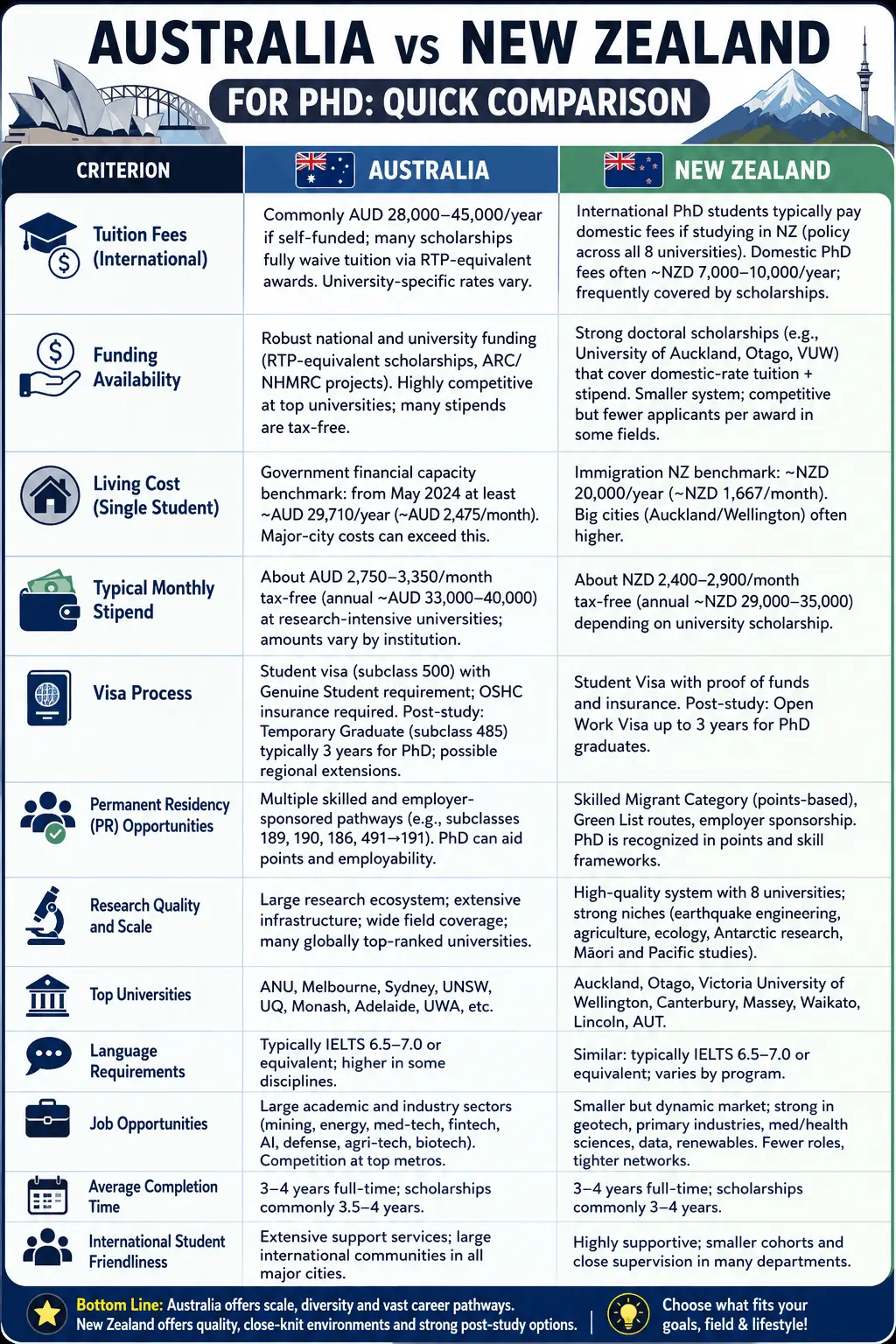
    Australia vs New Zealand for PhD: Quick Comparison

    Criterion Australia New Zealand
    Tuition Fees (International) Commonly AUD 28,000–45,000/year if self-funded; many scholarships fully waive tuition via RTP-equivalent awards. University-specific rates vary. International PhD students typically pay domestic fees if studying in NZ (policy across all 8 universities). Domestic PhD fees often ~NZD 7,000–10,000/year; frequently covered by scholarships.
    Funding Availability Robust national and university funding (RTP-equivalent scholarships, ARC/NHMRC projects). Highly competitive at top universities; many stipends are tax-free. Strong doctoral scholarships (e.g., University of Auckland, Otago, VUW) that cover domestic-rate tuition + stipend. Smaller system; competitive but fewer applicants per award in some fields.
    Living Cost (Single Student) Government financial capacity benchmark: from May 2024 at least ~AUD 29,710/year (~AUD 2,475/month). Major-city costs can exceed this. Immigration NZ benchmark: ~NZD 20,000/year (~NZD 1,667/month). Big cities (Auckland/Wellington) often higher.
    Typical Monthly Stipend About AUD 2,750–3,350/month tax-free (annual ~AUD 33,000–40,000) at research-intensive universities; amounts vary by institution. About NZD 2,400–2,900/month tax-free (annual ~NZD 29,000–35,000) depending on university scholarship.
    Visa Process Student visa (subclass 500) with Genuine Student requirement; OSHC insurance required. Post-study: Temporary Graduate (subclass 485) typically 3 years for PhD; possible regional extensions. Student Visa with proof of funds and insurance. Post-study: Open Work Visa up to 3 years for PhD graduates.
    Permanent Residency (PR) Opportunities Multiple skilled and employer-sponsored pathways (e.g., subclasses 189, 190, 186, 491→191). PhD can aid points and employability. Skilled Migrant Category (points-based), Green List routes, employer sponsorship. PhD is recognized in points and skill frameworks.
    Research Quality and Scale Large research ecosystem; extensive infrastructure; wide field coverage; many globally top-ranked universities. High-quality system with 8 universities; strong niches (earthquake engineering, agriculture, ecology, Antarctic research, Māori and Pacific studies).
    Top Universities ANU, Melbourne, Sydney, UNSW, UQ, Monash, Adelaide, UWA, etc. Auckland, Otago, Victoria University of Wellington, Canterbury, Massey, Waikato, Lincoln, AUT.
    Language Requirements Typically IELTS 6.5–7.0 or equivalent; higher in some disciplines. Similar: typically IELTS 6.5–7.0 or equivalent; varies by program.
    Job Opportunities Large academic and industry sectors (mining, energy, med-tech, fintech, AI, defense, agri-tech, biotech). Competition at top metros. Smaller but dynamic market; strong in geotech, primary industries, med/health sciences, data, renewables. Fewer roles, tighter networks.
    Average Completion Time 3–4 years full-time; scholarships commonly 3.5–4 years. 3–4 years full-time; scholarships commonly 3–4 years.
    International Student Friendliness Extensive support services; large international communities in all major cities. Highly supportive; smaller cohorts and close supervision in many departments.

    Funding Opportunities

    Both countries offer competitive funding, but mechanisms and typical award sizes differ.

    Australia

    Most international PhD candidates target university-administered, government-backed Research Training Program (RTP)-equivalent scholarships. These usually include a tuition fee offset and a living stipend that is generally tax-free. Typical stipends at research-intensive universities range around AUD 33,000–40,000 per year depending on the institution and project.

    • Examples: University of Sydney Research Training Program/University Scholarship lists a stipend in the ~AUD 40,000/year range; University of Melbourne and ANU also offer competitive stipends around ~AUD 36,000–37,000+ per year. Amounts are indexed and vary by year and institution.
    • Project funding often comes via national councils such as the Australian Research Council (ARC) and National Health and Medical Research Council (NHMRC).

    Official resources:

    New Zealand

    New Zealand’s standout feature is that international PhD candidates typically pay domestic-rate tuition if they live in New Zealand and their research is primarily conducted there. Most doctoral scholarships cover the domestic tuition fee plus a stipend. Typical annual stipends fall roughly in the NZD 29,000–35,000 range.

    • Examples: University of Auckland Doctoral Scholarship (tuition at domestic rate + stipend ~NZD 30,000); University of Otago Doctoral Scholarship (tuition + stipend, often above NZD 30,000); Victoria University of Wellington Doctoral Scholarship (tuition + stipend around the high-20s to low-30s thousands).

    Official resources:

    Advantages and Disadvantages

    • Australia – Advantages: Larger pool of funded supervisors and major grants; higher top-end stipends at some universities; broad field coverage.
    • Australia – Disadvantages: Tuition can be high if unfunded; scholarship competition is intense at Group of Eight (Go8) universities.
    • New Zealand – Advantages: Domestic-rate tuition for international PhDs; many doctoral scholarships waive tuition entirely; closer supervisory contact in smaller departments.
    • New Zealand – Disadvantages: Fewer total positions and projects; niche fields may have limited capacity.

    Which is better? If you need a guaranteed tuition waiver and prefer a smaller, close-knit research environment, New Zealand is attractive. If you want access to a large research ecosystem, multiple large grants, and potentially higher stipends at top institutions, Australia often wins—provided you secure funding.

    Research Opportunities

    Australia

    Australia’s research landscape is large and internationally connected. You’ll find world-class labs across STEM, medicine, social sciences, and humanities. Strategic strengths include medical and health sciences, data science/AI, energy and minerals, climate and marine science, agriculture and biosecurity, and defense/aerospace. Beyond ARC and NHMRC, collaborative structures like Cooperative Research Centres (CRCs) align academia with industry.

    New Zealand

    New Zealand punches above its weight in specific niches: earthquake engineering and geoscience, agriculture and food science, ecology and conservation biology, Antarctic and Southern Ocean research, renewable energy, and indigenous (Māori and Pacific) studies. The system’s size fosters close collaboration and mentorship, which many doctoral candidates value.

    Major Funding Agencies

    Which is better? For breadth and scale, Australia. For targeted strengths (e.g., seismic engineering, ecology) and a tight mentorship model, New Zealand is compelling.

    Cost of Living

    Australia

    The Australian Government’s student visa financial capacity requirement increased in 2024 to at least AUD 29,710 per year for living costs. Actual spending in Sydney, Melbourne, or Brisbane can exceed this depending on rent and lifestyle.

    • Indicative monthly costs (major cities): AUD 2,200–3,000 for shared housing, transport, food, utilities, and incidentals. Single-student studios or central locations cost more.
    • Health insurance: Overseas Student Health Cover (OSHC) is mandatory for student visa holders.

    Official resources:

    New Zealand

    Immigration New Zealand’s living cost benchmark for tertiary students is generally NZD 20,000 per year. Auckland and Wellington are pricier than smaller cities like Christchurch or Dunedin.

    • Indicative monthly costs (Auckland/Wellington): NZD 1,800–2,600 for shared housing, transport, food, utilities, and incidentals.
    • Insurance: Most universities require approved medical and travel insurance for international students.

    Official resources:

    Which is better? On baseline requirements, New Zealand often looks cheaper. However, stipends also differ by currency and level. Always build a city-specific budget and compare net stipend after likely rent.

    Visa Process and Post-Study Work

    Australia

    • Student visa (subclass 500): Requires Genuine Student (GS) criterion, English proficiency, financial capacity, and OSHC. See official guidance.
    • Post-study work: PhD graduates are typically eligible for the Temporary Graduate visa (subclass 485, Post-Study Work stream) of about 3 years; additional regional extensions of 1–2 years may apply if you studied and lived in eligible regional areas. See official 485 information.

    New Zealand

    • Student Visa: Requires an offer of place, sufficient funds (generally NZD 20,000/year), and approved insurance. See Immigration NZ.
    • Post-study work: PhD graduates can usually obtain a Post-study Work Visa for up to 3 years with open work rights. See official post-study work information.

    Which is better? For PhD holders, both offer around 3 years of post-study work. Australia’s regional incentives may extend stay length; New Zealand’s open work visa simplifies employer changes.

    Permanent Residency Opportunities

    Australia

    PhD graduates pursue skilled or employer-sponsored pathways. Common routes include Skilled Independent (subclass 189), Skilled Nominated (190), Employer Nomination Scheme (186), and regional pathways (491 leading to 191). A completed Australian qualification can help with points and employability, but eligibility depends on occupation lists, skills assessments, English, and current policy settings.

    Official resources:

    New Zealand

    Key routes include the Skilled Migrant Category Resident Visa (points-based) and Green List pathways for designated occupations, along with employer-assisted residence from an Accredited Employer Work Visa (AEWV). A PhD is favorably recognized under qualification frameworks, but eligibility still hinges on occupation, earnings thresholds, and points.

    Official resources:

    Which is better? It depends on your occupation and where you find employment. Both systems favor in-demand skills and higher-earning roles.

    Career Opportunities After Graduation

    Academic Careers

    • Australia: Larger university sector and research institutes mean more total openings for postdocs and teaching/research fellows, especially in major metros. Competition remains strong and often requires publications, grant activity, and teaching experience. Typical academic salary bands vary by institution and level, with superannuation benefits common.
    • New Zealand: Fewer positions but a tight-knit community can accelerate visibility. Strong niches (e.g., geosciences, ecology) may offer targeted roles. Competitive publication and grant records are essential.

    Industry Careers

    • Australia: Substantial demand in mining/resources, med-tech and pharmaceuticals, biotech, agri-tech, fintech, AI/data science, cybersecurity, and defense/aerospace. Large private R&D labs and government agencies (e.g., CSIRO) broaden options.
    • New Zealand: Growing opportunities in agri-food, environmental tech, data and digital, renewable energy, and niche deep-tech startups. Networks matter; internships and industry-linked projects help.

    Visa Pathways and Salaries

    Post-study work periods (~3 years) in both countries give time to build a local track record. Employer sponsorship can be pivotal. Salary levels are generally higher in Australia in absolute terms, but costs are also higher in major cities. Always assess real take-home relative to rent and transport in your specific city.

    Which is better? For sheer breadth of roles and corporate R&D, Australia. For targeted niches aligned with NZ’s strengths and a balanced lifestyle, New Zealand.

    Best Universities

    Australia

    • Australian National University (ANU)
    • University of Melbourne
    • University of Sydney
    • University of New South Wales (UNSW Sydney)
    • University of Queensland (UQ)
    • Monash University
    • University of Adelaide
    • University of Western Australia (UWA)

    Rankings vary by discipline, but multiple Australian universities appear high in global rankings (QS, THE). Always check department-level performance, supervisor fit, and lab resources.

    New Zealand

    • University of Auckland
    • University of Otago
    • Victoria University of Wellington
    • University of Canterbury
    • Massey University
    • University of Waikato
    • Lincoln University
    • Auckland University of Technology (AUT)

    New Zealand’s eight public universities are all research-active and internationally ranked; strengths often cluster by field.

    Official ranking resources:

    Application Process

    Similarities

    • Identify potential supervisors and align your proposal with lab and departmental priorities.
    • Prepare a strong research proposal, CV, academic transcripts, publications (if any), and references.
    • Demonstrate English proficiency (IELTS/TOEFL), unless exempted by prior qualifications in English.

    Australia

    • Many programs require supervisor agreement prior to offer; scholarship rounds are typically 1–2 times per year (some rolling intakes exist).
    • For scholarships, competitive metrics include publications, research experience, awards, and fit with funded projects.
    • Check university pages for RTP-equivalent scholarship deadlines and documentary requirements.

    New Zealand

    • Supervisor match is critical; most universities operate centralized doctoral scholarship rounds.
    • Because international PhDs pay domestic fees, universities carefully match candidates to available supervision and research capacity.
    • Funding often includes tuition waiver + stipend; timing and rounds vary by university.

    Actionable tip: Email supervisors first with a concise, evidence-based pitch (one page + CV). Tailor to ongoing grants and published work. Ask about available funding and start dates.

    Language Requirements

    Most universities in both countries set a baseline of IELTS 6.5–7.0 overall (with minimum band scores) or equivalent TOEFL iBT/PTE scores. Some disciplines (e.g., law, education, health) may require higher bands. Exemptions can apply for prior study in English; check institutional policy pages.

    Pros and Cons

    Pros of Australia

    • Large, diversified research ecosystem with substantial national funding.
    • Higher top-end stipends at leading universities in some fields.
    • Broader industry R&D and more total academic openings.
    • Multiple PR pathways and regional incentives.

    Pros of New Zealand

    • International PhDs pay domestic-rate tuition; many scholarships fully cover tuition.
    • Supportive, smaller cohorts and close supervisor engagement.
    • Strong niche strengths (earthquake engineering, ecology, agri-food, Antarctic research).
    • Open 3-year post-study work visa for PhD graduates.

    Cons of Australia

    • High tuition if unfunded; competitive scholarships at top institutions.
    • Higher living costs in major metros.
    • Visa and migration settings change periodically; must monitor occupation lists.

    Cons of New Zealand

    • Smaller job market; fewer total academic and industry roles.
    • Niche capacity can limit options if your field is not a national strength.
    • Fewer large-scale facilities compared with Australia.

    Which Option is Best for You?

    • Students with limited budgets: New Zealand often wins due to domestic-rate tuition for international PhDs and scholarships that cover fees plus stipend.
    • Biomedical researchers: Australia’s scale, hospitals, medical institutes, and NHMRC-backed labs can offer more options; NZ still offers quality training with HRC-backed projects.
    • Engineering students: For mining, energy, defense/aerospace, and large infrastructure, Australia; for earthquake engineering and geotech, New Zealand is globally respected.
    • Long-term immigration goals: Both work; choose the market where your occupation is in demand. Australia offers multiple skilled and employer-sponsored routes; NZ has Skilled Migrant and Green List pathways.
    • Industry careers: Australia’s corporate R&D and sector breadth are advantageous. NZ suits those targeting agri-tech, environmental tech, and select deep-tech niches.
    • Academic careers: Australia has more total openings but higher competition. NZ offers strong mentorship and visibility in smaller systems.

    Bottom line: Choose the ecosystem that best fits your field’s strengths and your funding chances. For many budget-conscious candidates, New Zealand’s domestic-rate PhD is hard to beat; for scale and breadth, Australia shines.

    Expert Tips

    • Start with the supervisor, not the country. A well-matched mentor and funded project often outweigh small cost differences.
    • Apply to multiple universities across both countries to maximize scholarship odds. Tailor your proposal to active grants.
    • Budget in local currency. Compare net stipend after rent and transport in your target city.
    • Check official immigration pages every few months. Policy updates can affect post-study work and PR timing.
    • Use department seminars or online talks to build rapport before applying. Ask about lab resources and project deliverables.
    • Secure strong references that speak to research independence, methods, and publication potential.
    • Demonstrate impact: link your proposal to national research priorities (e.g., health, climate, advanced manufacturing).
    • Plan publications early with your supervisor: set milestones for first-year outputs and conference presentations.

    External Resources (Official)

    Internal Links

    Frequently Asked Questions

    1) Is Australia or New Zealand cheaper for a PhD?

    Often New Zealand, because international PhD students usually pay domestic-rate tuition and many scholarships cover fees plus a stipend. However, costs vary by city and housing. In Australia, scholarships frequently waive tuition and offer competitive stipends; without funding, Australia is usually more expensive.

    2) What are typical PhD stipends in Australia vs New Zealand?

    Australia: commonly around AUD 33,000–40,000/year tax-free at research-intensive universities. New Zealand: commonly around NZD 29,000–35,000/year tax-free. Exact figures depend on the institution, discipline, and year.

    3) How long does a PhD take in each country?

    Typically 3–4 years full-time in both Australia and New Zealand. Many scholarships fund 3.5–4 years in Australia and 3–4 years in New Zealand.

    4) What are the English language requirements?

    Most programs require IELTS 6.5–7.0 (or equivalent TOEFL/PTE), with minimum sub-scores. Some disciplines need higher scores. Exemptions may apply for prior English-medium study.

    5) What post-study work rights do PhD graduates have?

    Australia: generally 3 years via the Temporary Graduate (subclass 485) visa, with possible regional extensions. New Zealand: up to 3 years open Post-study Work Visa for PhD graduates.

    6) Can a PhD help with permanent residency?

    Yes, in both countries, but PR depends on occupation demand, points, earnings thresholds, English, and other requirements. Review Australia’s skilled and employer-sponsored pathways and New Zealand’s Skilled Migrant and Green List routes for current criteria.

    7) Which is better for engineering research?

    Australia offers broad engineering options and industry links (mining, energy, aerospace). New Zealand is world-class in earthquake engineering and geotech. Choose based on project fit and supervisor.

    8) Which is better for life sciences and medicine?

    Australia has a larger biomedical ecosystem with hospitals and NHMRC-backed institutes, creating more lab options. New Zealand provides strong training environments, especially aligned with HRC and niche strengths. Supervisor and facility match should drive your choice.

    9) Do international PhD students in New Zealand really pay domestic fees?

    Yes, provided you reside in New Zealand and your research is primarily conducted there (policy is applied across NZ’s eight universities). Always check the latest university policy for details.

    10) How should I improve my scholarship chances?

    Secure supervisor support early, tailor your proposal to funded projects and national priorities, highlight publications and methods expertise, and apply to multiple institutions across both countries.

    Conclusion: Australia vs New Zealand for PhD

    Both destinations are excellent for doctoral study. Australia offers scale, breadth of labs and grants, and broad industry R&D—ideal if you secure a strong scholarship and want diverse career options. New Zealand offers domestic-rate tuition for international PhDs, scholarships that often cover fees and living costs, and closer supervisory support—ideal for budget-conscious candidates and those targeting NZ’s research niches.

    • Choose Australia if you want a large ecosystem, higher top-end stipends at leading universities, and wider industry pathways across multiple sectors.
    • Choose New Zealand if you value domestic-rate tuition, strong chances of a tuition-waiver scholarship, close mentorship, and strengths in earthquake engineering, ecology, agri-food, or Antarctic research.

    In short, the best choice in the Australia vs New Zealand for PhD decision depends on supervisor fit, funding security, city-level costs, and where your field has the strongest labs and employment demand.

    About IR Research Publication

    IR Research Publication is dedicated to helping scholars, students, and professionals advance their academic and research careers. We share practical guidance on publishing, proposal development, scholarships, and career strategy—bridging research excellence with real-world impact. Explore curated insights, templates, and resources to strengthen every stage of your research journey.

    Related Articles

  • Highest-Paying Postdoctoral Fellowships Worldwide (2026)

    Highest-Paying Postdoctoral Fellowships Worldwide (2026)

    Introduction

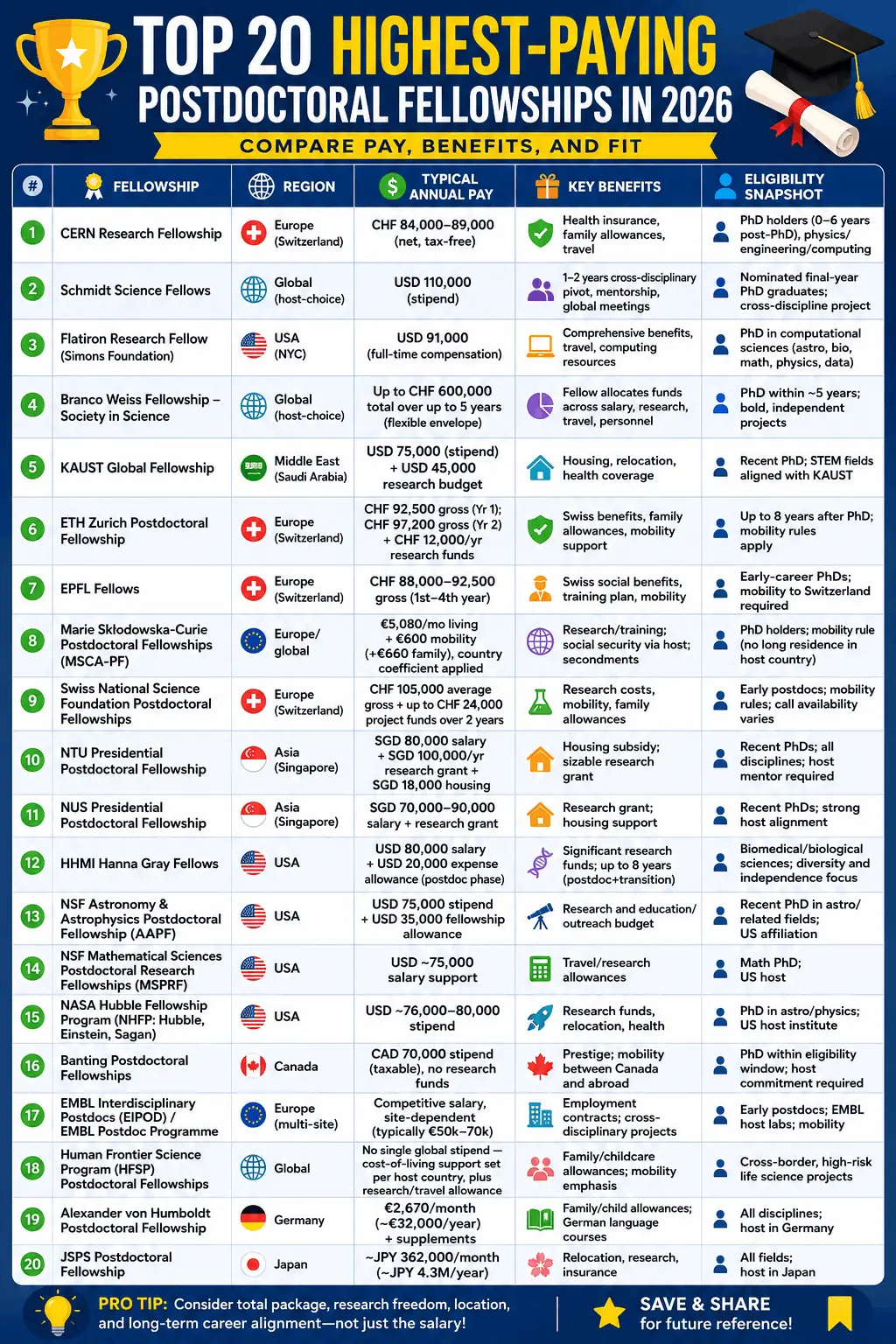
    The race for the highest-paying postdoctoral fellowships is more competitive than ever. Beyond prestige, these awards provide real advantages: higher take-home pay, generous research and travel budgets, relocation and family allowances, excellent health coverage, and stronger placement pathways into faculty or industry research roles.

    Who should read this guide? Final-year PhD candidates, current postdocs seeking a better-funded move, PIs advising mentees, and international researchers comparing salary and benefits across countries. Because eligibility, taxes, and benefits differ widely by region and host institution, this article highlights how programs vary in practice and how to choose the best fit.

    Common pitfalls include chasing a single “dream” program, underestimating lead times for letters and visas, misaligning your host’s expertise with your proposal, and presenting budgets or timelines that panels find unrealistic. We help you avoid these pitfalls with a step-by-step plan.

    A note on figures in this guide: all stipend and salary amounts below reflect verified 2026 call data where available. Some are quoted gross (before tax and social contributions), others net (after tax, or tax-free), so we flag this for each program — always confirm the exact figure and tax treatment on the official page before you plan your budget.

    Quick Summary Table

    TopicRecommendationCommon MistakeBest Practice
    Targeting programsApply to 5–8 well-matched, high-paying fellowships across regions.Applying to 1–2 “dream” awards only.Portfolio approach based on fit, pay, and odds; diversify by region and sponsor type.
    Host alignmentChoose hosts with recent, citable outputs directly enabling your project.Picking hosts by brand name alone.Demonstrate unique synergy and concrete co-mentoring/training opportunities.
    Budget and payModel gross vs. net pay, benefits, and cost-of-living by city.Ignoring taxes, social insurance, and currency swings.Use official calculators and include allowances and family benefits in comparisons.
    TimelineStart 6–8 months before the deadline.Last-minute reference requests.Back-schedule deliverables; pre-book letter writers and compliance (ethics/visa).
    Proposal designFocus on training outcomes, independence, and method feasibility.Long literature summaries without a clear plan.Provide milestones, risks, alternatives, and measurable outputs.
    Review criteriaMap each section to published scoring rubrics.Assuming the panel will “get it.”Use headings mirroring criteria; include a one-page review response checklist.
    Letters of supportSecure detailed, specific letters with mentoring and integration plans.Generic letters repeating your CV.Send letter writers bullet prompts and submission reminders early.
    InterviewsPrepare a 60–90 second “fundable idea” pitch and 1–2 slide storyboard.Overloading with technical detail.Lead with problem importance, novelty, impact, and feasibility.
    CompliancePre-clear ethics/IRB/IBC/animal protocols and data agreements.Deferring compliance until award stage.State approvals and data-sharing plans in the application.
    Backup plansLine up host-funded or bridge options.All-or-nothing fellowship dependence.Negotiate host guarantees (lab access, interim pay) contingent on results.

    Which postdoctoral fellowships pay the most? Quick answer

    The following programs are consistently among the highest-paying postdoctoral fellowships worldwide, based on verified 2026 figures (always confirm final call details on official pages):

    • CERN Research Fellowships (Switzerland): CHF 7,004–7,425/month, net and tax-free — approximately CHF 84,000–89,000/year, plus family and travel allowances.
    • Schmidt Science Fellows (global): USD 110,000/year stipend for the 2026 cohort, up to 2 years, plus mentorship and global meetings.
    • Branco Weiss Fellowship – Society in Science (global): up to CHF 600,000 total funding over up to 5 years — a flexible envelope fellows allocate across salary, research, travel, and personnel, not a fixed annual salary.
    • ETH Zurich Postdoctoral Fellowship (Switzerland): CHF 92,500 gross in year 1, rising to CHF 97,200 gross in year 2, plus CHF 12,000/year in research funds.
    • EPFL Fellows (Switzerland): CHF 88,000–92,500/year gross (1st–4th year) plus Swiss social benefits.
    • SNSF Swiss Postdoctoral Fellowships (Switzerland): this transitional scheme has been discontinued now that Switzerland has rejoined MSCA — it used to average CHF 105,000/year gross, but researchers should apply to MSCA-PF directly for a Swiss placement now.
    • HHMI Hanna Gray Fellows (USA): USD 80,000/year salary plus a USD 20,000 expense allowance during the postdoc phase.
    • KAUST Global Fellowship (Saudi Arabia): USD 75,000/year stipend, plus a USD 45,000 research budget, housing, and relocation support.
    • NTU Presidential Postdoctoral Fellowship (Singapore): SGD 80,000/year salary, plus an SGD 100,000/year research grant and SGD 18,000 housing allowance.
    • Marie Skłodowska-Curie Postdoctoral Fellowships (Europe/Global): living allowance €5,080/month + mobility €600 (+ family €660 if eligible), adjusted by country coefficient.
    • NSF Astronomy & Astrophysics Postdoctoral Fellowship (USA): USD 75,000/year stipend plus a USD 35,000 fellowship allowance.
    • Flatiron Research Fellow (Simons Foundation, USA): USD 91,000/year full-time compensation, plus comprehensive benefits.

    Top 20 highest-paying postdoctoral fellowships in 2026 (compare pay, benefits, and fit)

    Amounts reflect verified 2026 call data where confirmed; where not yet published for 2026, the most recent verified figures are used and flagged. “Typical annual pay” indicates whether the amount is gross, net, or a flexible multi-year envelope — always confirm on official pages.

    FellowshipRegionTypical Annual PayKey BenefitsEligibility SnapshotUsual Deadline WindowOfficial Link
    CERN Research FellowshipEurope (Switzerland)CHF 84,000–89,000 (net, tax-free)Health insurance, family allowances, travelPhD holders (0–6 years post-PhD), physics/engineering/computingRolling calls; several cycles per yearcareers.cern
    Schmidt Science FellowsGlobal (host-choice)USD 110,000 (stipend)1–2 years cross-disciplinary pivot, mentorship, global meetingsNominated final-year PhD graduates; cross-discipline projectInstitutional nominations mid-year; finals in Q4schmidtsciencefellows.org
    Flatiron Research Fellow (Simons Foundation)USA (NYC)USD 91,000 (full-time compensation)Comprehensive benefits, travel, computing resourcesPhD in computational sciences (astro, bio, math, physics, data)Varies by center; typically Q3–Q4simonsfoundation.org/flatiron
    Branco Weiss Fellowship – Society in ScienceGlobal (host-choice)Up to CHF 600,000 total over up to 5 years (flexible envelope)Fellow allocates funds across salary, research, travel, personnelPhD within ~5 years; bold, independent projectsCall typically opens Q1; deadline ~Aprilbrancoweissfellowship.org
    KAUST Global FellowshipMiddle East (Saudi Arabia)USD 75,000 (stipend) + USD 45,000 research budgetHousing, relocation, health coverageRecent PhD; STEM fields aligned with KAUSTAnnual calls; often Q3–Q4KAUST Global Fellowship Program
    ETH Zurich Postdoctoral FellowshipEurope (Switzerland)CHF 92,500 gross (Yr 1); CHF 97,200 gross (Yr 2) + CHF 12,000/yr research fundsSwiss benefits, family allowances, mobility supportUp to 8 years after PhD; mobility rules applyTwo rounds/year (spring and fall)ETH Fellows
    EPFL FellowsEurope (Switzerland)CHF 88,000–92,500 gross (1st–4th year)Swiss social benefits, training plan, mobilityEarly-career PhDs; mobility to Switzerland requiredTypically one deadline/year (spring)EPFL Postdocs
    Marie Skłodowska-Curie Postdoctoral Fellowships (MSCA-PF)Europe/global€5,080/mo living + €600 mobility (+€660 family), country coefficient appliedResearch/training; social security via host; secondmentsPhD holders; mobility rule (no long residence in host country)Annual EU call; deadline typically SepMSCA Postdoctoral Fellowships
    Swiss National Science Foundation Postdoctoral FellowshipsEurope (Switzerland)Discontinued — was CHF 105,000 average gross + up to CHF 24,000 project funds over 2 yearsResearch costs, mobility, family allowancesThis transitional scheme has been sunset now that MSCA is available again in Switzerland since 2025; researchers should apply directly to MSCA-PF insteadScheme closedSNSF programme page (status)
    NTU Presidential Postdoctoral FellowshipAsia (Singapore)SGD 80,000 salary + SGD 100,000/yr research grant + SGD 18,000 housingHousing subsidy; sizable research grantRecent PhDs; all disciplines; host mentor requiredUsually Q1–Q2NTU PPF
    NUS Presidential Postdoctoral FellowshipAsia (Singapore)SGD 70,000–90,000 salary + research grantResearch grant; housing supportRecent PhDs; strong host alignmentTypically Q1–Q2NUS Programmes
    HHMI Hanna Gray FellowsUSAUSD 80,000 salary + USD 20,000 expense allowance (postdoc phase)Significant research funds; up to 8 years (postdoc+transition)Biomedical/biological sciences; diversity and independence focus; from the 2028 competition (opening Nov 2026) selection merges with the Freeman Hrabowski Scholars ProgramAnnual; usually Q1 (2028 cycle opens Nov 2026)HHMI Hanna H. Gray Fellows
    NSF Astronomy & Astrophysics Postdoctoral Fellowship (AAPF)USAUSD 75,000 stipend + USD 35,000 fellowship allowanceResearch and education/outreach budgetRecent PhD in astro/related fields; US affiliationAnnual; usually Q4NSF AAPF
    NSF Mathematical Sciences Postdoctoral Research Fellowships (MSPRF)USAUSD ~75,000 salary supportTravel/research allowancesMath PhD; US hostAnnual; typically Q4–Q1NSF MSPRF
    NASA Hubble Fellowship Program (NHFP: Hubble, Einstein, Sagan)USAUSD ~76,000–80,000 stipendResearch funds, relocation, healthPhD in astro/physics; US host instituteAnnual; Sep–NovNHFP
    Canada Postdoctoral Research Award (CPRA) — replaces BantingCanadaCAD 70,000/year (taxable), 24-month termPrestige; part of the harmonized Canada Research Training Awards SuiteThe Banting Postdoctoral Fellowship’s final competition was 2024–25; it has been folded into CPRA, which runs through CIHR, NSERC, or SSHRC depending on field. PhD within eligibility window; host commitment requiredAnnual; check the relevant tri-agency streamCPRA (NSERC)
    EMBL Interdisciplinary Postdocs (EIPOD) / EMBL Postdoc ProgrammeEurope (multi-site)Competitive salary, site-dependent (typically €50k–70k)Employment contracts; cross-disciplinary projectsEarly postdocs; EMBL host labs; mobilityCycles vary by site/programEMBL Postdoctoral Programme
    Human Frontier Science Program (HFSP) Postdoctoral FellowshipsGlobalNo single global stipend — cost-of-living support set per host country, plus research/travel allowanceFamily/childcare allowances; mobility emphasisCross-border, high-risk life science projectsAnnual; typically Aug pre-reg, Sep fullHFSP Postdoctoral Fellowships
    Alexander von Humboldt Postdoctoral FellowshipGermany€2,670/month (~€32,000/year) + supplementsFamily/child allowances; German language coursesAll disciplines; host in GermanyRollingHumboldt Research Fellowship
    JSPS Postdoctoral FellowshipJapan~JPY 362,000/month (~JPY 4.3M/year)Relocation, research, insuranceAll fields; host in JapanMultiple rounds/yearJSPS Fellowships

    A few important clarifications:

    • CERN figures are net and tax-free, while ETH Zurich, EPFL, and SNSF figures are gross — meaning cantonal/federal tax and social contributions come out before you see the money. Don’t compare them at face value.
    • Branco Weiss is not a fixed annual salary. It’s a flexible, multi-year funding envelope of up to CHF 600,000 that fellows can allocate across their own salary, research costs, travel, and personnel over as long as 5 years.
    • HFSP does not publish one global stipend figure. Awards are set relative to the cost of living in the host country, so the “take-home” amount varies significantly depending on where you’re placed.
    • SNSF Swiss Postdoctoral Fellowships was a transitional scheme for researchers who wanted a Switzerland-based MSCA-style fellowship while Switzerland was a non-associated third country in Horizon Europe. Now that Switzerland has rejoined MSCA (since early 2025), the SNSF scheme has been discontinued — apply to MSCA-PF directly for a Switzerland placement instead.
    • Banting Postdoctoral Fellowships ran their final competition in 2024–25 and have been folded into the new harmonized Canada Postdoctoral Research Award (CPRA), part of the Canada Research Training Awards Suite. The pay level (CAD 70,000/year) and duration carry over, but applicants now go through CIHR, NSERC, or SSHRC depending on their field rather than a standalone “Banting” competition.

    How to choose among the highest-paying postdoctoral fellowships

    Beyond headline pay, compare the following:

    • Cost of living and taxes: CHF 90k gross in Zurich, USD 90k in the US, and SGD 90k in Singapore all net out very differently. Use official tax calculators, and factor in whether health insurance and social contributions are employer-covered.
    • Gross vs. net vs. envelope: As shown above, some awards (CERN) are quoted net and tax-free, others (ETH, EPFL, SNSF) are gross, and some (Branco Weiss) are multi-year flexible funding rather than a fixed salary. Normalize before comparing.
    • Benefits: Housing subsidies (common in the Middle East and Singapore), family allowances (CERN, MSCA, SNSF), research budgets (Schmidt, KAUST, NTU/NUS, NSF, NHFP, HHMI), and travel support can outweigh stipend differences.
    • Eligibility windows: Some restrict years since PhD (HFSP, MSCA, CERN), mobility rules (MSCA, SNSF, EPFL/ETH), or host nationality/residency constraints (NSF, NIH).
    • Career outcomes: Programs with strong alumni networks (CERN, MSCA, Schmidt, Flatiron, NHFP) often correlate with strong placement into faculty or high-impact industry roles.

    Step-by-step guide to winning a top-paying postdoc in 9 steps

    Step 1: Build a targeted list (5–8 programs)

    Use a portfolio strategy: 2–3 “reach” awards (e.g., Schmidt, Branco Weiss, Flatiron), 2–3 strong matches (MSCA, ETH/EPFL, NHFP, NSF), and 1–2 safety options (institutional or national schemes with higher success rates). Track pay, benefits, deadlines, eligibility, and document requirements in a simple spreadsheet — and note whether each figure is gross, net, or an envelope.

    Step 2: Validate host fit early

    • Write a 150-word “fit statement” that links your methods to the host’s recent 2–3 papers.
    • Secure a primary mentor and, if allowed, a co-mentor in a complementary area (panels reward cross-training).
    • Confirm lab capacity: bench space, compute/GPU access, datasets, cohorts, field sites.

    Step 3: Pre-flight compliance and logistics

    • Human/animal research: IRB/IACUC or ethics approvals. For data-sharing across borders, add a DUA/GDPR plan.
    • Visa and start date windows: some awards require starting within 6–12 months of the offer.
    • Budget alignment: clarify who pays fringe, tuition-like fees, and overheads (if any).

    Step 4: Design a fundable research and training plan

    Panels want independence and feasibility. Organize your plan as follows:

    • Problem and significance: 1–2 paragraphs with concrete gaps and societal/field impact.
    • Innovation: what is new (algorithm, assay, dataset, theory) and why it matters now.
    • Approach: 2–3 aims with methods, timelines, and objective milestones.
    • Risks and alternatives: 2–3 credible fallbacks per aim.
    • Training gains: new techniques, co-mentorship, coursework, industry/clinical rotations.
    • Outputs: target journals, preprint policy, code/data release, seminars, teaching.

    Step 5: Present a clear calendar and Gantt-like milestones

    • Quarterly milestones, each ending with a tangible output (preprint, dataset, prototype).
    • Reserve 10–15% time for career development: grantwriting, pedagogy, leadership.
    • Include an explicit manuscript and conference plan to demonstrate productivity cadence.

    Step 6: Write for evaluators, not insiders

    • Use short paragraphs, descriptive headings mirroring the scoring rubric, and figures only if allowed.
    • Lead each Aim with 1–2 sentences on hypothesis/goal before technical details.
    • Include a one-paragraph “Why now at this host?” statement.

    Step 7: Optimize letters of support

    Provide letter writers with bullet prompts and a draft of your one-page summary. Ask them to address:

    • Your independence and originality beyond the PhD supervisor’s line.
    • Evidence of project feasibility in 24–36 months.
    • Concrete mentoring and integration plan (lab meetings, co-mentoring, annual reviews).

    Step 8: Mock interviews and chalk talks

    • Prepare a 60–90 second pitch: Problem → Innovation → Feasibility → Impact.
    • Anticipate 6–8 FAQs: novelty, risks, data access, ethical approvals, contingency, independence from PI, timeline realism.
    • Practice with non-specialists to ensure clarity.

    Step 9: Submission quality control

    • Run a final checklist against the sponsor’s scoring criteria.
    • Confirm file names, page limits, margins, and font rules; submit 24–48 hours before deadline.
    • Save a PDF of the submission confirmation.

    Salary, taxes, and benefits: country-by-country considerations

    • Switzerland: High gross pay; excellent social benefits; taxes vary by canton. CERN is the exception — its stipend is net and tax-free, while ETH, EPFL, and SNSF figures are gross.
    • United States: Stipends may be taxable; benefits and health insurance differ by host; NIH NRSA scale sets a floor but many high-end fellowships (HHMI, Flatiron) exceed it.
    • European Union: Many awards are employment contracts with social security; MSCA uses country correction coefficients for cost of living.
    • Middle East (e.g., KAUST): High stipend plus a separate research budget, furnished housing, and relocation; often tax-free personal income; strong research support.
    • Singapore: Competitive salary plus housing support and sizable, separately budgeted research grants; personal taxes relatively low; CPF does not usually apply to foreign postdocs.
    • Japan and Germany: Solid benefits and stability; base stipends may be lower but cost of living and social protection can balance the package.

    Timelines: a month-by-month application planner

    • Months −8 to −7: Identify 5–8 programs; contact hosts; gather eligibility facts.
    • Months −6 to −5: Draft 2-page concept note; secure mentor buy-in; outline training plan.
    • Month −4: Full proposal draft; internal peer reviews; budget alignment.
    • Month −3: Finalize letters; obtain necessary pre-approvals (IRB/IACUC/DUA).
    • Month −2: Polish narrative; prepare lay summary and DEI statements if required.
    • Month −1: Compliance check, formatting, and portal rehearsal submission.
    • Week −2: Submit; confirm references received; archive all files.

    Email templates and document outlines

    Cold email to a potential postdoc host

    Subject: Prospective postdoc and fellowship application (Your Name – Target Award)

    Dear Prof. [Last Name],

    I am a final-year PhD candidate at [University] working on [1-sentence problem]. I plan to apply for the [Fellowship Name] (deadline [Date]) and would value the opportunity to pursue this project in your group, building on your work in [Specific Paper or Method].

    In brief, my proposed project aims to [1–2 sentences on novelty and aims]. I attach a 1-page summary and 2 representative publications. If this aligns with your interests, could we schedule a 20-minute call to discuss fit, training opportunities, and logistics?

    Thank you for considering, and I would be delighted to provide any additional materials.

    Sincerely, [Your Name], PhD Candidate [Website/Google Scholar | ORCID | Contact]

    CV outline for top-paying fellowships

    • Header: Name, degrees, current affiliation, contact, ORCID, website.
    • Research focus: 3–4 bullet statements (methods, domains, key contributions).
    • Publications: separate peer-reviewed articles, preprints, and in-preparation; indicate equal contributions; include DOIs.
    • Awards and funding: fellowships, grants, best-paper awards.
    • Teaching/mentoring: guest lectures, TA roles, mentorship of students.
    • Outreach and leadership: open-source software, datasets, outreach talks, DEI activities.
    • References: 3–4 with emails and roles (PhD advisor, collaborator, external).

    Statement of Purpose (one-page) outline

    • Why this fellowship: fit to mission and criteria.
    • Your trajectory: key results, skills, independence.
    • Project summary: 3–5 sentences: problem → approach → outcomes.
    • Host fit: mentoring, facilities, training, co-mentors.
    • Career plan: specific next steps and how this fellowship accelerates them.

    Research proposal outline (8–12 pages typical)

    1. Title and abstract (200–300 words).
    2. Background and significance (1–1.5 pages).
    3. Innovation and hypotheses (0.5–1 page).
    4. Aim 1 (methods, data, analysis, milestones, risks/alternatives).
    5. Aim 2 (as above).
    6. Aim 3 (optional for 3-year projects).
    7. Training plan and mentoring structure (courses, rotations, industry/clinical exposure).
    8. Open science plan (preprints, code/data sharing, reproducibility).
    9. Timeline and Gantt chart narrative.
    10. Ethics, risk, and safety considerations.
    11. References (consistent style, recent and relevant).

    Interview preparation: common questions

    • What is the single biggest risk in your project and how will you mitigate it?
    • How is this work distinct from your PhD advisor’s research?
    • What preliminary data or proof-of-concept supports feasibility?
    • What will success look like in 12, 24, and 36 months?
    • How will the host’s environment accelerate your progress?
    • What are your plans for data management, sharing, and reproducibility?
    • How will this fellowship position you for your target career (faculty/industry)?

    Cover letter template (for fellowships with employment contracts)

    Dear Members of the Selection Committee,

    I am applying to the [Fellowship Name] to pursue [project title] under the mentorship of [Host PI] at [Institution]. My doctoral work in [Field] produced [1–2 key outcomes], which provide a strong foundation for this proposal’s [methods/innovation].

    This fellowship is the best fit because [alignment with mission/criteria]. The host offers [specific facilities/training], and we have established a clear mentoring and integration plan. Over [duration], I expect to deliver [outputs], share results via [journals/conferences/open data], and undertake training in [skills].

    Thank you for your consideration. I look forward to the opportunity to contribute to the [fellowship community/lab/field].

    Sincerely, [Your Name]

    Expert Tips

    • Use award-specific language: mirror key terms from the call in headings and topic sentences.
    • Quantify ambition and feasibility: “We will benchmark on [dataset] to exceed [metric] by X%” is stronger than “We will evaluate performance.”
    • Attach host commitment: a signed, detailed support letter promising resources and supervision cadence significantly boosts credibility.
    • Leverage dual mentorship: pair a content mentor with a methods mentor (e.g., domain + AI/ML) to show cross-disciplinary training.
    • Pre-register and preprint: panels reward open science and rapid dissemination that do not jeopardize IP.
    • Pilot first: even a small pilot (n=10, prototype script, power analysis) strengthens the feasibility argument.
    • Know the pay components: some fellowships list gross amounts before employer contributions; others are net or tax-free; a few (like Branco Weiss) are multi-year envelopes rather than annual salaries. Clarify this in your comparison sheet before you plan a budget.
    • Use internal reviews: run at least one senior and one junior peer review; incorporate feedback and maintain version control.
    • Show independence: avoid overlapping aims and figures with your PhD advisor’s grants; state clearly what is yours.
    • Back-up submission: where permitted, pursue a national or institutional scheme in parallel to cover timing risk.

    Common Mistakes to Avoid

    • Ignoring mobility rules: programs like MSCA and Swiss fellowships require you not to have resided in the host country beyond specified limits.
    • Overly broad aims: panels prefer two well-defined, feasible aims over four ambitious but vague goals.
    • Missing country corrections: for MSCA, failure to apply country coefficients leads to inaccurate salary expectations.
    • Confusing gross, net, and multi-year envelopes: treating a CHF 600,000 five-year Branco Weiss award as if it were a CHF 600,000/year salary, or comparing CERN’s net stipend directly against ETH’s gross salary, will throw off your planning.
    • Generic letters: references that restate your CV without specifics can sink an application; brief writers early and provide bullets.
    • No contingency plans: absence of risks/alternatives signals lack of realism.
    • Weak host rationale: selecting a prestigious host without a direct methodological link reduces perceived feasibility and training gain.
    • Late compliance: waiting to address IRB/animal/data approvals suggests timeline naivety.
    • Poor formatting: violating page limits, fonts, or margin rules can lead to desk rejections.
    • Underestimating taxes and benefits: a higher gross stipend may net less depending on country and family status.
    • No narrative arc: a cut-and-paste methods section without a compelling problem-impact story rarely scores top marks.

    Useful Resources (official)

    Internal Links and how IR Research Publication can help

    Strengthen your applications with rigorous, citable outputs and visibility:

    Frequently Asked Questions

    Which are the highest-paying postdoctoral fellowships in 2026?

    Programs that consistently top pay scales include Schmidt Science Fellows (USD 110,000/year), Branco Weiss (up to CHF 600,000 over 5 years, flexible), ETH Zurich (CHF 92,500–97,200/year gross), EPFL Fellows (CHF 88,000–92,500/year gross), CERN Research Fellowships (CHF 84,000–89,000/year net, tax-free), and HHMI Hanna Gray Fellows (USD 80,000/year + USD 20,000 allowance). Note that the SNSF Swiss Postdoctoral Fellowships scheme, which used to average CHF 105,000/year, has been discontinued now that MSCA is available again in Switzerland — apply to MSCA-PF for a Swiss placement instead. Verify current 2026 calls, and note whether each figure is gross, net, or a multi-year total.

    How do MSCA Postdoctoral Fellowship salaries work?

    MSCA-PF provides a monthly living allowance (€5,080), mobility allowance (€600), and family allowance (€660 if eligible), all multiplied by a country correction coefficient. Amounts are before taxes and employer contributions; you are typically an employee with social security via the host.

    What is the difference between stipend and salary?

    Salary is employment income with withholdings and benefits; stipend can be tax-free or taxable depending on country and sponsor. CERN, for example, quotes a net, tax-free stipend, while ETH, EPFL, and SNSF use gross salaries. Always compare net-of-tax figures and include benefits.

    Do high-paying fellowships always include research funds?

    No. Some provide primarily salary (e.g., ETH/EPFL base pay), while others bundle a separate research budget on top of the stipend (e.g., KAUST’s USD 45,000 research budget, NTU’s SGD 100,000/year research grant, or ETH’s CHF 12,000/year research funds). Read the call to see which costs are allowed (equipment, travel, page charges) and whether the research budget is separate from your personal pay.

    How many applications should I submit?

    Most successful candidates apply to 5–8 programs across sponsors and regions. Diversification increases your odds and gives negotiation leverage with hosts.

    Can I negotiate salary or benefits?

    Stipends are usually fixed by the sponsor, but benefits and top-ups can sometimes be negotiated with the host (e.g., housing, relocation, supplementary funds, or bridging salary while awaiting results).

    What are acceptance rates like?

    Prestigious programs (Schmidt, Branco Weiss, Flatiron) may fund a small single-digit percentage of applicants. MSCA-PF and NSF postdocs often range roughly 10–15% overall, varying by panel and year. Institutional schemes can be higher. Check statistics in annual reports where available.

    When should I start preparing?

    Start 6–8 months before the deadline. Early preparation is essential for host coordination, ethics approvals, letters, and polished narratives.

    Are industry postdocs higher paying than fellowships?

    Often yes, especially in tech and biotech hubs; however, pure industry roles may trade off academic independence or teaching. This guide focuses on competitive academic or foundation-funded fellowships with strong research autonomy.

    What if I miss a major deadline?

    Line up institutional or national schemes with rolling or later deadlines, and ask your host about short-term contracts or internal bridging funds. Resubmit in the next cycle with improved preliminary data.

    Conclusion: How to act now

    The highest-paying postdoctoral fellowships offer more than salary: they accelerate independence, unlock resources, and expand networks. Start by shortlisting 5–8 awards, matching each to a host with demonstrable synergy, and scoping a focused, feasible, and high-impact project. Use the templates above to contact mentors, structure your CV and proposals, and prepare for interviews. Confirm 2026 stipend and benefits on official pages, model your net-of-tax income by city, watch for the difference between gross, net, and multi-year envelope figures, and submit at least 24–48 hours early. If you aim for the highest-paying postdoctoral fellowships, preparation 6–8 months ahead is the single biggest predictor of success.

    About IR Research Publication

    IR Research Publication is dedicated to advancing global scholarship by connecting researchers with reputable journals, rigorous peer review, and practical publishing resources. From manuscript preparation to dissemination, IR Research Publication supports early-career scientists and postdoctoral researchers in building credible, citable profiles that strengthen fellowship and grant applications. Learn more and get started at IR Research Publication.

    Related Articles

    Note: Stipends, benefits, and policies may change by the 2026 call. Always verify live details, tax treatment, and eligibility on the official fellowship pages and your prospective host’s HR office before committing.

  • Germany vs Netherlands for PhD in 2026: Costs, Funding, Language, Jobs

    Germany vs Netherlands for PhD in 2026: Costs, Funding, Language, Jobs

    Introduction: Why compare Germany vs Netherlands for PhD?

    Germany vs Netherlands for PhD is a common comparison for international researchers because both countries are research powerhouses in Europe, offer a large number of English-language doctoral projects, and provide internationally recognized training. Yet their models differ in crucial ways that affect your finances, supervision, and career outcomes.

    This guide is for master’s graduates, early-career researchers, and professionals considering a European doctorate. It is also useful for academic advisors and parents who want a precise, unbiased overview.

    The factors that usually matter most include funding model and salary, tuition and living costs, research culture and supervision, program structure and duration, visa/residence rules, language expectations, and post-PhD job opportunities (both academic and industry).

    In the next sections, you’ll learn how each country handles admissions, the realities of stipends and employment contracts, where each country excels by discipline, how to budget realistically, and what the immigration and career pathways look like after graduation—backed by official sources where possible.

    Key takeaways at a glance

    • Funding model: The Netherlands typically employs PhD candidates as full-time staff with a salary and benefits; Germany mixes salaried researcher contracts, scholarships, and some self-funded paths with very low or no tuition.
    • Tuition: Public universities in Germany usually charge no tuition for PhD (only small semester fees). In the Netherlands, employee-PhDs don’t pay tuition; external/self-funded PhDs may pay substantial tuition depending on the university.
    • Living costs: Expect moderate-to-high costs in both countries, typically higher in Dutch urban centers like Amsterdam, Utrecht, and Delft.
    • Language: Many PhDs run in English in both countries; local language may be essential for clinical or patient-facing research.
    • Post-PhD jobs: Both have strong academic and industry ecosystems; the Netherlands often provides structured development and a clear 4-year timeline, while Germany offers broad institute networks (Max Planck, Helmholtz, Fraunhofer) and an 18-month job-search period for graduates.

    Quick comparison table: Germany vs Netherlands for PhD

    Criterion Germany Netherlands
    Tuition Fees Usually no tuition at public universities for PhD; small semester contribution (€250–€350/semester varies). External/self-funded routes exist but are less common. Employee-PhDs typically pay no tuition; external/self-funded PhDs may pay tuition (often €10,000–€20,000+/year depending on university/program).
    Funding Availability Common: salaried doctoral researcher contracts (TV-L E13 at 50–100% FTE), scholarships (e.g., DAAD), DFG-funded projects, EU MSCA/ERC funding. Most PhD positions are paid employment under the Dutch Collective Labour Agreement (CAO-NU). External scholarships also possible (NWO, EU MSCA/ERC, national programs).
    Living Cost Approx. €900–€1,200/month in many cities; higher in Munich, Frankfurt, Hamburg, Berlin. Check university city specifics. Approx. €1,100–€1,600/month; higher in Amsterdam, Utrecht, Delft, Rotterdam.
    Monthly Stipend/Salary Salaried positions vary by state and %FTE under TV-L E13; scholarships like DAAD are commonly around €1,200+/month (plus benefits). Exact amounts vary. PhD employees earn a monthly salary per CAO-NU (scale P); typical gross range ~€2,700–€3,500/month over the 4-year contract (varies by university and year).
    Visa Process National visa (D) for study or research; employees typically receive a residence permit as a researcher/employee. Financial proof needed for student visas without salary. Universities usually sponsor employee PhDs; external/self-funded follow student/researcher routes. Clear processes via IND; orientation year (12-month) after graduation.
    Permanent Residency Opportunities Common route: permanent residence generally after 5 years of legal residence; Blue Card holders may qualify sooner under certain conditions. Permanent residence generally after 5 years of continuous legal residence plus integration requirements.
    Research Quality Extensive institute networks (Max Planck, Helmholtz, Fraunhofer, Leibniz) and strong universities across STEM, life sciences, and humanities. Highly ranked universities with strengths in engineering, life sciences, social sciences, and agriculture (e.g., TU Delft, Wageningen, Leiden, UvA, Utrecht).
    Top Universities LMU Munich, TUM, Heidelberg, RWTH Aachen, KIT, Humboldt, FU Berlin, Bonn, Freiburg, Göttingen; plus Max Planck and Helmholtz centers. TU Delft, Wageningen, Leiden, University of Amsterdam, Utrecht, Groningen, Eindhoven, Erasmus Rotterdam, Radboud, Maastricht, VU Amsterdam.
    Language Requirements Many PhDs offered in English; German helps for integration and is essential for some clinical or fieldwork roles. Most PhDs run fully in English; Dutch needed mainly for patient-facing or public-facing roles.
    Job Opportunities Strong academic and industry sectors; notable in automotive, chemicals, pharma/biotech, AI, manufacturing, and green tech. Excellent industry links, especially in semiconductors, high-tech systems, agriculture/food, water, and health sciences.
    Average Completion Time Typically 3–5 years, depending on funding model and discipline. Typically 4 years (standard full-time employment contract).
    International Student Friendliness Very high; wide English use in academia and strong international communities in major cities. Very high; widespread English proficiency and structured doctoral training environments.

    Funding Opportunities

    How funding works in Germany

    Germany offers a mixed system. Many PhD candidates hold paid positions as research staff (Wissenschaftliche Mitarbeitende) funded by externally won grants (often DFG or EU) or institute budgets. These are typically TV-L E13 contracts at 50–100% FTE (hours and pay percentage vary by project and state). Other candidates are funded by competitive scholarships such as DAAD, foundation scholarships (e.g., Konrad Adenauer, Heinrich Böll), or EU Marie Skłodowska-Curie Actions. Tuition at public universities is usually zero for PhDs, with only semester contributions.

    Useful links:

    How funding works in the Netherlands

    The Netherlands often employs PhD candidates as university staff on a 4-year contract with a salary and benefits (pension, paid leave), covered by the Collective Labour Agreement for Dutch Universities (CAO-NU), salary scale P. Some universities also host external/self-funded PhDs who bring their own funding (e.g., national scholarships) and, in those cases, tuition may apply.

    Useful links:

    Advantages

    • Germany: No/low tuition at public universities; many salaried researcher posts; large number of foundations and DFG-funded projects; DAAD is globally recognized.
    • Netherlands: Clear employee status with salary and benefits for most PhDs; structured career development and training; predictable 4-year funding horizon.

    Disadvantages

    • Germany: Funding model varies by supervisor and state; if on a scholarship, social benefits can be limited; contract percentages (e.g., 50–75%) affect take-home pay.
    • Netherlands: Employee-PhD positions are competitive; external/self-funded routes may incur significant tuition; cost of living is relatively high in major Dutch cities.

    Which is better?

    If you prioritize an employee contract with a predictable 4-year salary and benefits, the Netherlands tends to be better. If you value zero tuition, immense institute networks, and diverse funding sources (including scholarships), Germany offers excellent breadth—with the caveat that compensation and contracts vary.

    Research Opportunities and Strengths

    Germany

    Germany hosts some of the world’s strongest non-university research networks and graduate schools. The Max Planck Society focuses on basic science, Helmholtz Centers emphasize large-scale applied research (e.g., energy, health, aerospace), Fraunhofer specializes in industry-facing applied R&D, and Leibniz covers a broad spectrum. Universities such as LMU Munich, TUM, Heidelberg, RWTH Aachen, and KIT are consistently well-regarded. Funding is abundant in STEM, life sciences, and increasingly in AI and sustainability.

    Key agencies and infrastructures:

    Netherlands

    The Netherlands punches above its weight in high-tech systems, microelectronics/semiconductors, photonics, water management, sustainable energy, agriculture and food (WUR), data science/AI, and health sciences. Universities such as TU Delft, Wageningen, Leiden, Amsterdam (UvA & VU), Utrecht, Groningen, Eindhoven, and Erasmus Rotterdam are active in European consortia and industry collaborations.

    Key agencies and infrastructures:

    Advantages

    • Germany: Scale and diversity of research institutes; breadth across disciplines; strong EU project participation; powerful applied research network (Fraunhofer).
    • Netherlands: Tight integration with industry and societal challenges; strong project management culture; high supervisor accessibility; excellent research training frameworks.

    Disadvantages

    • Germany: Heterogeneity—quality of supervision and structure can vary by chair/department; navigation may be more decentralized.
    • Netherlands: Smaller system may have fewer total positions; highly competitive environment for certain fields.

    Which is better?

    For large research infrastructures and extensive institute ecosystems, Germany leads. For structured programs with strong industry links and project clarity, the Netherlands often feels more streamlined.

    Cost of Living and Budgeting

    Living costs depend heavily on city, housing, and lifestyle.

    Germany

    • Typical monthly budget: €900–€1,200 in many cities; expect higher in Munich, Frankfurt, Hamburg, and central Berlin.
    • Semester contributions (for public transport and admin) of ~€250–€350/semester are common.
    • Reference: Study in Germany (official) provides up-to-date guidance on costs.

    Netherlands

    • Typical monthly budget: €1,100–€1,600, with Amsterdam, Utrecht, Delft, and Rotterdam at the higher end.
    • Employee-PhDs earn a salary and may access housing assistance or university housing services; availability is competitive.
    • Reference: Study in NL (official) outlines typical living costs for international students.

    Actionable budgeting tips

    • Apply early for university housing and compare neighborhoods carefully.
    • Leverage student/employee discounts for transport and insurance.
    • In Germany, check whether your semester contribution includes a transport pass.
    • In the Netherlands, calculate net salary using Dutch tax calculators and consider mandatory health insurance costs.

    Language, Culture, and Supervision

    Language requirements

    • Germany: Many PhD projects are fully in English. German helps with administration, community life, and clinical/fieldwork roles. Universities list language requirements per program.
    • Netherlands: English is widely used in research. Dutch is usually not required except for specific clinical, educational, or public-facing roles.

    Supervision culture and training

    • Germany: Supervision structures vary by chair and graduate school. Many institutions now use supervision agreements and graduate program milestones, but practices differ.
    • Netherlands: Generally more standardized, with training and supervision plans (TSP), annual progress evaluations, coursework/professional development, and a clear 4-year schedule.

    Which is better?

    If you prefer a highly structured environment with formal milestones, the Netherlands tends to fit better. If you value flexibility and can self-navigate a more decentralized system, Germany provides that latitude—especially in professor-led chair models.

    Visa and Residence Pathways

    Germany

    • Entry/residence: National visa (D) for study or research via consulates; employees often receive a residence permit as researchers or skilled workers.
    • Financial proof: Required for student visas without employment; typically shows funds for a year of living costs. Requirements update periodically—check official sources.
    • After graduation: Graduates of German universities can generally apply for an 18-month job-seeking residence permit to find qualified employment.
    • Permanent residence: Commonly after 5 years of legal residence; Blue Card holders may be eligible sooner depending on conditions and language level.
    • Official links: Federal Foreign Office – Visa, Make it in Germany.

    Netherlands

    • Entry/residence: Universities typically sponsor permits for employed PhDs. External/self-funded candidates follow student/researcher routes.
    • Orientation year: A 12-month “orientation year for highly educated persons” allows job searching after graduation or doctoral completion.
    • Permanent residence: Generally after 5 years of continuous legal residence plus integration requirements.
    • Official link: Dutch Immigration and Naturalisation Service (IND) and Orientation Year.

    Which is better?

    Both countries offer clear post-PhD pathways. Germany’s 18-month job-search period for graduates is generous, while the Netherlands’ 12-month orientation year is straightforward and aligns with its strong high-tech industry hiring.

    Career Opportunities After Graduation

    Academic jobs

    • Germany: Opportunities in universities and research institutes (Max Planck, Helmholtz, Fraunhofer, Leibniz). Habilitation/postdoc routes vary; many positions are fixed-term and tied to third-party funding.
    • Netherlands: Postdoc and assistant professor tracks are competitive but transparent; institutions emphasize mentoring and professional development.

    Industry jobs

    • Germany: Strong in automotive, chemicals/materials, pharma/biotech, engineering/manufacturing, green tech, and AI. Many R&D roles value German language, but English-only roles exist in multinationals.
    • Netherlands: Leading in semiconductors (e.g., ecosystem around ASML), photonics, life sciences/health, data/AI, water/agritech/sustainability. English is widely used in tech environments.

    Salary expectations and pathways

    • Salaries vary widely by sector and language ability. Both countries have robust tech and research labor markets; check sector-specific salary benchmarks (e.g., Glassdoor, university career services, or official labor statistics).
    • Work authorization: Germany—graduates typically get 18 months to find skilled work; Netherlands—orientation year is 12 months. Both offer routes to highly skilled migrant permits and longer-term residence.

    Which is better?

    If you aim for applied R&D with Europe’s largest economy and broad institute networks, Germany is compelling. For a high-tech, English-friendly environment with strong university-industry pipelines, the Netherlands is excellent.

    Best Universities and Institutes

    Germany (examples)

    Netherlands (examples)

    Application Process: Similarities and Differences

    Germany

    • Two models: individual doctorate (find a supervisor/chair, align a topic, secure funding) and structured doctoral programs (grad schools with cohorts and coursework).
    • Common steps: identify supervisors/projects, email with a focused research pitch, apply through department/university, secure funding (contract/scholarship).
    • Deadlines vary; many positions are advertised year-round via university portals and EURAXESS.

    Netherlands

    • Most positions are posted as job vacancies with a defined project. You apply like for a professional role (CV, motivation letter, research fit, interviews).
    • Contracts typically start for 4 years; a progress review in year 1 may be standard.
    • External/self-funded PhD tracks exist at some universities; check tuition and supervision arrangements carefully.

    Documentation and language

    • Both countries commonly accept IELTS/TOEFL for English-taught PhDs; waivers may apply if prior education was in English. Program pages specify minimum scores and document checklists.

    Actionable advice

    • Germany: Write targeted emails to potential supervisors demonstrating publication awareness and a short, feasible project idea. Ask early about funding (TV-L %FTE, duration, lab resources).
    • Netherlands: Tailor applications to posted projects, echoing key methods and deliverables; prepare for structured interviews and a possible research presentation.

    Pros and Cons

    Pros of Germany

    • No or very low tuition at public universities for PhD; wide availability of scholarships.
    • Vast research ecosystem (Max Planck, Helmholtz, Fraunhofer, Leibniz).
    • Strong industry across multiple sectors; many English-language research environments.
    • 18-month post-study job-search option for graduates.

    Cons of Germany

    • Funding and supervision structures vary widely by supervisor and state.
    • Scholarship holders may have fewer social benefits than employees.
    • German language is advantageous for broader job markets and administration.

    Pros of the Netherlands

    • PhD candidates are often employees with salary, benefits, and a clear 4-year plan.
    • High English proficiency and structured doctoral training/supervision.
    • Strong university–industry links in high-tech, agri-food, and health.
    • Orientation year (12 months) helps transition to the labor market.

    Cons of the Netherlands

    • Fewer total positions compared with Germany; intense competition in some fields.
    • External/self-funded routes can be expensive.
    • Higher living costs in major cities.

    Which Option is Best for You?

    • Students with limited budget: Germany often wins due to zero tuition at public universities and numerous scholarships. Living costs can be lower in many German cities.
    • Those who want a salaried, employee-style PhD: Netherlands—most PhDs are employment contracts with benefits and a well-defined timeline.
    • Biomedical researchers and life sciences: Both countries are strong. Germany offers extensive institute networks and hospitals; the Netherlands provides highly collaborative, translational environments and excellent biostatistics/data resources.
    • Engineering and high-tech (semiconductors, photonics, robotics): The Netherlands is outstanding for tight industry links and high-tech campuses; Germany is excellent for manufacturing, automotive, and industrial R&D.
    • Long-term immigration goals: Both offer routes to permanent residence typically after 5 years. Germany’s 18-month job-search window is generous; the Netherlands offers the orientation year and highly skilled migrant pathways.
    • Academic careers: Both are competitive. If you prefer structured doctoral training and early-career development plans, the Netherlands has an edge; if you value large institute ecosystems and EU project involvement, Germany excels.
    • Industry careers: Netherlands for high-tech ecosystems and English-friendly workplaces; Germany for breadth of sectors and global industrial players.

    Expert Tips

    • Prioritize supervisor and lab fit over country prestige. Your day-to-day mentor quality heavily influences completion time and output.
    • Ask precisely about funding: contract percentage (Germany), gross-to-net salary (Netherlands), teaching loads, and duration guarantees.
    • Compare cities, not just countries. Housing scarcity and costs vary by location; apply early for accommodation.
    • Check IP policies and publication expectations; clarify authorship norms and data management plans.
    • Plan for skills training early (statistics, coding, academic writing); many graduate schools offer free courses.
    • Use EURAXESS and official university portals—avoid unverified listings.
    • For self-funded paths, model a 4–5 year budget including health insurance, tuition (if any), research costs, and inflation.
    • Discuss visa timing with HR/International Office; start paperwork early to avoid delays.

    External Resources (Official)

    Internal Resources from IR Research Publication

    For hands-on application advice, templates, and checklists, explore:

    Frequently Asked Questions

    Is Germany or the Netherlands better for a fully funded PhD?

    Both offer fully funded options. In Germany, many PhDs are salaried research posts or funded by scholarships (DAAD, DFG, EU). In the Netherlands, most PhDs are salaried employee positions. Your best choice depends on the specific project, supervisor, and compensation details.

    Do PhD students pay tuition in Germany?

    At public universities, PhD tuition is typically zero. You usually only pay a semester contribution (administrative and transport). Private institutions and special programs may differ.

    Do PhD candidates pay tuition in the Netherlands?

    Employee-PhDs (the majority) normally do not pay tuition. External or self-funded PhDs may pay tuition, which can be substantial depending on the university. Always verify on the specific program page.

    What is the average PhD salary in the Netherlands?

    Salaries follow the CAO-NU (scale P) and rise over the 4-year contract. Exact gross amounts vary by year and university. Check the latest figures on university vacancy pages or the CAO-NU website.

    How much is a DAAD PhD scholarship?

    DAAD doctoral scholarships commonly provide a monthly rate around €1,200 (plus possible allowances such as insurance and travel). Specific programs vary—see DAAD’s official database.

    How long does a PhD take in Germany vs the Netherlands?

    Germany: typically 3–5 years depending on field and funding model. Netherlands: typically 4 years with a full-time employment contract.

    Are programs offered in English?

    Yes. Many PhDs in both countries are fully in English. Local language may be required for clinical or fieldwork roles and is helpful for daily life and broader job markets.

    What are the post-PhD work options?

    Germany: 18-month job-search residence for graduates; strong academic and industrial R&D sectors. Netherlands: 12-month orientation year; high-tech and life sciences clusters actively hire PhDs.

    How do I find open PhD positions?

    Use EURAXESS, university job portals, and institute websites (e.g., Max Planck, Helmholtz, TU Delft, UvA). In Germany, also contact supervisors directly with a focused research pitch.

    Which is cheaper overall for a PhD: Germany or the Netherlands?

    Germany often has lower total costs due to no tuition and, in many cities, slightly lower living costs. The Netherlands can be more expensive but provides reliable salaries and benefits for employee-PhDs.

    Conclusion: Germany vs Netherlands for PhD

    Choosing between a PhD in Germany vs Netherlands depends on your priorities, not a universal “best.”

    • Choose Germany if you want zero tuition at public universities, access to vast institute networks (Max Planck, Helmholtz, Fraunhofer, Leibniz), and are comfortable navigating variable supervision and funding models (salaried contracts or scholarships). It’s a great fit for those seeking broad research ecosystems and diverse industry sectors.
    • Choose the Netherlands if you prefer a salaried, employee-style PhD with benefits, a clear 4-year structure, and strong university–industry connections—especially in semiconductors, high-tech systems, agrifood, water, and health sciences. The structured training and English-friendly environment are major advantages.

    Define your must-haves—funding certainty, supervision style, city preference, and post-PhD plans—then shortlist programs whose supervisors and projects match your research goals. Use the official resources linked above to validate details and timelines before applying.

    About IR Research Publication

    IR Research Publication empowers students and researchers with practical, peer-reviewed guidance on academic writing, research methods, funding, and careers. Our mission is to make scholarly success accessible through clear tutorials, templates, and expert insights—helping you move from aspiration to publication with confidence.

    Related Articles

  • PhD Scholarship Guide 2026: How to Find, Win, and Fund a Fully Funded PhD

    PhD Scholarship Guide 2026: How to Find, Win, and Fund a Fully Funded PhD

    Introduction

    Winning a competitive PhD scholarship can transform your academic career—freeing you from financial stress and letting you focus on impactful research. Yet, funding systems differ dramatically by country and discipline, deadlines arrive early, and selection panels look for specific evidence of research potential that applicants often overlook.

    This guide is for senior undergraduates, master’s students, PhD applicants, and early-career researchers seeking fully funded doctoral opportunities worldwide. It is especially valuable if you are comparing the US assistantship model, UK/EU doctoral training partnerships, German/Scandinavian employment contracts, and major international fellowships.

    Common mistakes include emailing supervisors with unfocused topics, submitting generic statements of purpose, misunderstanding visa and employment rules, and missing references or proof of English proficiency. Another frequent error is chasing prestige rather than “fit”—a clear alignment between your question, methods, supervisor, and funder priorities.

    By the end, you will know how to identify suitable funding, build a target list, approach supervisors professionally, prepare documents that win interviews, manage budgets and timelines, and navigate country-specific rules. We also include ready-to-use templates and official links for fast, accurate applications.

    Quick Summary Table: PhD Scholarship Guide 2026: How to Find, Win, and Fund a Fully Funded PhD

    TopicRecommendationCommon MistakeBest Practice
    Funding modelsMap country-specific options: assistantships (US), DTP/studentships (UK), MSCA DNs (EU), DAAD/IMPRS (DE), RTP (AU), Vanier (CA), SINGA (SG), CSC (CN), MEXT (JP).Assuming all PhDs are scholarships; in many countries PhD candidates are employees.Confirm whether you’ll be a student with stipend or an employee with salary and benefits.
    TimelineStart 12–18 months ahead of your intended start date.Waiting for program deadlines; funder deadlines are often earlier.Create a backward timeline from the earliest external funder deadline.
    Supervisor contactEmail a concise, tailored note with a 1–2 page research pitch.Mass emails, vague topics, generic CV attachments.Demonstrate alignment with recent papers and available infrastructure.
    ProposalDraft a focused, feasible proposal aligned to funder themes and methods you can execute.Over-ambition, buzzwords, no methodology or risks.Include research question, methods, data, timeline, risks/mitigation, outputs.
    Evidence of potentialShow publications, preprints, code, datasets, conference papers, or a robust master’s thesis.Listing coursework only.Link to repositories; quantify impact (citations, downloads, awards).
    Tests & eligibilityVerify GRE status (often optional) and English requirements per university.Assuming waivers universally apply.Check departmental pages; stash test results early if needed.
    ReferencesSecure 3 referees who can assess research ability.Choosing referees unfamiliar with your work.Provide your draft proposal and bullet points for tailored letters.
    BudgetModel cost of living, fees, and health insurance; confirm stipend indexation.Underestimating housing and relocation costs.Use university calculators; ask current students for realistic figures.
    InterviewsPrepare a 3–5 minute pitch; anticipate methods and feasibility questions.Over-focusing on background story; underselling methods.Lead with the question, contribution, and why you can deliver it now.
    Country differencesAdjust expectations: EU/Scandinavia salaried PhDs; US assistantships cover tuition + stipend.Comparing stipends without taxes/benefits context.Compare net income, benefits, teaching load, and visa conditions.

    Step 1: Understand what a PhD scholarship really covers

    A PhD scholarship usually covers tuition and a stipend for living costs. In some countries, doctoral candidates are employees with a salary (not “scholarships”). Always confirm:

    • What’s covered: tuition, stipend/salary, fees, insurance, visa, relocation, conference travel.
    • Duration: typical funding lasts 3–4 years (UK/EU) or 4–6 years (US).
    • Restrictions: many scholarships cannot be “stacked” with full assistantships; read the terms.
    • Eligibility: citizenship, residency, time-since-degree, field limitations.

    Step 2: Know the major funding models by region

    United States

    • Graduate Assistantships (RA/TA): The main route; includes tuition waiver + stipend. Competitive internal university selection.
    • Fellowships: Examples include NSF GRFP (US citizens/permanent residents), NIH F31 (biomedical), DoD NDSEG, DOE CSGF, Hertz (STEM). Often portable across institutions.
    • Key differences: Many programs admit first, then match to funding. Some require GRE (decreasing trend); check department policy.

    United Kingdom

    • UKRI Studentships: Doctoral Training Partnerships (DTPs) and Centres for Doctoral Training (CDTs) via councils like EPSRC, BBSRC, ESRC, AHRC, MRC, NERC.
    • University Awards: Clarendon (Oxford), Gates Cambridge (Cambridge), President’s Scholarships (Imperial), and departmental studentships.
    • Commonwealth PhD Scholarships: For eligible citizens of Commonwealth countries to study in the UK.

    European Union

    • MSCA Doctoral Networks: Transnational, salaried positions with mobility rules, living/mobility/family allowances.
    • Country-specific: France (doctoral contracts), Netherlands (employee positions), Spain/Italy (mixed; often funded projects).

    Germany and Austria

    • DAAD scholarships: For international doctoral candidates; also short-term research and “sandwich” models.
    • IMPRS (Max Planck): Structured programs with full funding and strong training.
    • Employment model: Many PhD candidates are staff with contracts paid under TV-L wage agreements (Germany).

    Canada

    • Tri-Agency: NSERC/SSHRC/CIHR doctoral awards; Vanier CGS for top candidates.
    • University/Provincial: Ontario Trillium; UBC Four Year Fellowships; many departmental TA/RA packages.

    Australia and New Zealand

    • Australia RTP (Research Training Program): Covers tuition and stipend; universities rank applicants.
    • University schemes: University of Melbourne Graduate Research Scholarships, ANU AGRTP, Monash Graduate Scholarships.
    • New Zealand: Most funding is via university doctoral scholarships; many PhD students pay domestic fees (policy varies; verify current rules).

    Asia and Switzerland

    • Singapore SINGA: Collaborative A*STAR–NUS–NTU funding for international PhDs.
    • China CSC: Chinese Government Scholarship supports PhD study at Chinese or partner universities.
    • Japan MEXT: Government scholarships for doctoral study.
    • Swiss Government Excellence Scholarships: For PhD and research in Switzerland.

    Always read the current call text for allowances, eligibility, and mobility rules.

    Fully Funded Postdoc Positions in Switzerland for Indian Researchers: 2026 Opportunities and Application Guide

    Step 3: Build a target list and timeline (12–18 months ahead)

    1. Define your topic and methods: 3–5 keywords plus 1–2 core methods (e.g., single-cell RNA-seq; Bayesian causal inference; archival legal history).
    2. Identify 6–12 programs/labs: Use departmental pages, FindAPhD, and recent publications. Track in a spreadsheet (deadline, requirements, funding route, supervisor fit).
    3. Backwards plan: If the earliest funder deadline is September, schedule supervisor contact by June, draft proposal by July, referees by August.
    4. Check country documents: Language tests, degree equivalence, notarization, visa timelines.

    Step 4: Make first contact with potential supervisors

    Good supervisor fit is often the single strongest predictor of success. Before writing:

    • Read 2–4 recent papers and the lab’s funding/projects page.
    • Confirm the supervisor is taking students and has compatible methods/equipment.
    • Prepare a 1–2 page concept note: question, novelty, method, data, feasibility, timeline.

    Etiquette varies by country:

    • US: Email before applying is helpful but not always required; departments often admit by committee.
    • UK/EU/DE: For advertised positions, follow the call instructions; for self-proposed topics, early supervisor contact is essential.
    • Scandinavia: Positions are advertised as jobs; apply via HR portals (supervisor contact may follow shortlist).

    Step 5: Prepare an application portfolio that proves research potential

    • Academic CV (2–4 pages): Lead with publications/preprints, then research experience, technical skills, grants/awards, teaching/service. Link to ORCID, Google Scholar, GitHub/OSF/Dataverse.
    • Statement of Purpose (SOP): 750–1,000 words focusing on your research direction, evidence of preparedness, fit with program/supervisor, and career goals.
    • Research Proposal: 3–7 pages if required; UK/EU often mandatory; US varies by program.
    • Writing Sample: In humanities/social sciences; submit your strongest peer-reviewed or thesis chapter.
    • References: Choose referees who can speak to research independence and rigor.

    Where possible, attach evidence: preprints, code, data, posters, awards. For transparency and credibility, consider linking to a profile at IR Research Publication journals or your ORCID.

    Step 6: Write a competitive research proposal

    Panels seek feasibility, significance, and fit with priorities. Make your project “doable” within the funding period.

    • Core question and why it matters: Tie to a gap in recent literature (last 3–5 years).
    • Methods and data: Specify datasets, instruments, sampling plan, or archives. Name labs/infrastructures needed.
    • Timeline and milestones: Break down by semesters/years. Include feasibility buffer.
    • Risks and mitigation: Alternatives if data are delayed or methods underperform.
    • Ethics and reproducibility: IRB/ethics plans, preregistration where appropriate, open data/code.
    • Outputs and impact: Publications, software, datasets, policy briefs, outreach.
    • Fit to funder themes: Explicitly map objectives to call priorities or SDGs where relevant.

    Step 7: Tests, language, and eligibility nuances

    • GRE: Many US programs have dropped or made it optional; check current department policy.
    • English proficiency: TOEFL/IELTS/Duolingo requirements vary. Some waive if prior degree was in English or country-specific rules apply.
    • Degree equivalence: Some universities require credential evaluation (e.g., WES) depending on country.
    • Residency and mobility: EU programs (e.g., MSCA) often have mobility rules (cannot have lived/studied in host country for more than X months in the past Y years).

    QS World University Rankings 2027 Released: MIT’s Historic Streak, Asia’s Rise, and the Global Top 20

    Step 8: Budget realistically and compare offers

    Compare net pay, not just headline stipend/salary. Consider:

    • Taxes and benefits: In many EU/Scandinavian positions you are an employee with paid leave and pensions; taxes will apply.
    • Health insurance: US coverage varies by campus; ask about premiums and dependents.
    • Cost of living: Big-city premiums can erode stipends; check housing waitlists.
    • Conference/travel funds: Essential for visibility; confirm annual amounts.
    • Visa and fees: Budget application fees, visa costs, biometrics, relocation, deposits.

    Step 9: Submit a high-quality, compliant application

    • Follow the portal instructions exactly: File names, formats (PDF), page limits, font/spacing.
    • Consistency: SOP, proposal, and CV should tell one coherent story of why you can deliver this project now.
    • Proofreading: Ask two readers: one for content, one for line edits.
    • Accessibility: Embed fonts, add alt text for figures if requested, ensure PDF text is selectable.

    Where relevant, review writing quality expectations in journals to which your future work might be submitted, for example, browse journal scopes at IR Research Publication journals.

    Step 10: Interviews and research talks

    • Prepare a 3–5 minute pitch: Problem, novelty, approach, feasibility, fit.
    • Expect methods questions: Sample size/power, identification strategy, instrument calibration, archival access.
    • Team fit: Be ready to discuss collaboration, teaching, and mentoring experiences.
    • Ask informed questions: Lab culture, supervision style, project ownership, authorship policy, graduation rates.

    Step 11: Offers, visas, and enrollment

    • Read the award letter: Amounts, duration, renewal conditions, teaching load, IP, outside work rules.
    • Visa timing: Start immediately after acceptance; some countries require financial proof even for funded students.
    • Negotiation: It’s appropriate to ask about top-ups, additional teaching hours, or deferrals where policies allow.

    Step 12: First-year plan to stay funded and productive

    • Milestones: Coursework (if any), candidacy exam plans, ethics approvals, data access.
    • Progress reporting: Some scholarships require annual reports; schedule deliverables ahead.
    • Publication plan: Target 1–2 conference papers/posters; outline a paper pipeline early.

    Examples and Templates

    Sample email to a potential PhD supervisor (concise)

    Subject: Prospective PhD on [Your Topic]: [Method/Approach] fit with your lab

    Dear Dr. [Surname],

    I’m a [current position/degree] at [Institution], working on [1-line topic]. I read your recent paper on [specific finding] and was excited by its [method/dataset/insight].

    I’m applying for 2026 entry and would like to explore a PhD on [your 1–2 sentence question and method]. I believe it aligns with your group’s work on [very specific overlap]. I attach a 1-page concept note and a 2-page CV (links: Google Scholar, GitHub/OSF).

    Would you have 15 minutes for a brief call next week? I’d value your feedback on fit and potential funding routes (e.g., [DTP/MSCA/RAship]).

    Thank you for your time,

    [Name], [Current role] | [Institution] | [Website/ORCID]

    Supervisor email (longer version)

    Subject: Exploring PhD supervision on [specific project] (proposal attached)

    Dear Professor [Surname],

    I’m a [position] specializing in [methods], with publications in [venue/journal/preprint]. Your group’s work on [two recent papers] motivates my proposed project on [question]. Methodologically, I plan to use [methods], leveraging [available datasets/instruments].

    My preliminary results (preprint: [link]) indicate [1–2 findings]. I’d be grateful to discuss alignment with your lab and funding options (e.g., [UKRI DTP call name]/[MSCA DN upcoming call]/[university studentship]).

    Attached: 2-page CV and 2-page proposal outline. Thank you for considering,

    [Name] | [Contact] | [Links]

    Statement of Purpose (SOP) outline

    • Opening: 2–3 sentences on your research theme and why now.
    • Preparation: Key research experiences, methods, outputs (with impact where possible).
    • Proposed direction: 1–2 paragraphs on problems you will tackle; relate to faculty/lab strengths.
    • Fit and resources: Supervisors, centers, datasets, equipment, collaborations.
    • Career goals: Academic/industry pathway and how this program advances them.
    • Closing: Synthesize why you are ready to deliver this project.

    Research proposal outline (compact)

    • Title
    • Abstract (150–250 words)
    • Background and gap (cite 6–10 recent, topically close sources)
    • Research questions/hypotheses
    • Methods (design, data, instruments, analysis plan, power/sample size)
    • Timeline (Gantt-style milestones per semester)
    • Risks/alternatives
    • Ethics and data management (consent, privacy, preregistration, open sharing)
    • Expected contributions (papers, datasets, software, policy)
    • References

    Academic CV section examples

    • Publications: Doe, J. (2024). Title. Journal. DOI.
    • Preprints: Doe, J. (2025). Title. OSF/ArXiv link.
    • Research experience: RA, Lab of X (2023–2025). Built [tool]; co-authored [paper].
    • Technical skills: R (tidyverse, brms), Python (PyTorch), Stata, NVivo, GIS, LaTeX.
    • Awards/funding: Dept Research Prize (2024), Travel Grant (2023).

    Scholarship motivation letter (template)

    Dear Members of the Selection Committee,

    I am applying for the [Scholarship Name] to pursue a PhD in [field] at [University]. My research will address [precise problem], building on my prior work on [experience] where I [impact].

    The scholarship’s focus on [priority theme] aligns directly with my proposed methodology [methods] and intended outcomes [outputs]. With access to [lab/supervisor resources], I will deliver [feasible milestones] within [duration].

    Your support will enable [specific benefits: access to field sites, longitudinal data, collaboration]. I am committed to open, reproducible science and to disseminating findings via [venues] and community outreach.

    Thank you for considering my application.

    Sincerely,

    [Name]

    Interview questions (typical)

    • What is your research question in one sentence, and why is it important now?
    • Walk us through your methods. What are the main risks and your fallback plan?
    • How does your project fit the lab’s strengths and the funder’s priorities?
    • Tell us about a time your analysis failed. What did you change?
    • What outputs will you produce by the end of year one?

    Cover letter for RA/TA/Studentship (template)

    Dear [Hiring Committee/Professor],

    I am writing to apply for the [RA/TA/Studentship] associated with [project/program]. My background in [methods/field], evidenced by [publication/preprint/code], equips me to contribute to [specific project tasks].

    I am particularly motivated by [project aim], and I offer [skills], [software], and [relevant experience]. I look forward to contributing to [lab/course] while advancing my doctoral research on [topic].

    Attached are my CV and [proposal/portfolio]. Thank you for your consideration.

    Sincerely,

    [Name]

    Expert Tips

    • Align to “calls” not just programs: Many awards list yearly priorities; echo their phrasing where genuinely appropriate.
    • Feasibility beats flashiness: Panels prefer realistic scopes with clear methods and backups.
    • Show you can finish: Evidence of completing substantial projects (thesis, publication) reassures assessors.
    • Pre-contact current students: They can signal lab culture, typical graduation times, and hidden costs.
    • Portfolio links matter: Host code/data on GitHub/OSF; use ORCID and Google Scholar for verifiability.
    • Use mock panels: Ask 2–3 academics outside your subfield to “score” your proposal against real rubrics.
    • Mind stacking rules: Check whether external fellowships can top up assistantships; policies vary by country and funder.
    • Rejection strategy: If you miss a competitive fellowship, apply to internal departmental funds and paid RA roles while reapplying next cycle.
    • Stay organized: A master spreadsheet with deadlines, contacts, documents, and status prevents last-minute mistakes.
    • Publish early: Even a short methods note, dataset descriptor, or workshop paper strengthens signals of research readiness.

    Common Mistakes to Avoid

    1. Vague research topic: Panels can’t assess feasibility without a defined question and method.
    2. Mass emails to supervisors: Generic outreach harms your credibility; always tailor to their recent work.
    3. Ignoring country differences: Treating EU salaried posts like scholarships leads to confusion about taxes, benefits, and teaching.
    4. Underestimating timelines: Reference letters and test results can take weeks; start early.
    5. Overly broad SOPs: Narratives without evidence of methods or outputs weaken your case.
    6. No risk plan: Proposals without contingencies look naive.
    7. Unverified claims: Always link to evidence (preprints, datasets) to back skills and results.
    8. Weak referee selection: Choose writers who can discuss research independence, not just coursework grades.
    9. Poor file hygiene: Wrong file names, missing pages, or unselectable PDFs can disqualify applications.
    10. Ignoring fit: Prestige chasing without supervisor alignment leads to rejections even with strong grades.
    11. Budgeting by headline: Comparing stipends without considering local costs or taxes misleads decisions.
    12. Not reading the call text: Many applications fail for eligibility or formatting noncompliance.

    Useful Resources (Official)

    Internal Linking and Further Reading

    To strengthen your scholarly profile and publication strategy as you apply for a PhD scholarship, explore these resources at IR Research Publication:

    Frequently Asked Questions

    What is a PhD scholarship and how is it different from a stipend or salary?

    A PhD scholarship typically waives tuition and provides a living stipend; in some countries (e.g., much of the EU and Scandinavia) PhD candidates are employees on fixed-term contracts with salaries and benefits. Always read the specific terms and local tax rules.

    How do I get a PhD scholarship with average grades?

    Strong research evidence can offset average grades: preprints, code, datasets, a high-quality master’s thesis, or conference papers. Focus your proposal, show feasibility, and get detailed reference letters addressing your research independence and methods.

    Which countries offer fully funded PhD opportunities for international students?

    Common pathways include US assistantships (RA/TA), UKRI studentships (UK), MSCA Doctoral Networks (EU), DAAD/IMPRS (Germany), RTP (Australia), Vanier/tri-agency (Canada), SINGA (Singapore), CSC (China), MEXT (Japan), and Swiss Government Excellence Scholarships.

    Do I need the GRE?

    Many US programs have dropped or made the GRE optional, but some departments still require it. Always verify on the program’s admissions page; humanities and social sciences often do not require it, STEM varies.

    Should I email potential supervisors before applying?

    Generally yes—especially outside the US or when proposing your own topic. Keep it concise, demonstrate fit to their recent work, and attach a short concept note and CV. For advertised job-style PhD posts, follow the call instructions first.

    Can I hold multiple scholarships or combine with an assistantship?

    “Stacking” rules vary widely. Some external fellowships replace your assistantship; others allow top-ups within caps. Ask the graduate office and read the award terms carefully before accepting multiple offers.

    What makes a proposal stand out to panels?

    Clarity, feasibility, and alignment. Define a precise question, specify methods and data, include a realistic timeline, present risk mitigation, and explicitly map aims to funder priorities. Evidence of prior outputs strengthens credibility.

    How early should I start preparing?

    Start 12–18 months before your intended start date. External fellowships often close 10–12 months ahead; references, tests, and visas add lead time.

    How do I compare stipends across cities and countries?

    Use net income (after taxes/fees), benefits (health, leave, pension), teaching load, and local cost of living. Ask current students for typical housing costs and whether stipends are indexed for inflation.

    Is publishing before the PhD necessary?

    Not required everywhere, but any peer-reviewed output, preprint, or demonstrable research product strongly improves your competitiveness, particularly for external fellowships.

    Conclusion

    Securing a PhD scholarship in 2026 requires early planning, precision, and evidence. Start 12–18 months out: define a focused question, map funding by country, contact supervisors with a tailored concept note, and assemble a portfolio that proves research readiness. Align your proposal with funder priorities, budget realistically, and prepare for interviews with a concise pitch. Your next steps: shortlist 8–12 programs, book referee commitments, draft your SOP and proposal, and schedule mock reviews. Begin now—small, consistent progress dramatically increases your odds of a fully funded offer.

    About IR Research Publication

    IR Research Publication is an international publishing platform committed to advancing rigorous, transparent, and accessible research. We support students and scholars with high-standards editorial policies, reputable journals, and practical author resources. Whether you are preparing your first manuscript, refining a research proposal, or planning a publication strategy for your PhD, explore our journals and guidelines at IR Research Publication.

    Related Articles

  • USA vs Canada for PhD: Best Choice for Indian Students in 2026

    USA vs Canada for PhD: Best Choice for Indian Students in 2026

    Introduction: Why Indian students compare a USA vs Canada PhD

    The USA vs Canada PhD for Indian students is a classic comparison because both countries offer world-class research ecosystems, strong academic and industry job markets, and globally recognized universities. Yet they differ in important ways: typical program structure and length, funding models, living costs, immigration rules and PR pathways, and the breadth of labs and grants in specific fields.

    This guide is for Indian applicants who want a clear, unbiased, and source-backed comparison before shortlisting supervisors and programs. It’s also helpful for working professionals in India considering a PhD for career pivoting (e.g., R&D, AI/ML, policy, biotech), as well as master’s graduates evaluating direct-entry options.

    What matters most? The total cost of attendance (tuition plus living), the odds of a guaranteed funding package, the strength of your intended research area, time-to-completion, visa/work rules during and after the PhD, and how each route aligns with long-term immigration and career goals.

    In the next sections, you’ll learn how the USA and Canada compare on funding, tuition, living costs, research opportunities, application processes, language tests, time-to-degree, jobs and salaries, immigration pathways, and student support—so you can decide which path fits your academic ambitions, finances, and life plans.

    Quick comparison: USA vs Canada PhD for Indian students

    FactorUSACanada
    Tuition feesOften fully waived in funded PhD offers (department/PI-funded). Sticker tuition can be high at private universities but is usually covered if you secure RA/TA/fellowship.Frequently waived/offset for funded PhDs. Some universities offer minimum funding guarantees and tuition awards for international PhD students.
    Funding availabilityVery broad—federal agencies (NSF, NIH, DOE, NASA, DoD) and institutional/PI grants. Prestigious fellowships exist.Tri-Agency (NSERC, CIHR, SSHRC) plus provincial/ institutional awards. Many departments provide multi-year funding packages to international PhDs.
    Cost of livingVaries widely by city; the coasts and major tech hubs are expensive. Budget carefully for rent, insurance, and taxes.High in Toronto/Vancouver; moderate in other cities. Public healthcare coverage depends on province and student eligibility.
    Typical stipendHighly variable by field/institution. Many funded PhDs include a stipend; NIH NRSA sets reference rates for biomedical trainees.Varies by university/department. Several universities publish minimum PhD funding levels for international students.
    Visa processF‑1 (or J‑1) student visa via SEVIS/I‑20; work options include CPT during study and OPT (with STEM extension) after graduation.Study Permit via IRCC. Graduates often eligible for Post‑Graduation Work Permit (PGWP) up to 3 years (based on program length).
    Permanent residency (PR) pathwaysEmployment-based green cards (EB categories). Backlogs exist, especially for Indian nationals in EB‑2/EB‑3.Express Entry (CEC/FSW) and Provincial Nominee Programs. A Canadian degree + skilled work can significantly improve CRS scores.
    Research qualityLargest concentration of top-ranked research universities and labs across most fields.Excellent research ecosystem with globally top-ranked universities, especially strong in AI, quantum, sustainability, and health sciences.
    Top universitiesMIT, Stanford, Harvard, UC Berkeley, Caltech, CMU, Princeton, more.University of Toronto, UBC, McGill, Waterloo, McMaster, Alberta, more.
    Language requirementsTOEFL iBT/IELTS Academic commonly accepted; waivers possible if prior degree taught in English (varies).TOEFL iBT/IELTS Academic; some Quebec programs may require French. Waivers vary by institution.
    Job opportunitiesVery strong in academia, tech, biotech, finance, energy. Large market with high variance by region/visa.Strong in AI/ML, cleantech, healthcare, public sector, core engineering; growing tech clusters (Toronto/Waterloo, Montreal, Vancouver).
    Average completion timeOften 4–6+ years from first graduate enrollment; varies by field and program structure.Commonly 4–5 years post‑master’s (varies). Some direct‑entry PhDs take longer.
    International student friendlinessExtensive campus support; after-study work depends on OPT/H‑1B policies.Strong international offices; clear PGWP and PR frameworks attract many PhD students.

    Funding opportunities

    Compare: In both countries, the most decisive factor is whether you receive a fully funded offer (tuition + a living stipend via RA/TA/fellowship). Funded offers are common in lab-based STEM fields and many social sciences, but funding levels and guarantees vary by department.

    USA advantages:

    • Large, diversified funding ecosystem: federal agencies such as the National Science Foundation (NSF), National Institutes of Health (NIH), U.S. Department of Energy (DOE), NASA, and Department of Defense fund many labs and students. See NSF, NIH, DOE Office of Science, and NASA.
    • Flagship fellowships: The NSF Graduate Research Fellowship Program (GRFP) provides a competitive multi-year stipend and cost-of-education allowance for eligible fields; see NSF GRFP for current details. NIH NRSA sets official reference stipend levels for trainees in biomedical fields; see NIH NRSA.
    • Many departments cover tuition and health insurance in funded offers.

    USA disadvantages:

    • Funding is competitive and can depend on PI grants, department budgets, and field. Some humanities and professional doctorates may have more limited support.
    • Stipend adequacy varies with city costs; high-cost metros may require careful budgeting.

    Canada advantages:

    • Tri-Agency ecosystem: NSERC (natural sciences/engineering), CIHR (health), SSHRC (social sciences/humanities) support students and research groups; see NSERC, CIHR, SSHRC.
    • Many universities provide multi‑year funding packages. For example, the University of British Columbia states a minimum guaranteed PhD funding level for eligible students; see UBC’s policy at UBC Minimum Funding Policy.
    • Some institutions reduce international PhD tuition to domestic rates via awards (varies by program/university). At the University of Toronto, see the International Doctoral Student Award (IDSA) for details.

    Canada disadvantages:

    • Tri‑Agency awards are competitive; amounts and coverage can vary by province and program.
    • Funding in some humanities and smaller departments may be tighter; confirm with your supervisor/graduate office.

    Which is better? If your priority is maximum breadth of lab funding and federal fellowship options, the USA generally offers more opportunities across fields. If your goal is a predictable multi-year package and clearer post-graduation work/PR steps, Canada’s model can be advantageous. In both cases, the only comparison that truly matters is the written funding guarantee in your offer letter.

    Tuition and fees

    USA: Many funded PhD offers include full tuition waivers. However, “sticker” tuition at private universities can exceed tens of thousands of USD per year if you are unfunded—so do not assume a waiver unless explicitly stated. Always review department funding pages and your offer letter for tuition coverage, fee waivers, and health insurance details.

    Canada: International PhD tuition is typically lower than the US sticker price, and many departments waive or offset tuition for funded international PhDs. Some universities offer institution-wide supports (e.g., UBC’s minimum funding and tuition awards; U of T’s IDSA to reduce tuition to domestic levels for eligible students). Exact policies vary by faculty and year—verify with the graduate program.

    Tip: Compare “net cost” not “sticker price.” Net cost = tuition/fees you actually pay out-of-pocket after your offer’s waivers + your expected stipend + local living costs + taxes/insurance.

    Cost of living

    USA: Living costs vary sharply by location. San Francisco Bay Area, New York, Boston, Seattle, and Los Angeles are among the most expensive. Midwestern and some Southern cities are more affordable. Major expenses include rent, transportation, food, healthcare/insurance, and local/state taxes.

    Canada: Vancouver and Toronto are high-cost. Montreal, Edmonton, Calgary, Ottawa, Waterloo, and many other cities can be more moderate. You’ll need to account for rent, transit, food, and health coverage (provincial plans sometimes cover international students; when not, universities provide health insurance options).

    Use official university budgeting tools for realistic estimates:

    • UBC living cost guidance: UBC Living Costs
    • University of Toronto graduate cost information: U of T Graduate Finances
    • Check your target US program’s graduate financial aid or cost-of-attendance page for location-specific guidance.

    Monthly stipend and budgeting

    USA: Many funded PhDs provide a monthly or 9/12‑month stipend via RA/TA or fellowships. Amounts differ by field, department, and location. As a federal reference point in biomedicine, NIH NRSA publishes annual predoctoral stipend levels for trainees and fellows (NIH NRSA). Highly competitive fellowships (e.g., NSF GRFP) set independent stipend amounts for fellows. Your actual stipend will depend on your program and funding source.

    Canada: Stipends/funding packages are program-specific. Several universities post minimum PhD funding levels to ensure affordability. For example, UBC outlines a minimum annual funding commitment for eligible PhD students (UBC Minimum Funding). Always confirm components: RA/TA, scholarships, tuition awards, and duration (e.g., first four years).

    Budgeting tips:

    • Ask for the “12-month equivalent” of any 9‑month stipend and whether summer support is guaranteed.
    • Clarify health insurance costs, student fees, and taxes (state/provincial and federal).
    • Model rent scenarios with roommates vs studio apartments near campus or along transit lines.

    Visa, work during study, and post-study immigration

    USA (F‑1/J‑1):

    • Student visa pathway and compliance details: Study in the States (DHS).
    • During the PhD: On‑campus work allowed within limits; Curricular Practical Training (CPT) may be available if integral to the curriculum (consult your DSO).
    • After graduation: Optional Practical Training (OPT) allows up to 12 months of work; STEM graduates may qualify for a 24‑month extension (total up to 36 months). See USCIS: Students and Employment.
    • Longer-term: H‑1B specialty occupation visa requires employer sponsorship and is subject to an annual cap/lottery for most employers (USCIS H‑1B). Permanent residency via employment-based categories (e.g., EB‑2 NIW, EB‑1A/B) depends on qualifications and demand; Indian nationals often face backlogs in EB‑2/EB‑3—check the monthly Visa Bulletin (U.S. Visa Bulletin).

    Canada (Study Permit/PGWP/PR):

    • Study Permit information: IRCC: Study in Canada.
    • Work during study: Rules vary; typically, graduate students may work on campus and, under certain conditions, off campus (see IRCC for up‑to‑date limits).
    • After graduation: Post‑Graduation Work Permit (PGWP) for up to 3 years depending on program length; see IRCC: Work after graduation.
    • Permanent residency: Express Entry (Canadian Experience Class, Federal Skilled Worker) and Provincial Nominee Programs. A Canadian credential plus skilled work can significantly improve your Comprehensive Ranking System (CRS) score (IRCC: Express Entry).

    Which is better? For long-term immigration predictability after a PhD, Canada often offers clearer PR pathways for international graduates. For sheer scale of postdoc/industry roles, the USA is unrivaled—but your work authorization after OPT depends on employer sponsorship and policy landscapes. Always check the latest official guidance.

    Research quality and ecosystem

    USA: The USA has the largest concentration of top-ranked research universities and national labs across disciplines. Global ranking tables (e.g., QS, Times Higher Education, ARWU) consistently feature numerous US institutions at the top; see QS Rankings and THE Rankings. Federal agencies (NSF/NIH/DOE/NASA/DoD) fund expansive research programs, which can translate to more lab openings and cutting-edge equipment in many fields.

    Canada: Canada hosts world-leading universities with strong clusters in AI/ML (Toronto, Montreal, Edmonton), quantum (Waterloo, UBC), life sciences (Toronto, McGill), and sustainability/clean energy (UBC, Calgary). The Tri‑Agency framework and national strategies support high-impact research; key universities rank among the global top 50–100 in several subjects (check QS/THE/ARWU subject rankings).

    Major funding agencies at a glance:

    Which is better? If your subfield depends on large-scale facilities, very large lab groups, or deep federal funding (e.g., certain areas of physics, CS, biomedicine, aerospace), the USA often offers more options. For AI/ML, quantum, sustainability, and health, Canada’s strengths are globally competitive and can provide excellent supervisor fit plus strong industry collaborations.

    Best universities

    USA highlights: Massachusetts Institute of Technology (MIT Graduate Admissions), Stanford University (Stanford Graduate Admissions), Harvard University (Harvard GSAS), University of California, Berkeley (UC Berkeley Graduate Division), California Institute of Technology (Caltech Graduate Admissions), Carnegie Mellon University (CMU Graduate Studies), Princeton University (Princeton Graduate School), University of Illinois Urbana-Champaign (UIUC Graduate College), University of Michigan (Rackham Graduate School), Georgia Tech (Georgia Tech Graduate Education).

    Canada highlights: University of Toronto (U of T SGS), University of British Columbia (UBC Graduate Studies), McGill University (McGill Graduate Admissions), University of Waterloo (Waterloo Graduate Studies), McMaster University (McMaster Graduate Studies), University of Alberta (UAlberta FGSR), University of Montreal (UdeM Doctoral Admissions).

    Always shortlist by supervisor fit, recent publications, lab culture, and funding—not just brand-name rank. A strong mentor and a funded project aligned to your interests usually matter more than the overall university rank.

    Language and testing requirements

    USA: Most universities accept TOEFL iBT or IELTS Academic. Minimum scores vary by department. Some programs waive English tests if you completed a previous degree taught in English (policy varies). GRE requirements have become increasingly optional in many US programs—confirm on your program’s admissions page. See official test sites: TOEFL, IELTS, GRE.

    Canada: TOEFL iBT/IELTS Academic are widely accepted; minimums vary by university and faculty. Some Quebec programs may require or favor French proficiency. Waivers may be possible if your prior degree instruction was in English. Verify requirements on your program’s admission page.

    Application process and timelines

    USA:

    • Common to apply directly after a bachelor’s (BS/BE) into a PhD, especially in STEM; many programs include rotations and coursework before full-time dissertation research.
    • Typical application timeline: deadlines from November to January for fall intake; decisions from February to April; funding usually included in the offer.
    • Materials: statement of purpose, CV, transcripts, English test scores, letters of recommendation, writing sample (for some fields), GRE (if required), and evidence of research potential (papers, projects).

    Canada:

    • Many programs prefer or require a master’s before PhD; direct-entry PhDs exist but may take longer overall. Supervisor pre‑alignment is often crucial—contact potential supervisors early.
    • Deadlines vary by department; fall intake is common. Some programs review applications on a rolling basis subject to funding availability.
    • Materials: similar to the USA, but supervisor endorsement or a confirmed funding arrangement can be especially important.

    Actionable steps: Email prospective supervisors with a concise research pitch and CV, ask about funded openings and fit, and request a brief call. Send tailored emails (avoid generic templates) and reference their recent papers to demonstrate alignment.

    Average time to completion and program structure

    USA: Many US PhDs include substantial coursework and qualifying exams before advancing to candidacy. The National Science Foundation’s data show that median time-to-doctorate from first graduate enrollment is often around the 5–6 year mark across fields (varies); see NSF: Survey of Earned Doctorates. Direct‑from‑bachelor’s entrants may take longer than those entering with a master’s.

    Canada: Program length varies. Many Canadian PhDs after a research master’s target 4–5 years, with earlier transition to full-time research. Some universities state nominal durations (e.g., 4–6 years) on program pages; check your target department for expected timelines, candidacy exams, publication expectations, and residency rules.

    Career opportunities after graduation

    Academic jobs: Both countries have competitive tenure‑track markets. Publishing strong first‑author papers, securing teaching experience, and winning competitive fellowships improve prospects. Postdoctoral training is common in STEM and some social sciences/humanities.

    Industry jobs:

    • USA: Very strong opportunities across tech (AI/ML, data science, systems), biotech/pharma, finance/quant, energy, advanced manufacturing, and national labs. Visa pathways (OPT → H‑1B/O‑1/EB) can affect employer decisions.
    • Canada: Growing tech ecosystems in Toronto/Waterloo, Montreal, and Vancouver (AI/ML, fintech, gaming), plus robust public-sector, health, and resource/cleantech industries. PGWP and PR routes can ease hiring for employers.

    Salary expectations: Salaries vary by field, region, and role. Official references for the USA include the Bureau of Labor Statistics (BLS). For example, 2023 median pay for Computer and Information Research Scientists and Physicists is among the highest STEM medians; see BLS Occupational Outlook Handbook. For Canada, consult Government of Canada’s Job Bank wage data by occupation and province: Job Bank Wages. Use these official sources to benchmark by occupation and location; PhD holders may earn above occupational medians in specialized roles.

    Visa pathways and hiring: In the USA, the H‑1B cap/lottery introduces uncertainty unless the employer is cap‑exempt (e.g., universities, some nonprofits). In Canada, PGWP and Express Entry often make hiring simpler for employers after your PhD, especially once you gain Canadian experience and PR.

    International student support and campus life

    USA: Large universities typically offer international student offices, teaching centers, counseling, graduate housing, and family support. Student groups for Indian communities are vibrant at many campuses. Explore your target program’s mentorship infrastructure and teaching development resources.

    Canada: Strong international student advising, co‑op/internship offices (where offered), and inclusive student associations. Health insurance and coverage vary by province—review whether you’re eligible for provincial plans and what the university plan covers (dental/vision/mental health).

    Pros and cons

    Pros of a USA PhD

    • Unmatched depth and breadth of top research universities, labs, and funding sources.
    • High-density tech/biotech ecosystems with strong industry collaboration.
    • Prestigious fellowships and extensive seminar/conference networks.

    Cons of a USA PhD

    • Work authorization after OPT depends on employer sponsorship and policy changes.
    • High living costs in many top research hubs; stipends may lag local rents.
    • Longer average time-to-degree in some fields/programs.

    Pros of a Canada PhD

    • Clearer post‑graduation work (PGWP) and PR pathways for many graduates.
    • Strong research in AI/ML, quantum, health, and sustainability; collaborative culture.
    • Many programs offer multi‑year funding packages and tuition awards to international PhDs.

    Cons of a Canada PhD

    • Fewer total universities and labs than the USA; choice may be narrower in niche fields.
    • High living costs in Toronto/Vancouver; funding can vary by department.
    • Some programs expect a master’s before PhD, adding time and cost if you don’t have one.

    Which option is best for you?

    • Students with a limited budget: Compare guaranteed funding in writing. Canada’s multi‑year packages and tuition awards can produce lower net costs, especially outside the highest-cost cities. In the USA, target departments with strong RA/TA support and consider lower‑cost regions.
    • Biomedical researchers: USA often offers larger lab ecosystems and NIH‑funded projects; Canada has excellent options (Toronto, McGill, UBC) with strong hospital/research institute ties. If long-term immigration stability matters, Canada’s PGWP→PR path is attractive.
    • Computer science/AI/ML: USA maximizes Big Tech proximity; Canada has top-tier AI hubs (Toronto/Vector, Montreal/Mila, Edmonton/Amii, Vancouver). If you want PR soon after graduating, Canada may offer a smoother path. If your aim is FAANG-scale roles, the USA offers volume but requires navigating OPT/H‑1B.
    • Core engineering/energy/quantum: USA provides many national labs and large consortia; Canada’s Waterloo/UBC/Alberta/McMaster ecosystems are notable. Choose based on supervisor fit, lab facilities, and partnerships.
    • Long-term immigration goals: Canada generally provides clearer PR options for graduates. The USA offers employment-based green cards but with potential backlogs for Indian nationals in EB‑2/EB‑3—monitor the Visa Bulletin.
    • Industry-focused careers: USA has the largest market depth; Canada provides strong opportunities in AI/ML, fintech, gaming, health, and public sector with employer-friendly PGWP/PR frameworks.
    • Academic careers: Both are competitive; choose the supervisor and lab that best position you for high‑impact publications, grants, and a strong network.

    Expert tips

    • Prioritize supervisor fit and guaranteed funding over brand rank. A supportive PI with active grants beats a famous name without funding.
    • Email potential supervisors early (Aug–Oct for the following fall), referencing 1–2 of their recent papers with your aligned research idea in 150–200 words.
    • Ask programs to detail the funding breakdown: stipend amount, months covered, summer support, tuition/fee waivers, health insurance, and duration.
    • Model taxes and healthcare. In the USA, compare student health plan coverage and out-of-pocket costs; in Canada, confirm provincial coverage eligibility and university plan details.
    • Use official immigration pages only. Visa/PR rules change—verify with USCIS/DHS or IRCC before final decisions.
    • Build employability during your PhD: internships, teaching certificates, method/tool depth (e.g., PyTorch, R, MATLAB, Stata), and cross-disciplinary collaborations.
    • Network strategically: conferences, workshops, and lab visits. Ask your PI for targeted introductions in academia and industry.

    External resources (official)

    Internal resources from IR Research Publication

    Explore more research and publication guidance on IR Research Publication:

    Frequently asked questions

    1) Is a USA or Canada PhD better for Indian students?

    Neither is universally “better.” The right choice depends on your supervisor fit, confirmed funding package, field strengths, living costs, and immigration plans. The USA offers unmatched scale; Canada offers clearer PGWP→PR pathways for many graduates.

    2) Which is cheaper for a PhD: USA or Canada?

    Both can be affordable if you secure a fully funded offer with tuition waiver and stipend. Canada often yields lower net costs outside Toronto/Vancouver and with tuition awards; in the USA, costs vary heavily by city—compare your written offers line by line.

    3) Do PhD students get paid?

    Yes, in funded programs. Stipends commonly come from RA/TA roles or fellowships. Amounts vary widely by field and location. Some agencies publish reference stipend levels (e.g., NIH NRSA for biomedical trainees in the USA).

    4) What English tests are accepted?

    TOEFL iBT and IELTS Academic are widely accepted in both countries. Minimum scores and waiver policies vary by university and department. Always check your program’s official admissions page.

    5) How long does a PhD take in the USA vs Canada?

    USA programs often run 4–6+ years from first graduate enrollment (varies by field). In Canada, many PhDs after a research master’s target 4–5 years. Direct-entry PhDs can take longer in both countries.

    6) Is GRE required?

    Many US programs have moved to GRE-optional or GRE-not-required policies, but some still ask for it. In Canada, GRE is less commonly required outside specific departments. Confirm on the program’s website.

    7) What are the post-study work options?

    USA: OPT (and STEM OPT extension) after F‑1 studies; longer-term H‑1B/O‑1/EB pathways. Canada: PGWP up to 3 years (depending on program length) and PR via Express Entry/PNP. Always verify current rules on official sites.

    8) Can my spouse work during my PhD?

    Rules differ. In the USA, F‑2 spouses generally cannot work; J‑2 may be eligible with authorization. In Canada, spouses/partners may be eligible for an open work permit under certain conditions. Check DHS/USCIS and IRCC pages for the latest policies.

    9) Are there fully funded PhD scholarships for Indian students?

    Yes. Many departments offer funded positions. Competitive fellowships (NSF GRFP, agency fellowships in the USA; Tri-Agency and provincial/institutional awards in Canada) can boost funding. Search program and agency sites early.

    10) How do I pick a supervisor?

    Read 3–5 of their recent papers, verify active grants and lab size, speak with current students, and confirm funding security and mentoring style. Consider co‑supervision if your work is interdisciplinary.

    Conclusion: USA vs Canada PhD for Indian students—what should you choose?

    Both the USA and Canada offer outstanding PhD training for Indian students. The best choice aligns with your funding security, supervisor fit, research environment, life costs, and immigration priorities.

    • Choose the USA if you want the largest choice of labs and funding sources, proximity to top-tier industry hubs, and a program structure that supports broad coursework and rotations. Ensure you’re comfortable navigating OPT→H‑1B or alternative visa strategies and budgeting for potentially high-cost cities.
    • Choose Canada if you value a clear PGWP→PR pathway, strong AI/quantum/health/sustainability ecosystems, and multi‑year funding packages with predictable net costs. This is especially attractive if you already hold a research master’s and want a 4–5 year PhD trajectory.

    In all cases, compare written offers, talk to potential supervisors and current students, and verify immigration details on official sites before you decide.

    About IR Research Publication

    IR Research Publication is a platform dedicated to advancing scholarly communication and empowering researchers worldwide. We publish high-quality, peer-reviewed work and share practical guidance on research design, academic writing, and career development. Our mission is to help scholars—from early-stage graduate students to senior academics—disseminate impactful research and navigate academia with confidence.

  • Best Countries for PhD After MSc for Indian Students

    Best Countries for PhD After MSc for Indian Students

    Introduction

    Choosing where to pursue a PhD after MSc for Indian students is one of the most consequential academic decisions you will make. A strong PhD environment can accelerate publications, open global postdoc opportunities, and lead to careers in academia, R&D, data science, policy, or entrepreneurship. Yet applicants often struggle with fragmented information about funding, visas, program length, and how to pitch research ideas to supervisors.

    This guide is for MSc graduates in India (or Indian citizens abroad) across STEM, social sciences, arts, and management who want a step-by-step, evidence-based route to a fully funded PhD. It is also useful for final-year MSc students, research assistants, early-career faculty, and industry professionals considering a return to academia.

    Common mistakes include applying before matching with the right supervisor, ignoring country-specific funding models, overlooking visa or language rules, recycling generic SOPs, and underestimating timelines for tests and references. You will learn how to shortlist countries, find funded projects, write high-impact emails, tailor your SOP and proposal, compare stipends versus living costs, and plan visas without delays.

    Quick Summary Table

    TopicRecommendationCommon MistakeBest Practice
    Country SelectionChoose based on funding model, research fit, visa pathway, and career goals.Picking a country only for rankings or because friends went there.Map top-20 target labs and compare funding/visa policies per country.
    Supervisor MatchPrioritize labs with current grants and recent publications in your niche.Emailing generic CVs to hundreds of professors.Write targeted emails referencing specific papers and proposed experiments.
    FundingSecure institutional studentships or salaried PhD positions where possible.Assuming all countries offer tuition-free PhDs.Track country-specific schemes like DAAD, HKPFS, SINGA, RTP, Vanier.
    Language TestsPlan IELTS/TOEFL early; check waivers for English-medium degrees.Booking tests late or ignoring program-specific minimums.Keep official score reports ready; verify each department’s cutoffs.
    Research ProposalDevelop a feasible 2–6 page plan aligned with lab methods and datasets.Submitting a generic or overly ambitious proposal.Include objectives, methods, timeline, risks, and deliverables.
    TimelineStart 12–18 months in advance with a month-by-month plan.Rushing applications in the final month.Build a calendar for tests, writing, references, and visa steps.
    VisasFollow official immigration guidance; prepare finances and documents early.Relying on social media advice for visa rules.Use government sites (SEVP, UKVI, IRCC, UDI, IND, ICA) for up-to-date info.
    PublicationsQuality over quantity; preprints and strong theses can help.Believing a PhD is impossible without Scopus/SCI papers.Show rigorous methods, clear contributions, and reproducible code/data.
    Cost of LivingConvert stipends to purchasing power; compare net take-home.Ignoring taxes and city-level rent.Create a budget; cross-check with city price indices.
    NetworkingEngage via seminars, GitHub, and conference abstracts.Waiting until after admission to network.Reach out early; discuss synergies with current lab members.

    What “Best Country” Means for a PhD

    “Best” depends on your research area, funding needs, and career goals. Broadly:

    • US and Canada: Coursework + research; high stipends; strong industry pipelines.
    • UK, Ireland: 3–4 year research-intensive PhDs; proposal and supervisor match are crucial.
    • Germany, Netherlands, France, Switzerland, Nordic countries: Many PhDs are salaried employment with social benefits.
    • Singapore, Hong Kong: Prestigious competitive scholarships; fast-growing research ecosystems.
    • Australia, New Zealand: Scholarship-driven with strong lab networks; NZ offers domestic fees for international PhDs studying in-country.
    • Japan, South Korea: Scholarship + lab apprenticeship models; strong in engineering, robotics, materials, and AI.

    Best Countries for PhD After MSc for Indian Students: Snapshot Comparison

    Country/RegionFunding ModelTypical Stipend (Pre-Tax, Indicative)TuitionLanguageNotes
    United StatesRA/TA + institutional fellowshipsUSD 25k–45k/yrUsually waived when fundedEnglish5–6 years; strong industry links; F-1 with OPT/CPT options
    CanadaRA/TA + external awards (Vanier, OGS)CAD 22k–40k/yrVaries; often covered for funded studentsEnglish/French4–5 years; PR-friendly pathways after
    United KingdomUKRI studentships, DTP/CDT, institutionalGBP 19k–23k/yr (stipend)Covered in studentshipsEnglish3–4 years; ATAS for some fields; supervisor prereq often
    GermanySalaried positions (TV-L 65–100%), DAADEUR 25k–45k/yr grossMinimal/noneEnglish/GermanEmployee status common; strong engineering & basic sciences
    NetherlandsSalaried PhDs; some scholarship-based positionsEUR 28k–40k/yr grossN/A for employeesEnglish/Dutch4 years typical; excellent research culture
    FranceDoctoral contracts; CIFRE (industry)EUR 20k–30k/yr grossUsually minimalFrench/EnglishCIFRE funds industry-linked projects; 3-year norm
    SwitzerlandSalaried (e.g., ETH/EPFL)CHF 50k–70k/yrN/A for employeesEnglish/German/French/ItalianHigh cost of living; world-class labs
    Nordics (Sweden, Norway, Denmark, Finland)Mostly salaried PhDsEUR 30k–45k/yr gross (varies)N/A for employeesEnglish/localEmployee benefits; some countries introduced fees for non-EU at taught levels, but PhDs often employed
    SingaporeSINGA, NUS/NTU fellowshipsSGD 2,200–2,700/monthOften subsidized/waivedEnglishGlobal hubs in AI, bioengineering, materials
    Hong KongHKPFS + institutional~HKD 331k/yr stipend + travelWaivers common for fellowsEnglish/CantoneseHighly competitive; fast-track programs
    AustraliaRTP + university scholarshipsAUD 32k–38k/yrOffset by RTPEnglish3–4 years; strong industry partnerships
    New ZealandUniversity doctoral scholarshipsNZD 28k–35k/yrDomestic-rate tuition for internationals onshoreEnglish3–4 years; supportive supervision models
    JapanMEXT/JASSO + RAJPY 145k–200k/month (MEXT)Waivers common with MEXTEnglish/JapaneseStrong lab mentorship; check language needs by lab
    South KoreaGKS + RA/TAKRW 1.1–1.5m/month (varies)Often waived for scholarsEnglish/KoreanExcellent in semiconductors, robotics, biotech
    IrelandIRC/SFI + institutionalEUR 19k–22k/yr stipendFees often coveredEnglishGrowing research in data, pharma, medtech
    Spain/ItalyFPI/FPU (Spain), doctoral scholarships (Italy)EUR 15k–22k/yrTypically lowEnglish/localImproving funding; check program/lab carefully

    Step-by-Step Guide: How to Secure a Funded PhD After MSc

    Step 1: Define your research aim and “why PhD now”

    Clarify your motivation and niche. Shortlist 2–3 subtopics where you can credibly contribute within 3–4 years based on your MSc thesis, skills, datasets, and methods.

    • Deliverables: 1-page research sketch, list of 10–15 target keywords, 5–10 core methods you can execute.
    • Outcome: A focused profile that aligns with funded labs and supervisors.

    Step 2: Choose countries strategically

    Use the snapshot table to match your preferences:

    • Prefer structured coursework? Consider the US/Canada.
    • Prefer research-intensive, 3–4 year models? UK/Ireland/EU.
    • Prefer salaried positions with employee benefits? Germany, Netherlands, Switzerland, Nordics.
    • Prefer competitive, high-visibility fellowships? Singapore (SINGA), Hong Kong (HKPFS).

    Step 3: Build a target list of supervisors and labs

    1. Search top journals/conferences (e.g., Nature/Science/Cell; NeurIPS/ICML; IEEE/ACM; discipline-specific) for authors in your niche.
    2. Check lab websites for current grants and open PhD calls.
    3. Read 2–3 recent publications to identify shared interests.

    Maintain a spreadsheet with fields: Professor, University, Country, Funding type, Application deadline, Publications referenced, Your angle, Status.

    Step 4: Align with funding models

    • US/Canada: Departmental funding via RA/TA; external awards (Vanier in Canada). Many US programs fully fund international students; national fellowships like NSF GRFP are typically limited to US citizens/permanent residents.
    • UK/Ireland: UKRI studentships, doctoral training partnerships (DTP/CDT). Increasing but limited international slots; universities may cover fee differences for top candidates.
    • Germany/Netherlands/France/Switzerland/Nordics: Apply to advertised salaried PhD vacancies; often treated as employees with social insurance.
    • Singapore/Hong Kong: Apply directly to SINGA or HKPFS alongside university admission.
    • Australia/New Zealand: University scholarships (RTP in Australia; domestic-rate tuition in NZ for international PhDs onshore).

    Step 5: Prepare tests and credentials

    • IELTS/TOEFL: Book 9–12 months early; check department cutoffs. Some programs waive English tests if your degree medium was English—verify policy.
    • GRE/GMAT: Often optional in many countries since 2020; still required in some US programs. Check each department.
    • Field-specific prerequisites: ATAS (UK) for sensitive STEM fields, language certificates (e.g., German B1/B2 rarely mandatory for English-track PhDs but beneficial).

    Step 6: Strengthen your research profile

    • Convert your MSc thesis into a manuscript or preprint (e.g., arXiv, OSF), emphasizing methodology and reproducibility.
    • Showcase code/data on GitHub/Zenodo with clean documentation.
    • Submit abstracts to relevant conferences or poster sessions.

    Step 7: Contact potential supervisors (the right way)

    Write a concise, tailored email demonstrating fit, referencing two recent papers from their lab, and proposing a concrete idea. See template below.

    Step 8: Draft a high-impact SOP and research proposal

    Use lab-specific evidence: publications you build upon, datasets you will use, facilities required. Keep it realistic with clear milestones and risk mitigation.

    Step 9: Request strong letters of recommendation

    • Ask supervisors who observed you in research settings and can speak to methods, independence, and integrity.
    • Provide them with your CV, SOP draft, thesis abstract, and bullet points of achievements.

    Step 10: Apply early and completely

    • Track department and graduate school deadlines separately.
    • Upload degree transcripts, grading scale explanations, rank letters (if available), and English-medium certificates where relevant.

    Step 11: Prepare for interviews

    • Know the lab’s pipeline and last 2–3 grant abstracts.
    • Prepare 1–2 whiteboard-ready problems from your area (methods, derivations, experimental design).
    • Formulate questions about mentorship, resources, authorship, and career outcomes.

    Step 12: Secure visa and arrival logistics

    • Use official immigration portals (linked below), arrange financial proof, health insurance, and accommodation.
    • Keep degree legalization/apostille and police clearance if required by employer-style PhDs.

    Country-Specific Guidance

    United States

    • Model: Coursework + qualifying exams + research; 5–6 years typical.
    • Funding: RA/TA packages usually cover tuition + stipend + health insurance; check department guarantees for international students.
    • Exams: GRE optional in many programs; TOEFL/IELTS required unless waived.
    • Visa: F-1 with I-20; SEVIS fee; interview at US Embassy/Consulate; OPT for post-completion work.

    Best for applicants seeking strong industry connections (AI, biotech, energy), large lab ecosystems, and flexibility to pivot research after year 1–2.

    Canada

    • Model: 4–5 years with coursework + candidacy exam + thesis.
    • Funding: RA/TA + scholarships; Vanier Canada Graduate Scholarships are highly competitive but open to internationals through Canadian universities.
    • Visa: Study permit via IRCC; co-op/work authorization embedded for RA/TA; PR pathways post-PhD exist.

    United Kingdom & Ireland

    • Model: 3–4 years; emphasis on early research proposal and supervisor match.
    • Funding: UKRI DTP/CDT studentships, institutional scholarships, and industry co-funded projects.
    • Visa: UK Student route; ATAS for certain STEM; Ireland has separate immigration pathways for researchers.

    Germany, Netherlands, France, Switzerland, Nordics

    • Model: Many PhDs are employees with salaries, pension contributions, and social benefits.
    • Funding: Advertised positions on university sites and national portals (e.g., EURAXESS); DAAD in Germany; Swiss Government Excellence Scholarships in Switzerland; national doctoral contracts in France.
    • Visa: Residence permits for research/employment; blocked account generally not required when you have an employment contract.

    Singapore and Hong Kong

    • Model: Competitive fellowships with global visibility.
    • Funding: SINGA (Singapore) and HKPFS (Hong Kong) provide stipends, fee waivers, and travel/conference allowances.
    • Visa: Streamlined student passes/residence permits for researchers.

    Australia and New Zealand

    • Model: 3–4 year research degrees.
    • Funding: Australia’s Research Training Program (RTP) and university scholarships; New Zealand often charges domestic tuition rates to international PhD students studying in-country, plus university scholarships.
    • Visa: Student visa with evidence of funds/insurance; post-study work options vary by country and program.

    Japan and South Korea

    • Model: Lab-centric mentorship; coursework varies by university.
    • Funding: MEXT (Japan) and GKS (Korea) plus departmental RAs; English-track programs growing, but lab language expectations vary.
    • Visa: Student/research visas processed through university sponsorships.

    Application Timeline (12–18 Months)

    • Months 1–2: Topic focusing, country selection, test planning, initial supervisor mapping.
    • Months 3–5: Email outreach to supervisors; receive feedback; shortlist programs; start SOP and proposal drafts.
    • Months 6–8: Take IELTS/TOEFL; GRE if needed; finalize writing samples; get transcripts and ranking letters.
    • Months 9–11: Submit applications; monitor references; attend interviews; update proposal if invited.
    • Months 12–14: Decide offers; request formal funding letters; prepare visa documents.
    • Months 15–18: Visa application, housing, insurance, travel booking; pre-arrival reading and code/data preparation.

    Examples and Templates

    Cold Email to Potential Supervisor (Template)

    Subject: Prospective PhD Applicant (MSc, [Your Field]) – Research Fit with Your Work on [Specific Topic]

    Dear Prof. [Surname],

    I am an MSc graduate in [Discipline] from [University], where my thesis on “[Title]” achieved [Result/Distinction]. I read your recent papers on [Paper 1, Year] and [Paper 2, Year], and I am particularly interested in extending your method [X] to [Y application] using [method/dataset].

    In my thesis, I implemented [brief method] and achieved [key result]. I am attaching a 1-page sketch proposing [2–3 concrete aims], with a 12–18 month plan and risk mitigation. My skills include [methods, software, instruments], and my code/data portfolio is here: [Git/GitHub/Portfolio link].

    Could I request a short call to discuss openings and alignment with your current grants? I am targeting [intake/term] and can support applications for [studentship/scholarship name if relevant].

    Thank you for your time and consideration.

    Kind regards,
    [Your Name]
    [MSc, University]
    [Phone/WhatsApp] | [Email] | [LinkedIn/Website]

    SOP (Statement of Purpose) Outline

    1. Opening: 2–3 lines on your long-term research vision and practical impact.
    2. Background: MSc thesis summary; core methods; any publications/preprints; key skills.
    3. Research Fit: Why this department/lab; cite 2–3 recent group papers; facilities that matter.
    4. Proposed Direction: 2–3 aims; expected contributions; feasibility and novelty.
    5. Preparation: Evidence you can deliver (datasets, preliminary code, collaborations).
    6. Career Goals: Academia, industry R&D, policy—connect to lab strengths.
    7. Closing: Availability, intake, and enthusiasm grounded in evidence.

    Research Proposal Outline (2–6 pages)

    1. Title and Abstract (150–250 words)
    2. Background and Gap (with 6–12 references)
    3. Objectives/Aims (3–5 specific aims)
    4. Methodology (datasets, instruments, models, experiments, protocols)
    5. Work Plan and Timeline (Gantt-style narrative: months/years)
    6. Expected Outcomes (papers, prototypes, datasets, software)
    7. Risk and Mitigation (plan B/C for each aim)
    8. Ethics and Data Management (if applicable)
    9. References (consistent citation style)

    Academic CV Sections (Example)

    • Education (with thesis title, advisor, GPA/percentage, class rank if available)
    • Research Experience (projects, roles, outcomes, links to code/data)
    • Publications/Preprints (with DOIs/links); Posters/Talks
    • Technical Skills (methods, instruments, software; list proficiency)
    • Awards and Scholarships
    • Teaching/Leadership/Service
    • Professional Experience (if relevant to research)

    Interview Questions You Should Prepare For

    • Explain your thesis to a non-expert in 90 seconds.
    • What is the main limitation of your proposed method and how will you address it?
    • Which paper from our group do you want to extend, and what’s your experimental plan?
    • Describe a failure in your research and what you learned.
    • What does authorship mean to you? How do you handle data/code reproducibility?

    Cover Letter Template (for advertised PhD positions)

    Dear [Hiring Committee/Prof. Surname],

    I am applying for the advertised PhD position “[Title/Ref]” at [University/Institute]. My MSc in [Discipline] from [University] focused on [topic], where I developed [methods] resulting in [outcome]. Your project’s goals on [project summary] align directly with my experience in [skills], as shown in [link to code/data/paper].

    I am confident I can contribute to [specific work package], especially [subtasks]. I value open science and collaborative team culture, and I’m eager to join [lab/group] to deliver high-impact, reproducible research.

    Enclosed: CV, transcripts, research proposal, and references.

    Sincerely,
    [Your Name]

    Funding and Scholarships to Know

    Visas and Compliance (Official Resources)

    Expert Tips

    • Apply where your methods are in short supply. For instance, if you do robust causal inference or clean microfabrication, target labs that cite but don’t implement these techniques yet.
    • Ask about funding stability. Request clarity on source (grant vs. departmental), duration, and what happens if a grant lapses.
    • Check authorship norms in the lab. Look for consistent student-first authorship where appropriate and fair contribution statements.
    • Validate cost of living. Cross-check stipend after tax against city rent using official tax calculators and university cost-of-living pages.
    • Use seminar Q&A for visibility. Attend virtual talks and ask a well-prepared question; mention this in your email later.
    • Negotiate start date. Many labs prefer staggered starts; negotiate for an arrival that lets you wrap up publications or visa steps.
    • Back up data and code with version control. Provide a link in your application; reviewers value reproducibility.
    • For UK/EU, pre-contact supervisors with a 1-page concept note. Many programs expect a named supervisor before application.

    Common Mistakes to Avoid

    1. Choosing a country by brand alone: Overlooking the research fit or funding model leads to poor outcomes and burnout.
    2. Mass emailing professors: Generic emails are ignored. Tailored, evidence-based messages get replies.
    3. Ignoring department-specific rules: Requirements (GRE, ATAS, proposal length) vary widely within the same country.
    4. Underestimating timelines: References and official test score reporting can take weeks.
    5. Overly broad proposals: Ambition without feasibility signals risk; reviewers prefer focused, staged plans.
    6. Not budgeting realistically: Stipends vary; taxes and health insurance matter.
    7. Skipping pre-application chats: A 15-minute call can clarify lab expectations and funding before you invest time.
    8. Misrepresenting publications: Committee checks authenticity; use preprints or thesis links if under review.
    9. Ignoring visa details: Incomplete financial or document proof causes delays or refusals.
    10. Not reading student handbooks: Coursework loads, TA duties, and milestone policies may affect your timeline and workload.

    Useful Official and University Resources

    Internal Links for Research Writing and Publication Support

    Strengthen your profile with high-quality academic writing, peer review best practices, and publication ethics:

    Frequently Asked Questions

    1) Can I do a PhD after MSc for Indian students without publications?

    Yes. Publications help, but strong theses, preprints, robust methods, and clear proposals can secure offers—especially if you align with lab priorities and provide code/data evidence.

    2) Which country is easiest to get a fully funded PhD?

    No single “easiest” country. Many Indian students succeed in Germany/Netherlands/Nordics (salaried positions), UK/Ireland (studentships), Canada (RA/TA + scholarships), and the US (department funding). Focus on research fit and funding model over perceived ease.

    3) Is GRE required?

    Often optional post-2020. Some US departments still require GRE; many waive it. UK/EU/Canada/Australia/NZ typically do not require GRE for PhDs. Always check departmental pages.

    4) What are typical stipends and living costs?

    Indicative annual stipends: US USD 25k–45k; UK GBP 19k–23k; Canada CAD 22k–40k; Germany EUR 25k–45k gross; Switzerland CHF 50k–70k; Australia AUD 32k–38k; Singapore SGD 26k–32k; Hong Kong ~HKD 331k. Net take-home and rent vary by city—budget carefully.

    5) Can I get in without IELTS/TOEFL?

    Possible if the program provides a waiver for English-medium degrees, but policies vary by department and country. Some visas require English proof. Verify with the program and immigration authority.

    6) How long is a PhD after MSc?

    US/Canada: 4–6 years. UK/Ireland/EU: 3–4 years. Australia/NZ: 3–4 years. Singapore/HK: 3–4 years. Duration depends on field, publications, and lab resources.

    7) Do I need to contact supervisors before applying?

    Recommended in UK/EU/Ireland and for advertised PhD posts. In the US/Canada, contacting can still help, but formal matching may occur after admission. Always follow department guidance.

    8) Can spouses/partners accompany me?

    Often yes, with dependent visas (e.g., US F-2, Canada spouse open work permit in many cases, UK dependants subject to policy changes). Check official immigration pages for current rules.

    9) Is there an age limit for PhD?

    Generally no formal age limit. Funding rules may specify early-stage researcher definitions, but most programs welcome qualified applicants with strong research fit.

    10) Can I work part-time during a PhD?

    Varies by visa and institution. RA/TA roles are typical in US/Canada. Many countries cap outside work hours. Always check visa and university policies.

    Conclusion: Your Roadmap to the Best Countries for PhD After MSc for Indian Students

    Securing a funded PhD after MSc for Indian students is absolutely achievable with a research-first approach. Start 12–18 months early, shortlist countries by funding model and visa pathway, and target supervisors with grant-backed projects in your niche. Craft a focused SOP and feasible proposal, demonstrate reproducible skills with code/data, and verify language, test, and visa requirements for each department.

    Next steps:

    • Create a 1-page research sketch and target list of 20 labs across 3–4 countries.
    • Draft tailored emails, SOP, proposal, and request strong references.
    • Apply to a mix of salaried PhD jobs and studentships, and track official visa timelines.

    With evidence-based preparation and smart targeting, you can turn your MSc foundation into a world-class doctoral experience.

    About IR Research Publication

    IR Research Publication is dedicated to advancing scholarly communication by helping researchers disseminate rigorous, high-impact work. We promote ethical publishing, sound peer review, and accessible author guidance so students and early-career scholars can convert strong ideas into citable contributions. Explore resources, calls for papers, and research writing insights at IR Research Publication.

    Related Articles

  • Your Guide to Fully Funded Postdoctoral Fellowships in South Korea: Stipends, Eligibility, and 2026 Application Windows

    Your Guide to Fully Funded Postdoctoral Fellowships in South Korea: Stipends, Eligibility, and 2026 Application Windows

    Introduction: Why South Korea Is a Top Destination for Postdoctoral Researchers

    South Korea has rapidly become one of the world’s most competitive research destinations. With government-backed funding programs, world-class universities, and a national commitment to science and technology innovation, the country now offers some of the most generous fully funded postdoctoral fellowships in South Korea — and increasingly, the world.

    Whether you are a recent PhD graduate looking for your first postdoc or an established researcher seeking an international collaboration, South Korea postdoc programs can provide you with competitive stipends, relocation support, housing allowances, health insurance, and access to cutting-edge research infrastructure — all while building an internationally competitive CV.

    This guide covers the 10 best fully funded postdoctoral fellowships in South Korea for international and Korean researchers alike, including 2026 deadlines, stipend details, and direct links to official program pages.

    Explore Top Funded Postdoctoral Fellowships in UK for Indian Students in 2026

    And Fully Funded PhD Positions in UK for Indian Students 2026 (Complete Guide + List)

    Who should read this guide? International PhD holders, early-career scientists in STEM or humanities and social sciences, Korean researchers based abroad, and anyone exploring South Korea postdoc 2026 opportunities.


    Quick Summary Table: 10 Fully Funded Postdoctoral Fellowships in South Korea (2026)

    #ProgramHost / OrganizerOpen ToStipend / SalaryDuration2026 Deadline (Approx.)
    1NRF Brain Pool ProgramNational Research Foundation (NRF)International researchers (PhD + 5 yrs exp.)KRW 40M–90M/year (~USD 29,600–66,600)6 months–3 yearsDec–Q1 annually
    2Korea Research Fellowship (KRF)NRF / MSITForeign nationals & overseas Koreans (PhD ≤5 yrs)Up to KRW 70M/year (~USD 52,000)3–5 yearsJanuary & April (2 batches)
    3InnoCORE Postdoctoral FellowshipKAIST, GIST, DGIST, UNIST (MSIT)International PhD holders in STEMKRW 90M/year (~USD 66,000)Multi-yearRolling / announced per cohort
    4Yonsei Frontier Lab FellowshipYonsei UniversityInternational & domestic postdocsMin. KRW 52M/year (~USD 38,500)1 year (renewable to 3)February & August
    5Korea Foundation (KF) FellowshipKorea Foundation (KF)Foreign postdocs in Korean studiesKRW 2.3M–3M/month (~USD 1,700–2,200)1–12 months~September annually
    6Global Korea Scholarship (GKS) Postdoctoral Research ProgramNIIED / Korean GovernmentInternational researchers under 40KRW 1.5M/month + tuition + airfare6–12 months~February (Embassy Track)
    7POSTECH Postdoctoral FellowshipPohang University of Science and TechnologyInternational & domestic PhD holdersFrom KRW 45.6M/year (~USD 33,000+)1 year (renewable)Rolling / per department
    8SNU Frontier Fellow & Postdoctoral ProgramSeoul National University (SNU)International researchersVaries by program1–2 years (expanding 2026)Announced per cycle
    9Korea Forest Research Institute (KFRI / NIFoS) FellowshipNational Institute of Forest ScienceForeign researchers in forestry & related fieldsVaries by host1–2 yearsRolling per call
    10University BK21 FOUR Postdoctoral PositionsSNU, Korea University, SKKU, KAIST, etc.All nationalities fluent in EnglishKRW 36M–60M+/year (~USD 26,600–44,400+)1–3 yearsRolling (department-specific)

    Note: Deadlines are based on historical cycles. Always verify on official program pages before applying.


    The 10 Best Fully Funded Postdoctoral Fellowships in South Korea

    1. NRF Brain Pool Program

    Overview

    The Brain Pool Program is one of South Korea’s flagship international research initiatives, managed by the National Research Foundation of Korea (NRF) and funded by the Ministry of Science and ICT (MSIT). It invites distinguished overseas scientists and engineers to conduct collaborative research at Korean universities, national labs, and corporate research institutes for periods ranging from 6 months to 3 years.

    The program operates two tracks: a standard Brain Pool (BP) track and an extended Brain Pool Plus (BP+) track for longer-term engagements.

    Check this out- Fully Funded Postdoctoral Fellowships in Canada for Indian Students in 2026 [Complete Guide]

    Key Benefits

    • Monthly salary: KRW 5M–25M, totalling KRW 40M–90M annually (~USD 29,600–66,600)
    • Relocation and initial settlement support
    • Housing allowance
    • Child education subsidy
    • Medical insurance
    • Research funding (separate from personal stipend)
    • Korean language education support

    Who Should Apply

    International researchers with a PhD and at least 5 years of research experience who have identified a Korean host institution willing to invite them. Korean nationals residing abroad are also eligible. Note: applications are submitted by the Korean host researcher via the NRF IRIS system — candidates cannot apply independently.

    2026 Deadline

    Calls are typically announced in December or early Q1 each year. Relocating to Korea within three months of selection is mandatory.

    🔗 Official NRF Brain Pool Program | KUSCO Invitation Programs


    2. Korea Research Fellowship (KRF)

    Overview

    The Korea Research Fellowship (KRF) is specifically designed for outstanding early-career postdoctoral researchers — foreign nationals and overseas-based Korean researchers. Administered by NRF, the KRF supports all fields of science and technology, with preferred areas including ICT/software, biotechnology, energy, nano-materials, aerospace, and marine sciences.

    The KRF operates via a host researcher application system. NRF also runs a Research Host Matching Service at krf-help.net to connect Type 1 candidates with Korean hosts.

    Key Benefits

    • Up to KRW 70 million per year (~USD 52,000), comprising:
      • Personnel costs: up to KRW 50M
      • Living expenses: up to KRW 12M
      • Relocation, Korean language training, and other costs
    • Duration: 3–5 years
    • Full-time research position at a Korean institution
    • Annual performance evaluation with renewal possibility

    Dont forget to checkout- Top 10 Fully Funded Postdoctoral Fellowships in Australia for Indian Students 2026

    Who Should Apply

    Postdoctoral researchers from any country with diplomatic relations with Korea who obtained their PhD within the past 5 years. Type 1 is for researchers currently overseas; Type 2 is for foreign nationals already in Korea.

    2026 Application Deadlines

    The KRF operates in two annual batches — typically in January and April. Check the NRF ERND portal for the latest calls.

    🔗 EURAXESS KRF Information | UNIST KRF Overview


    3. InnoCORE Postdoctoral Fellowship Program (KAIST, GIST, DGIST, UNIST)

    Overview

    The InnoCORE (Innovation + Core Researchers) Program is one of the most exciting new developments in Korean research funding. Unveiled by the Ministry of Science and ICT (MSIT) in June 2025, InnoCORE aims to recruit 400 outstanding postdoctoral researchers in AI-convergent science and technology (AI+S&T) across four premier institutes: KAIST, GIST, DGIST, and UNIST.

    Eight interdisciplinary research clusters collaborate with Samsung, LG, Naver, Hyundai, and global institutions including MIT, Stanford, Harvard, and Oxford. The government committed KRW 300 billion (~USD 225 million) over five years. The inaugural 2025 cohort attracted 103 foreign nationals, including 26 from India and 18 from China.

    Key Benefits

    • Base annual salary: KRW 90 million (~USD 66,000) — approximately 1.8× the national postdoc average
    • Access to supercomputers, semiconductor cleanrooms, and cutting-edge biomedical facilities
    • Multi-layered mentoring (academic + industry + international)
    • Additional compensation available through industry partnerships
    • Collaboration with global institutions and Korean industry leaders

    Who Should Apply

    PhD holders in STEM awarded within the past 5 years. Open to international researchers worldwide. Particularly suited to researchers in AI, biomedicine, clean energy, aerospace, and advanced manufacturing.

    2026 Deadline

    The inaugural cohort was recruited in 2025. The next cycle is expected to be announced via official channels. Monitor innocore.re.kr and msit.go.kr for updates.

    🔗 Korea Herald InnoCORE Announcement | Official MSIT Press Release


    4. Yonsei University Frontier Fellowship for Postdoctoral Researchers

    Overview

    Offered by Yonsei University’s Frontier Lab (YFL), this fellowship supports outstanding postdoctoral researchers — international and domestic — across science, engineering, and humanities/social sciences at Yonsei’s Sinchon and International Campuses. It is one of the most accessible university-funded postdoc positions in South Korea for researchers already connected to a Yonsei faculty member.

    The program actively encourages simultaneous application to the NRF Brain Pool+ program, with preference given to applicants who have done so.

    Key Benefits

    • Minimum annual stipend: KRW 52 million (~USD 38,500), with YFL contributing KRW 40M
    • Duration: 1 year, renewable for up to 3 years
    • Access to Yonsei’s international research network
    • Priority given to first-time YFL applicants

    Who Should Apply

    Postdoctoral researchers with a PhD awarded within the last 7 years. STEM field applicants must have at least 2 publications in JCR Q1 journals within the past 2 years. A sponsoring Yonsei faculty member is required.

    2026 Application Deadlines

    • 1st round: February (contracts starting March–September)
    • 2nd round: August (contracts starting September–March)

    Apply via email to: ysfrontierlab@yonsei.ac.kr

    🔗 Yonsei Frontier Lab Fellowship Page


    5. Korea Foundation (KF) Fellowship for Field Research — Postdoctoral Track

    Overview

    The Korea Foundation (KF) has been supporting international scholars in Korean studies since 1992. Its Fellowship for Field Research provides on-site research support in South Korea for foreign researchers in the humanities and social sciences. This is the primary research fellowship option for non-STEM researchers exploring South Korea postdoc opportunities.

    Key Benefits

    • Monthly stipend: KRW 2.3M (Type A) or KRW 3M (Type B) — approximately USD 1,700–2,200/month
    • Round-trip airfare (for researchers from ODA-eligible countries)
    • Duration: 1 month to 12 months
    • Access to Korean academic institutions, archives, and research networks

    Who Should Apply

    Foreign postdoctoral researchers and advanced doctoral candidates specializing in Korean history, culture, politics, economics, language, or related humanities/social science fields. Applicants must be affiliated with a university or research institute outside Korea.

    2026 Application Deadline

    The 2025–2026 cycle closed September 12, 2025. The next cycle is expected to open in July 2026. Apply via apply.kf.or.kr.

    🔗 KF Fellowship Official Page


    6. Global Korea Scholarship (GKS) — Postdoctoral Research Program

    Overview

    The Global Korea Scholarship (GKS), administered by the National Institute for International Education (NIIED), is best known for its master’s and PhD programs. However, it also includes a Postdoctoral Research Program that provides funded research opportunities for foreign PhD holders at Korean universities for 6–12 months.

    For 2026, NIIED offered the GKS to students and researchers from 149+ countries across all major academic fields. The postdoctoral research track is available through the Embassy Track.

    Key Benefits

    • Monthly allowance: KRW 1,500,000 (~USD 1,100/month) for research/postdoctoral track
    • Round-trip economy class airfare
    • Medical insurance for the full fellowship period
    • Settlement allowance upon arrival
    • Access to all NIIED-designated Korean universities

    Who Should Apply

    Foreign nationals under 40 who hold a doctoral degree and have received an invitation from a NIIED-designated Korean university. Applicants and both parents must hold non-Korean citizenship.

    2026 Application Deadline

    Embassy Track applications for 2026 opened in February 2026 (deadline: February 25, 2026). The 2027 cycle is expected to open in February 2027. Check studyinkorea.go.kr for updates.

    🔗 Study in Korea — GKS Portal | NIIED Scholarship Page


    7. POSTECH Postdoctoral Fellowship (PIURI & BK21 FOUR)

    Overview

    POSTECH (Pohang University of Science and Technology) is one of South Korea’s most prestigious science and engineering universities. POSTECH runs two main postdoctoral schemes:

    • PIURI (POSTECH Institute for Undergraduate Research Integration) Postdoctoral Fellowship, with intakes in the 1st and 2nd halves of each year
    • BK21 FOUR postdoctoral/research professor positions within academic departments, open to all nationalities

    Positions are available across mathematics, physics, chemistry, engineering, and life sciences.

    Key Benefits

    • Annual salary from KRW 45.6M (~USD 33,000+) for postdoctoral fellows
    • Initial appointment of 1 year, renewable upon performance
    • Access to POSTECH’s world-class research labs and facilities
    • Open to all nationalities fluent in English

    Who Should Apply

    PhD holders in natural sciences, mathematics, engineering, or related fields with a strong research record. Industry or postdoctoral experience required for research professor positions.

    2026 Deadlines

    PIURI runs two intakes per year. BK21 FOUR positions are posted on a rolling basis by department. Check postech.ac.kr and individual department pages regularly.

    🔗 POSTECH Official Website | POSTECH Mathematics Postdoc Positions


    8. SNU Frontier Fellow & Postdoctoral Researcher Development Program

    Overview

    Seoul National University (SNU), South Korea’s most prestigious university, significantly expanded its postdoctoral support in 2025–2026. The SNU Frontier Fellow & Postdoctoral Researcher Development Program formally launches in 2026, integrating talent development with international research collaboration.

    Related programs include the Ascending SNU Future Leader Fellowship (for researchers within 2 years of PhD completion) and the SNU OPEN WORLD (SOW) Program for inbound international scholar visits and co-authorship support.

    Key Benefits

    • Structured postdoctoral support across all major academic fields
    • Connection to NRF Brain Pool funding (SNU actively integrates MSIT programs)
    • Access to SNU’s network of international partner universities
    • Strategic Hub for International Research Collaboration (launched late 2025)

    Who Should Apply

    Postdoctoral researchers within 2 years of PhD completion for the Ascending Future Leader Fellowship. The broader Frontier Fellow Program (2026 launch) is expected to expand eligibility. Contact SNU’s Office of Research Affairs for current openings.

    2026 Deadline

    Program details are announced per cycle on SNU’s official job portal.

    🔗 SNU Official Website | SNU Job Openings


    9. Korea Forest Research Institute (KFRI / NIFoS) Fellowship

    Overview

    The National Institute of Forest Science (NIFoS), formerly the Korea Forest Research Institute (KFRI), is a government-affiliated research institution under the Korea Forest Service. It supports young foreign researchers in forestry, wood science, biotechnology, ecology, and related fields. Founded in 1922, NIFoS focuses on forest policy, forest genetic resources, and R&D aligned with Korea’s Forest Resources Enhancement Plan.

    This is one of the few Korean research fellowships for international researchers specifically targeting environmental and agricultural sciences — a valuable option outside STEM’s mainstream focus areas.

    Key Benefits

    • Research fellowship salary paid by host institution
    • Full-time research at government forestry and biotechnology labs
    • Access to Korea National Arboretum (Gwangneung forest) and research facilities
    • Duration typically 1–2 years

    Who Should Apply

    Foreign researchers with a PhD in forestry, wood science, ecology, biotechnology, environmental science, or related fields. Contact NIFoS researchers directly or watch for announcements via NRF and government research portals.

    2026 Deadline

    Positions are advertised on a rolling basis. Check nifos.go.kr and the Korea Forest Service portal for current calls.

    🔗 NIFoS Official Website | Korea Forest Service


    10. University-Specific BK21 FOUR Postdoctoral Positions (SNU, Korea University, SKKU, KAIST & Others)

    Overview

    BK21 FOUR (Brain Korea 21 Fostering Outstanding Universities for Research) is a large-scale national R&D human resources program run by MSIT and NRF. It funds postdoctoral researchers and research professors at Korea’s leading universities — including SNU, Korea University, Sungkyunkwan University (SKKU), KAIST, Yonsei University, and others — across all academic fields.

    Each BK21 FOUR project within a department can recruit postdoctoral researchers independently, making these among the most numerous and practically accessible funded postdoc positions in South Korea for foreign researchers. They are regularly listed on university department websites and global academic job boards.

    Key Benefits

    • Annual salary: KRW 36M–60M+ depending on university, discipline, and seniority (~USD 26,600–44,400+)
    • Initial appointment of 1 year, renewable for up to 3 years
    • Research funding and conference travel support through the project grant
    • Open to all nationalities fluent in English
    • Positions available in STEM, humanities, and social sciences

    Who Should Apply

    PhD holders in the relevant discipline at any career stage. Research professor positions typically require at least 1 year of postdoctoral or equivalent experience.

    2026 Deadline

    Positions are posted on a rolling basis throughout the year. Monitor KAIST Career, Korea University Hiring, SKKU Employment, and global job boards including AcademicPositions.com and ResearcherJob.com.

    🔗 NRF BK21 FOUR Overview | KAIST BK21 Postdoctoral Positions


    Stipend Comparison: What Do South Korea Postdocs Actually Earn?

    Here is a clear summary of South Korea postdoc stipends across all 10 programs:

    ProgramAnnual Stipend (KRW)USD Equivalent (Approx.)
    InnoCORE (KAIST/GIST/DGIST/UNIST)KRW 90,000,000~USD 66,000
    Brain Pool (top tier)KRW 90,000,000~USD 66,000
    Brain Pool (standard)KRW 40,000,000–60,000,000~USD 29,600–44,400
    Korea Research Fellowship (KRF)Up to KRW 70,000,000~USD 52,000
    Yonsei Frontier LabMin. KRW 52,000,000~USD 38,500
    BK21 FOUR (universities)KRW 36,000,000–60,000,000+~USD 26,600–44,400+
    POSTECH (BK21/PIURI)From KRW 45,600,000~USD 33,000+
    KF Field Research FellowshipKRW 27,600,000–36,000,000~USD 20,400–26,600
    GKS Postdoctoral ResearchKRW 18,000,000/year~USD 13,300/year
    NIFoS / KFRI FellowshipHost institution rateVaries

    These stipends compare favourably with many destinations in Asia and Europe, particularly when adjusted for South Korea’s relatively affordable cost of living.


    Which Universities in South Korea Offer Funded Postdoc Positions?

    The following universities are the most active in recruiting international postdoctoral researchers:

    For more scholarship and fellowship opportunities across Asia, explore related guides on irrespub.com.


    How to Apply for Postdoctoral Fellowships in South Korea: Step-by-Step

    Read or guide on 15 Best AI Tools to Find Postdoctoral Positions Worldwide in 2026

    Step 1: Identify the right program Match your career stage, field, and nationality to the right fellowship. Early-career researchers (PhD ≤5 years) should prioritise KRF, InnoCORE, and BK21. Established researchers (5+ years) should target Brain Pool.

    Step 2: Find a Korean host researcher Most programs require a Korean host researcher to submit the application on your behalf. Contact potential hosts via university faculty pages or use the NRF Research Host Matching Service for KRF.

    Step 3: Prepare your documents

    • PhD diploma/certificate (with conferral date)
    • CV with full publication list
    • Research proposal
    • 2–3 recommendation letters
    • Passport copy
    • Salary proof (Brain Pool)
    • Ethics and integrity pledge

    Step 4: Submit through the official system Brain Pool and KRF: host submits via NRF IRIS. Yonsei YFL and KF: candidates submit directly. GKS: use the Study in Korea portal.

    Step 5: Evaluation and results Evaluation involves document review and peer assessment. Competitive programs may include interviews. Results typically come 2–3 months after deadline.

    Step 6: Relocate and begin research Most programs require relocation to Korea within 3 months of official notification.

    For tips on writing research proposals and academic applications, visit irrespub.com.


    Frequently Asked Questions (FAQ)

    How do I get a postdoctoral fellowship in South Korea?

    Identify a Korean host researcher in your field, contact them directly, and have them submit an application to programs like NRF Brain Pool or KRF. You can also apply directly to university fellowships (Yonsei YFL) or government competitive programs (GKS, InnoCORE).

    Are postdoctoral fellowships in South Korea fully funded?

    Yes. The major programs — Brain Pool, KRF, InnoCORE, and GKS — are fully funded, covering stipend, relocation, health insurance, and often Korean language training.

    Can international researchers apply for postdoc positions in South Korea?

    Yes. Brain Pool, KRF, InnoCORE, GKS, and BK21 FOUR positions are all explicitly open to international researchers. InnoCORE’s inaugural 2025 cohort alone included 103 foreign nationals.

    What is the stipend for a postdoc in South Korea?

    Stipends range from KRW 1.5M per month (GKS Research Program) to KRW 90M per year (InnoCORE and top Brain Pool). KRF offers up to KRW 70M annually; Yonsei Frontier Lab guarantees at least KRW 52M per year.

    When are South Korea postdoc deadlines for 2026?

    Key 2026 deadlines:

    • Brain Pool: December–Q1 annually
    • KRF: January and April (two batches)
    • Yonsei Frontier Lab: February and August
    • GKS Research Program: ~February (Embassy Track)
    • KF Fellowship: ~September annually
    • InnoCORE: Rolling/cohort-based
    • BK21 / University positions: Rolling throughout the year

    What documents are needed for a South Korea postdoc application?

    Standard requirements: PhD diploma with conferral date, full CV, research proposal, 2–3 recommendation letters, passport copy, publication list, and consent/ethics forms. Brain Pool requires salary proof; GKS requires proof of both parents’ nationality.

    Which fellowship programs in South Korea support foreign postdocs in humanities?

    The Korea Foundation (KF) Fellowship for Field Research is the primary humanities-focused program, supporting Korean studies in history, culture, politics, and economics. The GKS Research Program also accepts humanities researchers at NIIED-designated universities.


    Final Thoughts

    South Korea’s investment in research talent has never been stronger. Programs like InnoCORE, Brain Pool, KRF, Yonsei’s Frontier Lab, and the growing BK21 FOUR university network represent a serious national commitment to attracting the world’s best scientists — and the stipends are now globally competitive. Whether you are pursuing a funded postdoc in South Korea for the first time or looking to extend a research career into East Asia, 2026 offers more options than ever before.

    Start by identifying your target program, contacting a potential Korean host researcher as early as possible, and bookmarking official program pages for deadline updates.

    For more guides on international fellowships, academic funding, and research career development, visit irrespub.com.


    Last reviewed: April 2026. Program details, stipend amounts, and deadlines are subject to change. Always verify on official program websites before applying.

    Further Reads

    Top Postdoctoral Fellowships in USA for Indian Students in 2026

    Pharma Jobs After PhD in India vs USA (2026): Salary, Growth & Opportunities Compared

    Government Jobs After PhD in India: Complete Guide (2026)

    Career Options After PhD in India: Industry Roles You Should Know in 2026